

Understanding Breast Augmentation Mastopexy: Combining Two Procedures for Complete Change
Breast augmentation mastopexy is a specialized surgical procedure that combines breast implants with a breast lift to address two common concerns at once: loss of breast volume and sagging (ptosis). This combined approach can restore a more youthful breast appearance by adding fullness while simultaneously lifting and reshaping the breasts.
Quick Answer: What Happens During Breast Augmentation Mastopexy?
- Volume is restored – Breast implants (saline or silicone) increase breast size
- Position is lifted – Excess skin is removed to raise the breasts higher on the chest
- Shape is improved – The nipple-areola complex is repositioned to a more youthful location
- Contour is improved – The overall breast shape becomes rounder and firmer
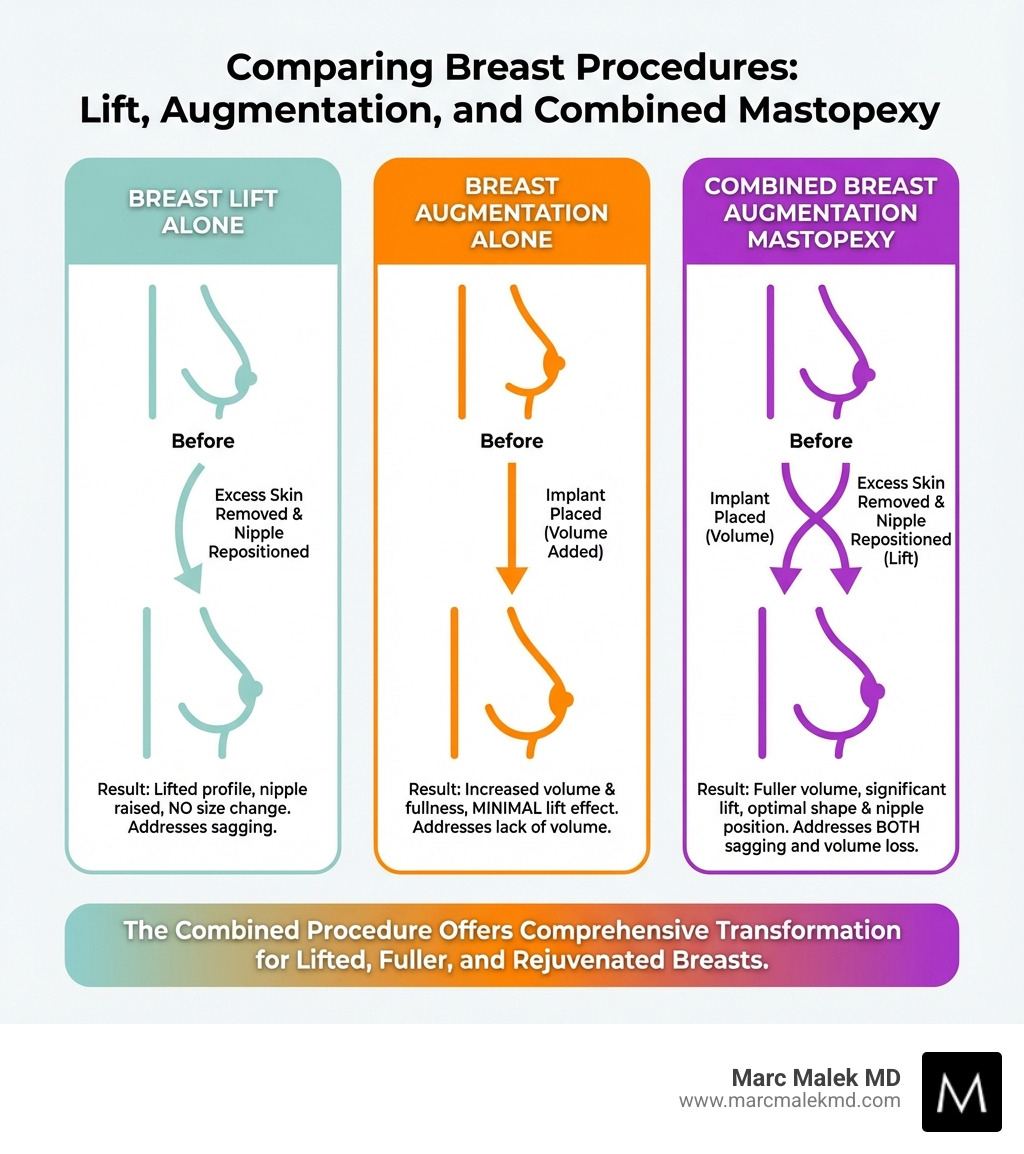
Over time, pregnancy, breastfeeding, significant weight changes, and aging can cause breasts to lose volume and sag. You might notice your breasts appear deflated in the upper portion, or that your nipples point downward. Neither breast augmentation alone nor a breast lift alone can fully address both issues.
A breast lift tightens the skin envelope and raises nipple height, but it doesn’t add volume. Breast augmentation alone won’t significantly raise nipple position or achieve results comparable to a lift. The majority of patients with Grade 3 ptosis (severe sagging) will choose augmentation mastopexy because breast implants alone usually won’t significantly improve the position of the nipple.
This is where the combined procedure becomes particularly valuable. By performing both surgeries together, the implant is placed through the same incisions used for the lift, which means no additional scarring. The result is breasts that are fuller, higher, and more proportionate to your body.
The procedure typically takes 3.5 to 4.5 hours under general anesthesia and is performed on an outpatient basis. Most patients can return to non-strenuous work within 5 to 7 days and resume full activities after 4 to 6 weeks.
Are You an Ideal Candidate? The Consultation and Benefits
Deciding on a breast augmentation mastopexy is a deeply personal journey, and determining if you’re an ideal candidate is the first crucial step. At our Scottsdale and Phoenix, AZ, practice, we prioritize a thorough consultation to understand your unique aesthetic goals and ensure this combined procedure is the right fit for you.
Generally, ideal candidates for breast augmentation mastopexy are individuals who present with concerns regarding both breast ptosis (sagging) and a noticeable loss of breast volume. Often, these changes follow significant life events such as pregnancies, breastfeeding, or substantial weight loss. The natural aging process can also lead to a loss of skin elasticity and breast tissue, resulting in breasts that appear deflated, have downward-pointing nipples, or lack the youthful projection you desire.
We often see patients who wish to achieve an outcome closer to their pre-pregnancy appearance, aiming for a more youthful breast contour with increased volume. For those who have undergone massive weight loss, this procedure can be transformative, addressing both the excess skin and the significant volume loss that often accompanies such changes. If you’re looking to restore breast volume and create a rounder, firmer breast appearance while simultaneously tightening the skin envelope and repositioning your breasts, then breast augmentation mastopexy might be your answer.
Beyond aesthetic desires, there are also important health considerations. Ideal candidates should be physically healthy and maintain a stable body weight, ideally with a BMI lower than 30. It’s crucial for patients to be non-smokers, or be willing to commit to smoking cessation for at least one month before and after surgery. Smoking significantly slows healing and increases the risk of complications. If you’ve recently been pregnant or breastfed, we typically recommend waiting at least six months after completing breastfeeding before considering breast surgery to allow your body to stabilize.
During your consultation, we’ll dig into your medical history, including any personal or family history of breast cancer. We’ll also discuss your aspirations for the procedure, examining your breast anatomy, the degree of ptosis (which we classify from Grade 1 for mild sagging to Grade 3 for severe), and your skin elasticity. This detailed assessment helps us determine the most appropriate surgical plan and potential incision placements custom to your body. We believe in setting realistic expectations, ensuring you have a clear understanding of what the surgery can achieve.
To further explore your options and understand what might be best for you, we encourage you to read our guide on What Type of Breast Surgery Do I Need?.
Understanding the Benefits of Breast Augmentation Mastopexy
The combined approach of breast augmentation mastopexy offers a powerful synergy of benefits that neither procedure alone can fully deliver. Our patients consistently express immense satisfaction with the comprehensive change they experience.
Here are the key advantages of combining breast augmentation with a breast lift:
- Restored Breast Volume: For many, the primary goal is to regain lost fullness. Whether due to pregnancy, breastfeeding, or weight fluctuations, breasts can lose their natural volume. The implants used in breast augmentation mastopexy directly address this, adding significant volume and creating a fuller, more projected breast profile.
- Lifted Breast Position: The mastopexy component effectively combats sagging. We remove excess skin and tighten the surrounding tissue, raising the breasts higher on the chest to a more youthful and aesthetically pleasing position. This is particularly beneficial for those with downward-pointing nipples.
- Improved Cleavage: By lifting the breast tissue and adding volume, the procedure can significantly improve cleavage fullness, contributing to a more attractive and feminine silhouette.
- Youthful Breast Contour: The surgery reshapes and supports the breast mound, creating a firmer, smoother, and more rounded appearance. This effectively refreshs the overall breast contour, making your breasts look perkier and more vibrant.
- Symmetrical Appearance: Many individuals have natural breast asymmetry. Breast augmentation mastopexy allows us to address these imbalances, creating a more harmonious and symmetrical breast appearance.
- Reduced Areola Size: If your areolas have stretched and enlarged over time, the mastopexy portion of the procedure can reduce their size and reposition them for a more proportionate and aesthetically pleasing outcome.
- Improved Self-Confidence: The physical change leads to a profound psychological benefit. Our patients often report a significant boost in self-image and self-confidence, feeling more comfortable and vibrant in their own skin. As one patient shared, after her breast implant exchange and lift, “Getting dressed is fun again!”
For many women, especially those who have experienced the changes of motherhood, breast augmentation mastopexy is a cornerstone of a comprehensive “Mommy Makeover.” This combination of procedures helps restore your body to its pre-pregnancy contours, making you feel more like yourself again. You can learn more about how this procedure fits into a broader rejuvenation plan by visiting our page on More about a Mommy Makeover.
The Breast Augmentation Mastopexy Procedure: A Step-by-Step Guide
Undergoing breast augmentation mastopexy is a significant decision, and understanding the surgical process can help alleviate any anxieties you may have. We ensure every step is carefully planned and executed with your safety and desired aesthetic in mind.
The procedure is performed under general anesthesia, meaning you’ll be comfortably asleep throughout the operation. Before you enter the operating room, Dr. Malek will perform detailed surgical markings on your breasts. These markings are crucial for guiding the incisions, ensuring precise placement of implants, and achieving optimal symmetry and lift.
The breast augmentation mastopexy procedure is essentially a two-step process, performed seamlessly during a single surgery:
- Breast Augmentation (Implant Placement): The first step involves creating a precise pocket for the breast implants. This pocket can be either subglandular (behind the breast tissue) or submuscular (behind the chest wall muscle), depending on your anatomy, implant type, and desired outcome. Once the pocket is prepared, the chosen breast implant (saline or silicone) is carefully inserted. A significant advantage of combining these procedures is that we can often place the implant through the same incisions used for the lift, minimizing additional scarring.
- Mastopexy (Lifting and Reshaping): Following implant placement, the mastopexy, or breast lift, component begins. This involves removing excess skin and tightening the remaining breast tissue to lift and reshape the breast mound. The nipple-areola complex (NAC) is then carefully repositioned to a higher, more youthful location on the newly contoured breast. If your areolas have become enlarged, their size can also be reduced during this stage to ensure they are proportionate to your improved breasts.
Throughout the procedure, Dr. Malek will carefully sculpt and reshape the breasts, often adjusting your position on the operating table to judge the breasts in an upright position. This allows for the most precise assessment and helps us achieve the best possible symmetry and aesthetic outcome. Once the desired shape and position are achieved, the incisions are carefully closed, typically using dissolvable sutures that will not require removal. The entire process generally takes between 3.5 to 4.5 hours, and most patients are able to return home the same day, with a loved one providing support for the initial 24 hours.
Choosing Your Incision and Implants
The choice of incision pattern and implant type are critical decisions in your breast augmentation mastopexy, directly impacting both the aesthetic outcome and the visibility of scars. We will discuss these options extensively during your consultation, tailoring them to your specific needs and degree of breast ptosis.
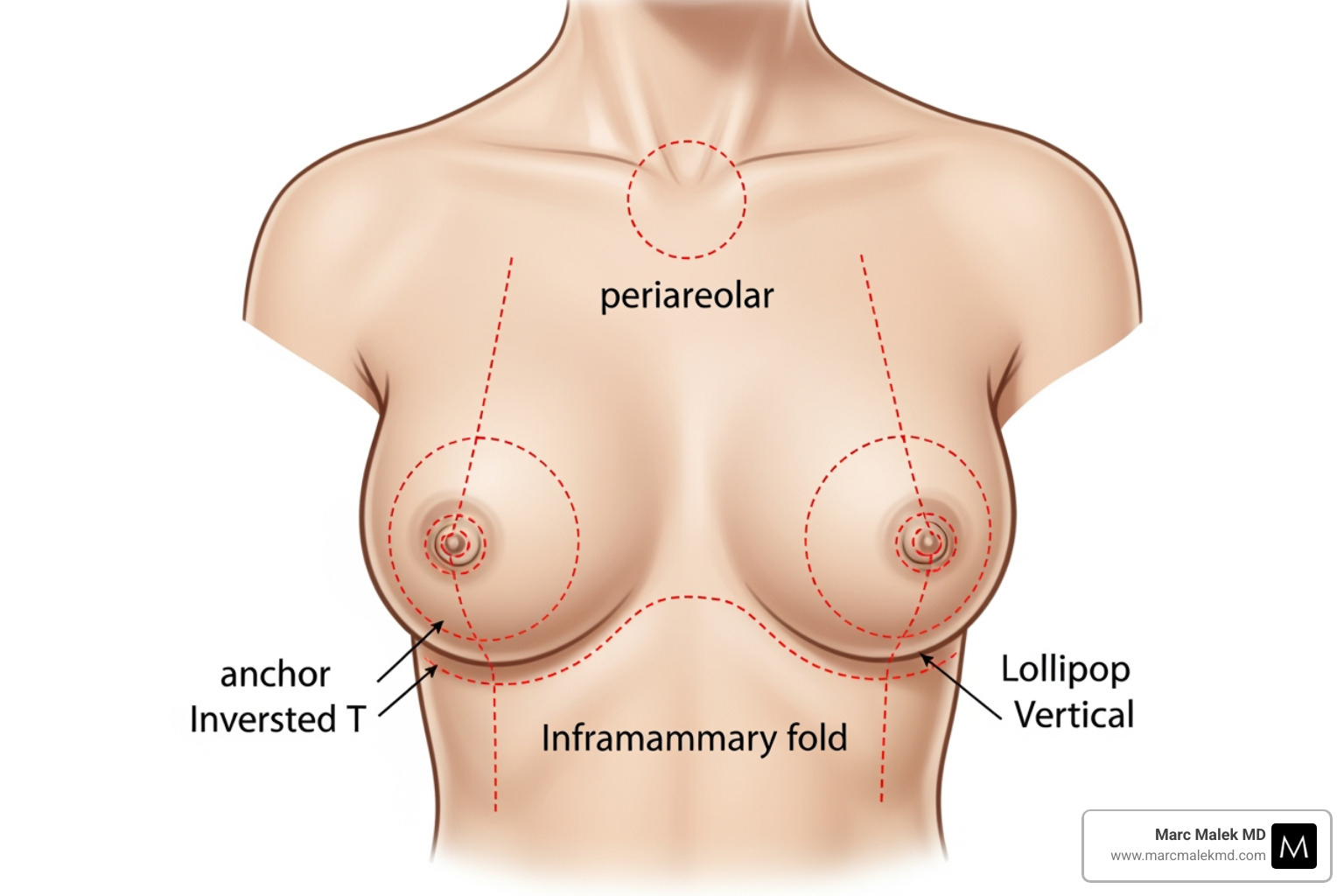
Here are the primary incision types we use for the mastopexy component:
- Periareolar (Donut) Incision: This technique involves a circular incision made around the areola. It results in the least visible scarring, confined solely to the border of the areola. However, the lifting effect is less powerful, making it suitable primarily for patients with mild ptosis (Grade I sagging) who require minimal lift.
- Vertical (Lollipop) Incision: For moderate ptosis (Grade II sagging), a vertical incision is often employed. This involves an incision around the areola combined with a vertical line extending from the bottom of the areola down to the breast crease. This allows for more significant skin removal and reshaping, providing a more substantial lift than the periareolar method.
- Inverted-T (Anchor/Wise Pattern) Incision: This is the most comprehensive incision pattern, used for patients with severe ptosis (Grade III sagging) or significant excess skin. It includes the periareolar and vertical incisions, plus an additional horizontal incision along the natural breast crease. While it results in more scarring, it provides the most powerful lift and allows for maximum reshaping and skin reduction.
Regarding implants, you’ll generally choose between saline and silicone options:
- Saline Implants: These are inserted empty and then filled with sterile salt water once in place. They require a smaller incision for insertion and can be easily adjusted for volume. However, they may have a higher rupture rate and a greater chance of visible rippling compared to silicone.
- Silicone Implants: Pre-filled with a cohesive silicone gel, these implants are known for providing a softer, more natural feel and a decreased tendency to cause rippling. While the FDA has not found sufficient evidence to link silicone implants to connective tissue diseases, some studies have indicated a potential association, and ongoing research continues.
We will also discuss implant shape and size. For breast augmentation mastopexy, round implants are often preferred as they tend to provide excellent upper breast fullness. The ideal size will be determined based on your desired aesthetic, existing breast tissue, and overall body proportions, ensuring a natural and balanced result. Implant placement is typically submuscular, offering better coverage and maintaining blood supply for optimal long-term outcomes.
To dig deeper into the nuances of implant choices and how they can best suit your goals, we invite you to review our detailed guide on Breast Augmentation Options.
Recovery and Results: What to Expect After Your Surgery
The recovery period following breast augmentation mastopexy is a crucial phase for ensuring optimal healing and achieving the beautiful results you desire. While every patient’s experience is unique, we provide comprehensive guidance to support you through each step.
Immediately after surgery, you can expect some soreness, swelling, and bruising in the chest area. This initial discomfort typically lasts for 3 to 7 days and is manageable with prescribed pain medication. As you progress, you can transition to over-the-counter pain relief like Tylenol. Swelling and bruising generally subside within 1 to 3 weeks, though some residual swelling can persist for a few months. It’s also common to experience numbness in the nipples, areolae, and breast skin, which might last for about six weeks.
A surgical support bra is essential during the initial recovery. We recommend wearing it 24 hours a day for the first 3 to 4 days, followed by a soft support bra for an additional 3 to 4 weeks. This garment provides crucial support to your healing tissues and helps maintain the new breast contour.
Activity restrictions are vital for a smooth recovery:
- Returning to Work: Most patients are able to return to non-strenuous, office-based work within 5 to 7 days post-procedure. If your job involves physical exertion, you may need a longer period of rest.
- Light Exercise: Light activities, such as walking, can typically be resumed around 2 weeks after surgery.
- Strenuous Activities: Heavy lifting, vigorous exercise, and activities involving the chest muscles (like jogging, weight lifting, yoga, pilates, aerobics, sports) should be avoided for a minimum of 4 to 6 weeks post-operatively. This helps decrease the risk of bleeding, further swelling, and prevents strain on your healing incisions.
- Driving: You can usually resume driving within a few days, once you are no longer taking prescription pain medication.
Scar maturation is a gradual process. While scars are an inevitable part of any surgical procedure, we carefully place incisions to minimize their visibility. They will initially appear red and raised but will soften and fade over time, typically taking 12 to 18 months to fully mature. Following proper scar care instructions, such as using silicone gels or sheets, can help optimize their appearance.
The journey to your final results unfolds over several months. You’ll see an immediate change, but your breasts will continue to settle into their natural shape, feel, and look over 3 to 6 months. Final results are generally appreciated around 1 year post-surgery.
We are proud of the changes we help our patients achieve. You can see examples of these results in our gallery: View our Breast Augmentation with Lift gallery.
How Long Do Results Last and What Are the Long-Term Considerations?
The results of your breast augmentation mastopexy are designed to be long-lasting, typically remaining for 10 to 15 years. However, it’s important to understand that no cosmetic surgery can permanently stop the natural aging process. Factors such as gravity, significant weight fluctuations, and future pregnancies can all contribute to changes in your breast appearance over time. Maintaining a stable weight and a healthy lifestyle can significantly help in prolonging the beautiful results of your surgery.
It’s also crucial to remember that breast implants are not lifetime devices. While modern implants are durable, they are prosthetic devices that may eventually require replacement. The lifespan of implants can vary, but generally, they may need to be exchanged every 10 to 20 years due to reasons such as implant rupture or deflation, shifting, or capsular contracture (a hardening of the tissue capsule around the implant).
Regarding future breast screening, routine mammogram screening is still required after breast augmentation mastopexy, just as it is for all women regardless of their breast surgery history. Generally, mammogram screening is recommended every two years starting at age 50, or earlier if you have a higher risk profile. It is absolutely vital to inform your mammogram center that you have breast implants. Implants can sometimes obscure breast tissue on a standard mammogram, so specialized views may be necessary to ensure comprehensive screening. For silicone implants, the FDA suggests breast imaging (like MRI) 5 to 6 years after placement, and then every 2 to 3 years thereafter, to screen for silent ruptures.
While we are based in Arizona, you can refer to guidelines from established programs like the Ontario Breast Screening Program as an example of how medical bodies recommend screening for patients with implants. Always follow the specific recommendations of your local Arizona healthcare providers and mammogram centers.
Understanding the Risks and Associated Costs
As with any surgical procedure, breast augmentation mastopexy carries potential risks and complications. While we take every precaution to minimize these, it’s important for you to be fully informed before making your decision.
Common surgical risks include:
- Infection: Although rare, infection can occur and may require antibiotics or, in some cases, implant removal.
- Bleeding (Hematoma): The most common complication for both mastopexy alone and augmentation with mastopexy is hematoma (blood collection under the skin).
- Anesthesia Complications: Adverse reactions to general anesthesia are possible, though rare and carefully monitored by our experienced anesthesia team.
- Delayed Wound Healing: Smoking is a significant contraindication as it drastically increases the risk of delayed healing and other wound-related issues.
- Changes in Nipple Sensation: You may experience temporary or, in some rare cases, permanent changes in nipple or breast sensation, including numbness or increased sensitivity.
- Asymmetry: While we strive for perfect symmetry, slight differences in breast shape, size, or nipple position can occur.
- Capsular Contracture: This is an implant-related complication where the scar tissue capsule around the implant tightens, potentially causing pain, firmness, and distortion of the breast shape.
- Unfavorable Scarring: While scars typically fade, some individuals may develop hypertrophic scars (raised, red scars) or keloids (thick, raised scars that extend beyond the incision line).
- Recurrent Ptosis: Over time, and due to factors like aging and gravity, some degree of sagging may recur.
- Implant-Related Issues: Beyond capsular contracture, implants can rupture or leak, requiring replacement. There’s also a very low, yet increased risk of developing breast implant-associated anaplastic large cell lymphoma (BIA-ALCL), particularly with textured implants.
- Breast Implant Illness (BII): Some patients report systemic symptoms like fatigue, brain fog, rash, and joint pain, which are collectively referred to as Breast Implant Illness. While research is ongoing and a direct causal link to implants is not fully understood, symptoms sometimes improve upon implant removal.
For a comprehensive medical overview of the potential risks associated with breast lift procedures, we recommend reviewing the Detailed overview of Mastopexy risks from StatPearls.
When considering the costs associated with breast augmentation mastopexy, it’s important to understand that these procedures are highly customized, and therefore, pricing can vary significantly. The total cost typically includes several components:
- Surgeon’s Fee: This covers the expertise and time of Dr. Malek.
- Anesthesia Costs: The fees for the anesthesiologist and the medications used during surgery.
- Facility Fees: Covers the use of our accredited surgical facility in Scottsdale or Phoenix.
- Implant Costs: The price of the chosen breast implants (saline or silicone).
- Post-Operative Garments: Special surgical bras or compression garments needed for recovery.
- Follow-up Appointments: Post-operative care visits.
Because of these variables, we don’t provide a single fixed price. During your consultation in Scottsdale, we will provide you with a personalized quote that encompasses all aspects of your unique surgical plan. It’s also worth noting that cosmetic procedures like breast augmentation mastopexy are generally not covered by health insurance, as they are elective. However, many patients explore financing options, and we can provide information on available plans.
Frequently Asked Questions about Augmentation Mastopexy
We understand you likely have many questions about breast augmentation mastopexy. Here are answers to some of the most common inquiries we receive:
Can I breastfeed after a breast augmentation mastopexy?
Yes, it is generally possible to breastfeed after a breast augmentation mastopexy. The surgery itself does not prevent you from breastfeeding. However, it’s important to be aware that the procedure may alter milk production and success rates for some individuals. Techniques that involve minimal adjustment to the nipple-areola complex are often designed to preserve milk ducts and nerves, which can help maintain breastfeeding capabilities.
If you are considering future pregnancies and breastfeeding, it is crucial to discuss these plans with Dr. Malek during your consultation. This allows us to tailor the surgical approach to best support your long-term goals. We often recommend waiting at least six months after completing breastfeeding before undergoing surgery to allow your breasts to stabilize.
How painful is recovery from a breast augmentation mastopexy?
The experience of pain is subjective and varies from person to person. However, we ensure that post-operative pain is effectively managed. You can expect some soreness and discomfort in the chest area, particularly for the first 3 to 7 days after surgery. We will prescribe medication to help manage this pain during the initial recovery period. Most patients find that they can transition from prescription pain medication to over-the-counter pain relievers like Tylenol within a few days.
Following all post-operative instructions diligently, including proper rest and activity restrictions, is key to a comfortable and smooth recovery. While you will feel discomfort, it is generally manageable, and most patients are pleasantly surprised by how well they feel within a week or two.
Will using larger implants give me a lift without the scars?
This is a common misconception, and understand that simply using larger implants will not provide a significant lift and cannot correct true breast ptosis (sagging). Implants primarily add volume and projection. While they might provide a very minimal upward push in some cases, they do not address excess skin or reposition the nipple-areola complex effectively.
Attempting to achieve a lift solely with larger implants without a concurrent mastopexy can lead to undesirable results, often referred to as “bottoming out.” This means the implant may settle too low, the nipple can remain in a downward position, and the breasts may appear disproportionately large with continued sagging of the skin envelope. This can result in a larger final breast size than desired, a continued droopy appearance, an enlarged areola, and further stretching of the breast tissue over time.
For patients with actual sagging, a mastopexy (breast lift) is necessary to remove excess skin, tighten existing breast tissue, and reposition the nipple-areola complex to a more youthful height. Combining this with implants in a breast augmentation mastopexy is the correct approach to achieve both increased volume and a beautifully lifted, aesthetically pleasing breast contour. It ensures you get the best aesthetic outcome without compromising the long-term shape and integrity of your breasts.
Conclusion: Begin Your Change Journey in Scottsdale
Breast augmentation mastopexy offers a truly transformative solution for women in Scottsdale, Phoenix, and across Arizona who are seeking to restore lost volume and lift sagging breasts. This combined procedure empowers you to reclaim a more youthful, supported, and aesthetically pleasing breast contour, enhancing your overall figure and boosting your self-confidence.
We believe in a personalized and artistic approach to plastic surgery. Dr. Marc Malek is dedicated to delivering fantastic, long-lasting results that reflect your natural beauty. Our focus is always on your comfort, convenience, and promoting a healthy lifestyle that contributes to a proportionally balanced body.
If you’re ready to explore how breast augmentation mastopexy can help you achieve your aesthetic goals, we invite you to schedule a consultation with us in Scottsdale. Let us guide you through your journey to a renewed sense of self and natural, lasting beauty.
To learn more about breast augmentation in general, visit our dedicated page: Learn more about Breast Augmentation.