

The Great Laser Debate: CO2 vs Erbium
CO2 vs Erbium Laser: Which Is Right for Your Skin?
CO2 erbium laser treatments are two of the most powerful options in skin resurfacing — and choosing between them (or combining them) can make a real difference in your results, recovery, and safety.
Here’s a quick comparison to help you decide:
| Feature | CO2 Laser | Erbium (Er:YAG) Laser |
|---|---|---|
| Wavelength | 10,600 nm | 2,940 nm |
| Ablation depth per pass | 50-100 µm | 10-20 µm |
| Thermal damage | 50-150 µm | 10-20 µm |
| Downtime | 7-14 days | 3-7 days |
| Best for | Deep wrinkles, acne scars, skin laxity | Fine lines, pigmentation, sensitive skin |
| Safer for darker skin tones? | Higher risk | Lower risk |
| Sessions typically needed | Usually 1 | 1-3 |
| Results longevity | Several years | 1-2 years |
Both lasers work by targeting water in skin tissue to vaporize damaged cells and stimulate collagen. But they behave very differently once they hit your skin.
CO2 goes deeper and generates more heat. That means more dramatic collagen tightening — but also more downtime and a higher risk of pigmentation changes, especially in darker skin tones.
Erbium is more precise and cooler. It removes thin layers of skin with minimal heat spread, which means faster healing and fewer pigmentation risks.
Neither laser is universally “better.” The right choice depends on your skin concerns, skin tone, and how much recovery time you can manage.
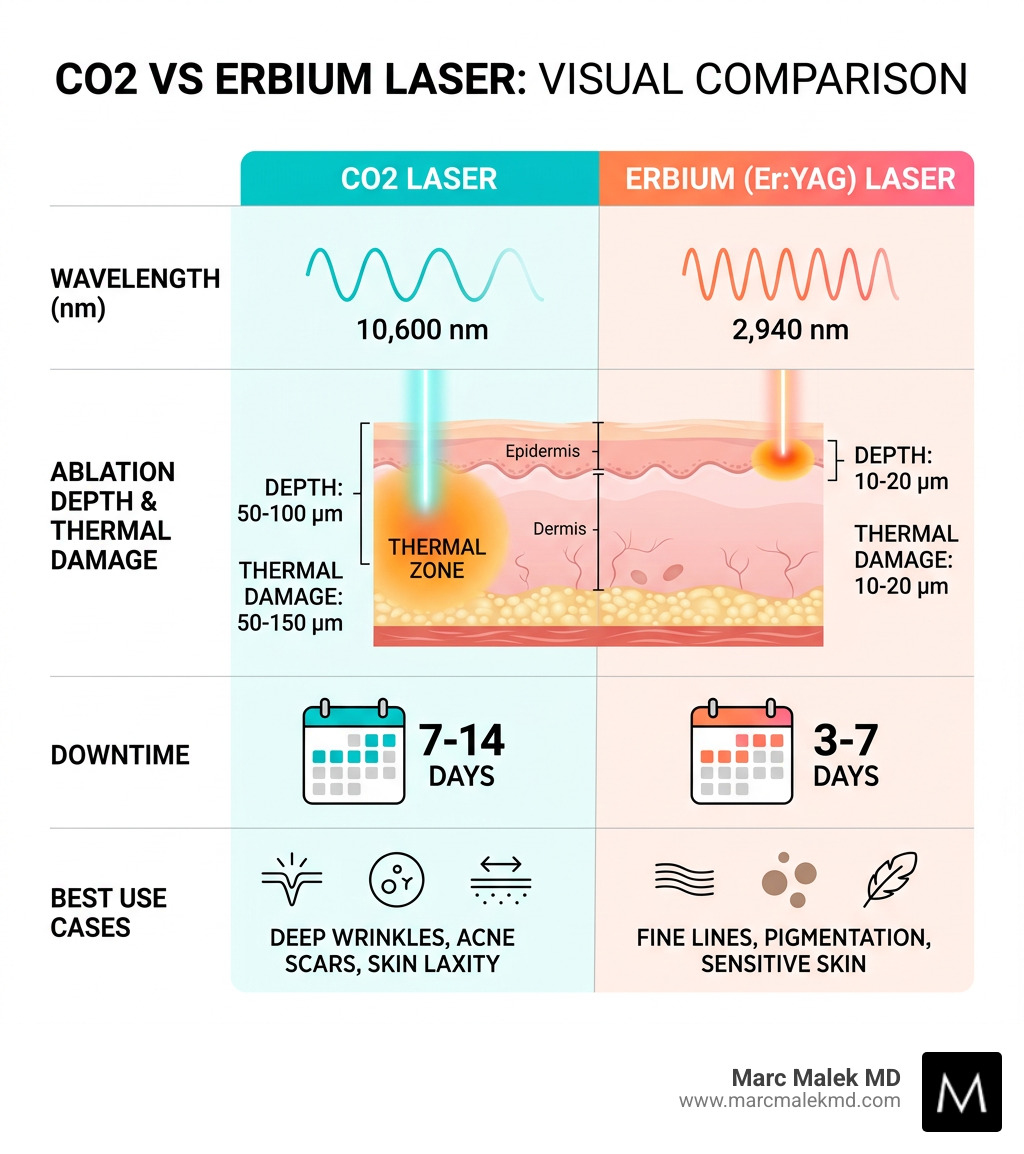
Co2 erbium laser terms simplified:
Understanding the Science of CO2 and Erbium Wavelengths
To understand the “great debate” between these two technologies, we first have to look at the science of how light interacts with your skin. In aesthetics, we use a principle called selective photothermolysis. This is a fancy way of saying we use specific wavelengths of light to target a “chromophore”—in this case, water.
Because our skin cells are made mostly of water, these lasers can precisely target and vaporize damaged tissue. However, the co2 erbium laser wavelengths differ significantly in how they are absorbed.
Ablative laser skin resurfacing involves selective thermolysis of epidermal layers and the superficial dermis. By removing these layers, we trigger the body’s natural healing response, leading to the growth of fresh, healthy skin and a massive boost in collagen production.
The CO2 laser operates at a wavelength of 10,600 nm. At this frequency, the light energy is absorbed by water and converted into heat. This heat doesn’t just vaporize the top layer; it travels deeper into the dermis, causing “controlled” thermal damage. While “damage” sounds scary, this heat is actually what causes the skin to contract and tighten.
The Erbium:YAG laser, on the other hand, sits at 2,940 nm. This wavelength is absorbed by water roughly 10 times more efficiently than the CO2 wavelength. You might think “more absorption” means it’s more aggressive, but it’s actually the opposite. Because the water in your skin grabs that energy so quickly, the laser vaporizes the tissue instantly before the heat has a chance to spread to the surrounding areas. This results in a much shallower vaporization depth and significantly less residual thermal damage.
Scientific overview of CO2 laser technology and water absorption shows that while CO2 is the “gold standard” for deep tissue remodeling, Erbium offers a level of precision that is hard to beat for surface-level refinement.
Precision of the Erbium:YAG System
The Erbium:YAG (yttrium aluminum garnet) system is a solid-state laser that we often describe as a “cold” laser compared to its CO2 cousin. Because it targets water so aggressively at 2,940 nm, it allows us to perform “clean ablation.”
Think of it like a high-precision scalpel made of light. Each pass of the Erbium laser removes a very thin, predictable layer of skin (about 10-20 µm). Because there is minimal heat spread, the surrounding tissue stays relatively cool. This is why research on Erbium laser for skin surgery and diagnostics often highlights its safety profile. It’s an incredible tool for patients who want to refresh their complexion without the extensive “burn” associated with older laser technologies.
Thermal Effects of the Carbon Dioxide Laser
In contrast, the CO2 laser uses a gas medium to produce its 10,600 nm beam. This laser is famous for its “stacking effect.” As we make passes over the skin, the heat builds up. This deep penetration is exactly what we want when we are dealing with severe sun damage or deep, etched-in wrinkles.
The heat from a CO2 laser causes immediate collagen contraction. If you’ve ever seen a video of a laser procedure where the skin seems to “shrink” instantly, that’s usually a CO2 laser at work. Expert consensus on clinical recommendations for fractional CO2 laser suggests that this thermal effect is the key to its longevity and its ability to treat skin laxity. However, that same heat is responsible for the longer redness and swelling you’ll experience during recovery.
Key Differences: Penetration Depth and Recovery Times
When we sit down with our patients in Scottsdale to discuss a co2 erbium laser plan, the conversation usually turns to “How long will I be out of commission?” The answer lies in the histology—the way the tissue actually reacts to the laser.
Residual thermal damage is the amount of “cooked” tissue left behind after the laser vaporizes the top layer. For a CO2 laser, this damage can extend 50-150 µm deep. For an Erbium laser, it’s usually only 10-20 µm. This difference is the primary driver of recovery time.
| Parameter | CO2 Laser | Erbium:YAG |
|---|---|---|
| Residual Thermal Damage | 50-150 µm | 10-20 µm |
| Reepithelialization (New Skin) | ~10-14 days | ~3-7 days |
| Persistent Erythema (Redness) | 1-3 months | 1-3 weeks |
Wound contraction and healing happen in phases. With Erbium, the “wounds” are shallower, so the skin can re-epithelialize (grow back) much faster. With CO2, the deeper thermal injury means the body has more work to do to clear out the damaged proteins and build new ones. Histologic effects of resurfacing lasers on tissue confirm that while CO2 creates a more robust inflammatory response (which leads to more collagen), it also requires a more patient approach to healing.
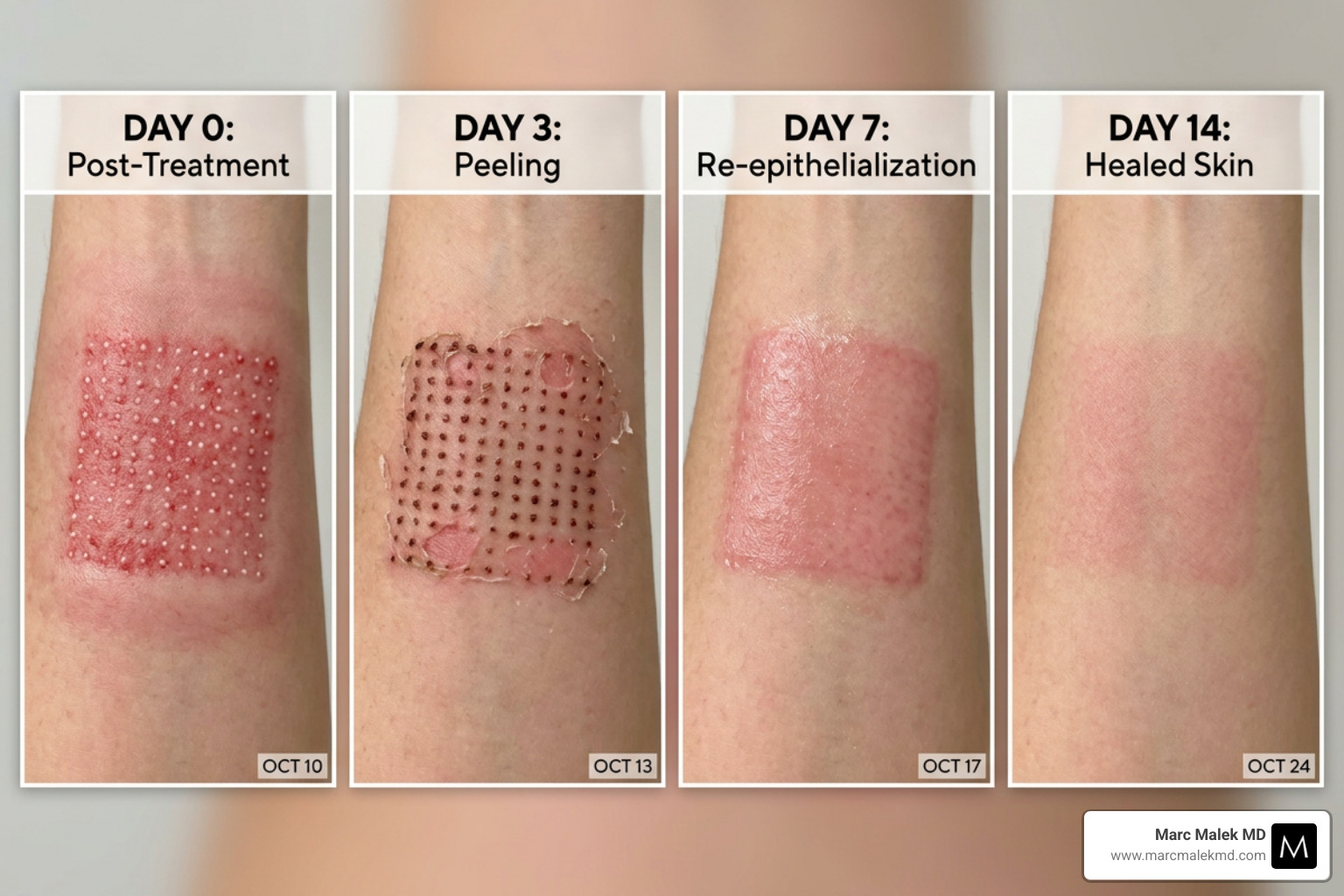
Downtime and Post-Operative Care
If you choose a CO2 treatment, you should prepare for 7 to 14 days of significant downtime. Your skin will likely be raw, red, and swollen. We often recommend a regimen of vinegar soaks (using a specific dilution) to keep the skin clean and help slough off the dead tissue without irritation.
Erbium downtime is much more manageable, typically lasting 3 to 7 days. You’ll still experience some peeling and redness, but it’s often described as a “bad sunburn” rather than a surgical recovery.
For both lasers, we take safety seriously. This includes prescribing prophylactic antivirals to prevent cold sore outbreaks (which can be triggered by the laser) and sometimes antibiotics. You can find more info about laser skin resurfacing recovery on our dedicated service page, where we outline exactly how to baby your skin in those critical first few days.
Long-Term Result Longevity
While Erbium wins on recovery speed, CO2 often wins on “one and done” longevity. Because CO2 triggers such deep collagen remodeling and dermal thickening, the results can last for several years. Many patients find that one aggressive CO2 session is more effective than three or four lighter treatments.
Erbium results are beautiful but may require “maintenance sessions” every 12 to 24 months to keep the skin looking its best. However, for many of our busy Phoenix patients, doing a lighter session once a year is much more appealing than taking two weeks off for a deep CO2 peel. A study on the longevity of CO2 laser results noted that improvements in skin texture and wrinkle depth continued to get better for up to six months after the procedure as new collagen matured.
Choosing the Right Treatment for Your Skin Concerns
So, which co2 erbium laser is right for you? It really comes down to the “damage” we are trying to undo.
If you are struggling with “dermatoheliosis”—a medical term for severe sun damage—or deep, structural wrinkles around the mouth (perioral) and eyes (periorbital), CO2 is likely the way to go. It provides the intensity needed to “reset” the skin’s clock. You can see the dramatic difference in our CO2 Laser Resurfacing Gallery.
A JAMA Dermatology study on CO2 lasers for deep wrinkles and scars confirmed that the deeper thermal energy of CO2 is superior for improving the texture of skin that has lost its elasticity.
However, if you are younger or simply have fine lines and “crepey” skin texture, Erbium is a fantastic choice. It’s also our go-to for general “skin brightening” and treating minor surface imperfections.
Addressing Acne Scars with CO2 Erbium Laser
Acne scars, particularly atrophic (pitted) scars, are notoriously difficult to treat. They require a laser that can reach deep into the dermis to break up scar tissue and stimulate new growth.
Traditionally, CO2 was the only answer for acne scars. Today, we often use a combination approach. We might use the CO2 laser to target the deep “ice pick” or “boxcar” scars and then use the Erbium laser to blend the edges and smooth the overall skin texture.
We’ve written extensively about how to erase scars with the help of laser technology, often combining lasers with other techniques like subcision (breaking up the fibrous bands under the scar). Clinical evaluation of fractional CO2 for acne scars shows that fractional technology has made these treatments much safer than they were twenty years ago, with significantly less risk of permanent scarring or pigment loss.
Pigmentation Control via CO2 Erbium Laser
When it comes to dyschromia (uneven skin tone), sun spots, and even certain types of melasma, the Erbium laser is often the safer bet. Because it generates less heat, there is a much lower risk of “rebound hyperpigmentation.”
In some cases, the heat from a CO2 laser can actually irritate the pigment-producing cells (melanocytes), causing them to dump more pigment into the skin as it heals. This is why the safety of Er:YAG lasers for treating dyspigmentation is so highly regarded. It allows us to vaporize the pigment-heavy cells in the epidermis without over-exciting the layers underneath.
Safety and Suitability for Diverse Skin Tones
One of the most important factors we consider is your skin type on the Fitzpatrick scale. This scale ranges from Type I (very fair, always burns) to Type VI (deeply pigmented skin).
Historically, laser resurfacing was only for Types I and II. If you had darker skin—including Asian, Hispanic, or Mediterranean heritage—the risk of Post-Inflammatory Hyperpigmentation (PIH) or hypopigmentation (loss of color) was simply too high.
The co2 erbium laser debate is particularly relevant here. CO2 lasers, with their high heat and “thermal stacking,” are much riskier for Fitzpatrick Types III and above. If the skin gets too hot, it can trigger a permanent change in color or even a “line of demarcation” where the treated skin looks significantly different from the untreated skin.
A comparative trial on pigmentation risks in darker skin tones found that Erbium:YAG lasers resulted in significantly fewer pigmentary complications. At 6 months post-op, only 5% of Erbium patients showed pigment changes, compared to 43% of CO2 patients. That is a massive difference in safety!
Minimizing Risks in Darker Skin
For our patients with darker skin tones in the Scottsdale and Phoenix area, we use very specific protocols to ensure safety. This often involves:
- Pre-treatment clarifiers: Using medical-grade hydroquinone or tretinoin for several weeks before the laser to “quiet” the melanocytes.
- Low fluence, multiple passes: Instead of one “hot” pass, we might do several “cool” passes with the Erbium laser to reach the desired depth without overheating the tissue.
- Fractional technology: Using lasers that only treat a percentage of the skin at a time, leaving “bridges” of untouched skin to aid in rapid, safe healing.
Fractional Erbium laser safety for photo-aging has opened the door for many patients who were previously told they weren’t candidates for laser resurfacing.
Avoiding Complications and Scarring
While lasers are incredibly effective, they are also powerful medical tools that require expert handling. Complications like ectropion (turning out of the eyelid) can occur if too much skin is removed in delicate areas. We also have to be extremely careful with patients who have a history of keloid scarring.
A thorough review of fractional CO2 laser resurfacing complications emphasizes that most “bad outcomes” are the result of poor patient selection or improper settings. This is why we always start with a comprehensive consultation to review your medical history and skin goals.
The Power of Combination: CO2 Erbium Laser Hybrid Protocols
In recent years, the “debate” has shifted from which laser is better to how we can use them together. This is the era of hybrid protocols.
By combining the two wavelengths, we can achieve the “best of both worlds.” We use the CO2 wavelength to reach deep into the dermis for tightening and the Erbium wavelength to refine the surface and minimize the thermal damage left behind by the CO2.
Our Pixel technology is a great example of how fractional energy can be used to provide dramatic results with minimized downtime. In a hybrid session, we might:
- Use CO2 on deep wrinkles around the mouth and eyes.
- Use Erbium on the cheeks and forehead for a smoother, brighter finish.
- Use a sequential approach where Erbium “cleans up” the thermal debris from the CO2 pass.
Research on combining fractional Erbium and CO2 for optimal results suggests that these synergistic effects lead to higher patient satisfaction and faster re-epithelialization than using CO2 alone.
Frequently Asked Questions about Laser Resurfacing
Which laser is better for deep acne scars?
For deep, pitted acne scars, the CO2 laser is generally more effective because it can penetrate deeper into the dermis to stimulate the necessary collagen remodeling. However, for patients with darker skin tones, a series of Erbium treatments or a hybrid approach may be safer to avoid pigmentation issues.
Is Erbium laser safer than CO2 for Asian skin?
Yes. Because Asian skin (typically Fitzpatrick Type III or IV) is more prone to post-inflammatory hyperpigmentation (PIH), the “cooler” Erbium laser is usually the preferred choice. It provides excellent resurfacing with a much lower risk of triggering excess melanin production.
How many sessions are typically required for full rejuvenation?
For an aggressive CO2 treatment, most patients only need one session to see dramatic results that last years. For Erbium laser resurfacing, we often recommend a series of 1 to 3 sessions, spaced about 4 to 6 weeks apart, depending on the severity of the skin concerns.
Conclusion
At the practice of Marc Malek MD, we believe that every face is a unique canvas. Whether we choose a co2 erbium laser or a combination of both, our goal is always the same: to provide a personal and artistic approach that delivers fantastic, long-lasting results.
We don’t believe in “cookie-cutter” treatments. By focusing on your individual comfort, the specific needs of your skin, and the artistic balance of your features, we help you achieve a refreshed, youthful look that never appears “done.” If you’re in Scottsdale, Phoenix, or the surrounding Arizona area and you’re ready to see what laser technology can do for you, we invite you to take the next step.
Schedule a consultation for Laser Skin Resurfacing with us today, and let’s create a plan that brings out the very best in your skin.