

Hair Transplant Cost and What to Expect
What Does a Hair Transplant Cost? Here’s What You Need to Know First
Hair transplant cost in the US typically ranges from $4,000 to $15,000, depending on the number of grafts needed, the technique used, and where you have it done.
Here’s a quick breakdown to answer the most common questions upfront:
| Factor | Typical Range |
|---|---|
| Average total cost (US) | $6,000 – $12,000 |
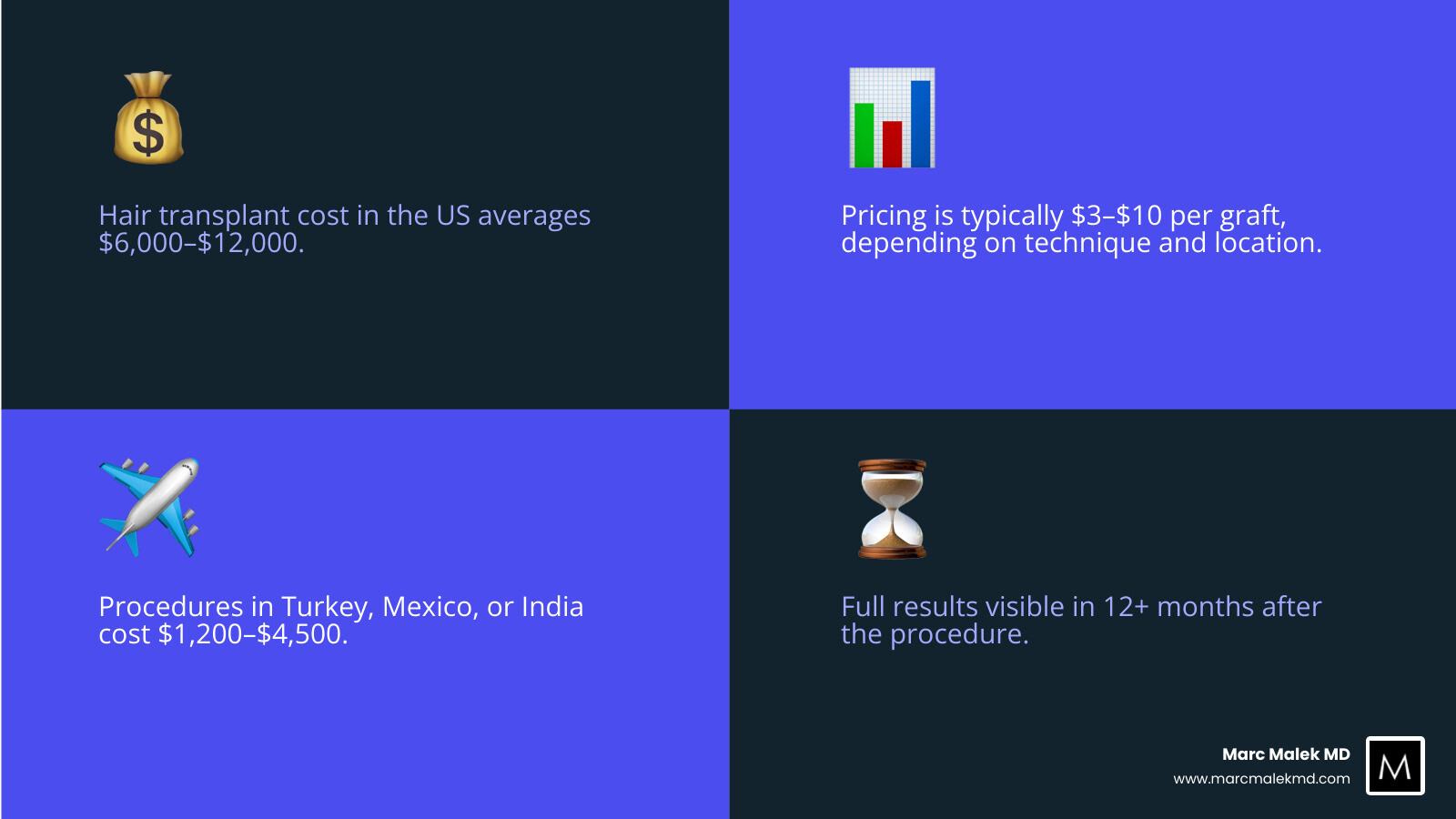
| Cost per graft | $3 – $10 |
| FUT (strip method) | $4,637 – $11,450 |
| FUE (follicular unit extraction) | $5,160 – $12,513 |
| DHI (advanced technique) | $10,000 – $30,000 |
| Low-cost countries (Turkey, Mexico, India) | $1,200 – $4,500 |
A few things to know before diving deeper:
- Most procedures are not covered by insurance — they’re considered cosmetic.
- Pricing is usually per graft. The more hair loss you have, the more grafts you need, and the higher the total cost.
- Results take time. Most people see noticeable growth in 6–9 months, with full results at 12 months or more.
Hair loss is incredibly common — it affects roughly 1 in 3 men and 1 in 4 women. For many people, it’s not just a cosmetic concern. It affects confidence, self-image, and how you feel every day. A hair transplant can be a lasting solution, but it’s a significant investment — and understanding what drives the cost helps you make a smarter decision.
This guide breaks down everything: average prices, what affects them, how techniques compare, and what hidden costs to watch for.
Understanding the Average hair transplant cost in the US
When we talk about the hair transplant cost, it is important to realize that there is no “one-size-fits-all” sticker price. While national averages sit between $6,000 and $12,000, some extensive procedures can exceed $15,000. These figures represent the baseline for surgical restoration, but the final invoice depends heavily on the complexity of your specific case.
In the United States, the price range for surgical hair restoration generally falls between $4,637 and $12,513. This variation is driven by several factors, including the surgeon’s expertise, the facility’s overhead, and the specific technology used during the procedure. For those of us living in Arizona, specifically in the Scottsdale and Phoenix areas, we see pricing that often aligns with these national mid-to-high ranges due to the high demand for specialized aesthetic care and the presence of top-tier surgical facilities.
Regional Variations and Scottsdale Pricing
Where you choose to have your surgery matters. Major metropolitan hubs often command a premium due to higher operational costs and the concentration of high-end specialists. For example, in a city like Chicago, costs can climb as high as $20,000, whereas in Houston, all-inclusive packages might start as low as $3,000 for smaller sessions.
In Scottsdale and Phoenix, patients can expect a competitive but premium market. We focus on providing an artistic, personalized approach that ensures the results look natural and last a lifetime. While some might be tempted by the lowest price possible, it is vital to remember that you are paying for the surgeon’s skill in design and execution.
| City | Estimated Price Range |
|---|---|
| Chicago | $10,000 – $20,000 |
| Los Angeles | $4,000 – $17,000 |
| New York City | $4,000 – $15,000 |
| Houston | $3,000 – $12,000 |
| Miami | $3,000 – $15,000 |
Beyond the surgery itself, we often recommend Hair Restoration with PRP as a complementary treatment. Platelet-Rich Plasma (PRP) can enhance the healing process and potentially improve the survival rate of transplanted grafts. Adding these regenerative therapies can influence the total hair transplant cost, but they often provide a significant boost to the final visual outcome.
How hair transplant cost varies by graft count
Most reputable clinics in the US utilize a per-graft pricing model. This is the fairest way to price the procedure because it scales with the amount of work actually being performed. A “graft” is a follicular unit that typically contains between one and four individual hairs.
The number of grafts you need is determined by your stage on the Norwood Scale, which measures the extent of male pattern baldness.
- Hairline Restoration: Typically requires 800 to 1,500 grafts.
- Crown Coverage: Often requires 1,000 to 2,500 grafts.
- Extensive Hair Loss: May require 3,000 grafts or more, sometimes spread over multiple sessions.
According to graft count requirements for different stages of hair loss, a patient with a slightly receding hairline will pay significantly less than someone needing full scalp coverage. At an average US rate of $3 to $10 per graft, a 2,000-graft procedure might range from $6,000 to $20,000 depending on the clinic’s tier and location.
Comparing international and domestic hair transplant cost
It is impossible to research hair transplant cost without seeing ads for “medical tourism” in countries like Turkey, Mexico, or India. In these regions, a 2,000-graft procedure might cost between $1,500 and $2,000, compared to the $8,000+ you might pay in the US.
While the headline price is attractive, it is important to weigh the risks associated with medical tourism. Lower costs abroad are often a result of lower labor costs and different regulatory environments. However, patients must factor in:
- Travel Expenses: Flights, hotels, and meals can add thousands to the “cheap” base price.
- Follow-up Care: If a complication arises once you return to Scottsdale or Phoenix, local doctors may charge significantly to manage the issue, and the original surgeon is thousands of miles away.
- Quality Standards: In some “hair mills” abroad, the surgery is performed by technicians rather than board-certified surgeons, which can lead to unnatural hairlines or over-harvested donor areas.
We believe that the safety, accountability, and artistic oversight provided by a local, board-certified plastic surgeon offer a value that far outweighs the initial savings of traveling abroad.
Key Factors and Techniques Influencing Pricing
The technology and technique used to move the hair are the primary drivers of the hair transplant cost. There are two main surgical methods used today: Follicular Unit Extraction (FUE) and Follicular Unit Transplantation (FUT).
FUE vs. FUT: What’s the Difference?
FUE (Follicular Unit Extraction): In this method, individual follicles are removed one-by-one from the donor area (usually the back of the head). This technique is more labor-intensive and takes longer — often 5 to 8 hours. Because it leaves no linear scar and allows for a faster recovery, it is generally more expensive. The average cost for FUE in the US is approximately $6,684. For more details, you can explore FUE procedure details and benefits.
FUT (Follicular Unit Transplantation): Also known as the “strip method,” this involves removing a small strip of scalp from the donor site, which is then divided into individual grafts under a microscope. While it leaves a linear scar, it is often more efficient for large graft counts and is slightly more affordable, with a US average of about $5,975.
Advanced technologies like robotic systems (ARTAS) or specialized tools like DHI (Direct Hair Implantation) can also increase the price. These systems often involve high licensing fees for the clinic, which are passed on to the patient. However, the comparison of FUT and FUE techniques shows that the skill of the surgeon is often more important than the specific tool used.
Surgeon Experience and Clinic Reputation
Not all hair transplants are created equal. A “bargain” transplant often looks like one — with “doll-hair” hairlines or poor density. The hair transplant cost reflects the years of training and the artistic eye of the surgeon.
We recommend looking for a surgeon with board certification, specifically through the American Board of Hair Restoration Surgery (ABHRS). A surgeon-led procedure ensures that the most critical steps — such as hairline design and graft extraction — are handled by an expert rather than an unlicensed technician. In Scottsdale, we pride ourselves on an artistic approach that considers your facial proportions and future hair loss patterns to create a result that looks natural even as you age.
Recovery Timeline and Post-Operative Care
Understanding the timeline is essential for managing your expectations. A hair transplant is not an overnight fix.
- Days 1-7: The scalp will be tender, and you may experience swelling or scabbing.
- Weeks 2-4: The “shedding phase” occurs. This is normal! The transplanted hairs fall out, but the follicles remain healthy beneath the skin.
- Months 3-6: New hair begins to sprout.
- Months 6-12: Significant density returns. Full results are typically seen at the one-year mark.
According to research from Johns Hopkins Medicine, the recovery process is generally smooth, but following post-operative instructions is vital for graft survival. This includes avoiding direct sunlight, heavy exercise, and certain hair products during the initial healing weeks.
Additional Expenses, Financing, and Alternatives
When budgeting for your hair transplant cost, don’t forget the “extras.” A quote for surgery usually covers the procedure itself, but you should also plan for:
- Prescription Medications: Post-op antibiotics, pain relief, and long-term maintenance meds like Finasteride or Minoxidil (which can cost $200–$600 initially).
- Blood Work: Some clinics require pre-op labs to ensure you are a healthy candidate.
- Follow-up Visits: While often included, ensure you know the clinic’s policy on post-op check-ups.
Non-Surgical Alternatives
For those not yet ready for surgery, there are non-surgical hair loss treatments that can slow thinning. These include:
- Minoxidil (Rogaine): An over-the-counter topical.
- Finasteride (Propecia): A prescription pill for men.
- Low-Level Laser Therapy (LLLT): Devices that use light to stimulate follicles.
- PRP Therapy: A great middle-ground option that uses your own blood’s growth factors.
Financing Your Confidence
Because hair transplants are elective, they are rarely covered by insurance. The Cleveland Clinic notes that insurance rarely covers cosmetic surgery, unless the hair loss is due to a medical trauma like a burn.
To make the hair transplant cost more manageable, we offer various financing options. Many of our patients use services like CareCredit or other medical lending platforms that allow for monthly payment plans. This allows you to invest in your appearance now and pay over time.
Frequently Asked Questions About Hair Restoration
Does insurance cover the cost of a hair transplant?
In almost all cases, the answer is no. Insurance companies view hair restoration as a cosmetic choice rather than a medical necessity. The only exceptions typically involve “secondary alopecia,” where hair loss is the result of a reconstructive need following an accident, burn, or specific types of surgery. We recommend checking with your provider, but you should budget with the expectation of paying out-of-pocket.
How many grafts are typically needed for a receding hairline?
A standard hairline restoration usually requires between 800 and 1,500 grafts. If you also want to fill in the “temporal points” (the hair on the sides of your forehead), you might need an additional 150 grafts per side. The goal is to create a soft, natural transition that matches the density of your existing hair.
Is a hair transplant a permanent solution?
Yes. Hair follicles taken from the “donor zone” (the back and sides of the head) are genetically resistant to the hormones that cause balding. Once transplanted, they continue to grow for a lifetime. Research on long-term graft survival shows that while some natural thinning can occur with age, the vast majority of transplanted hair remains permanent. However, we often recommend ongoing maintenance therapy to protect the non-transplanted hair surrounding the new grafts.
Conclusion
Investing in a hair transplant is about more than just moving follicles; it’s about restoring your self-assurance. While the hair transplant cost in the US can seem significant, the value of a permanent, natural-looking result is often life-changing. By choosing a local expert in Scottsdale or Phoenix, you ensure that your procedure is performed with the highest safety standards and an artistic touch that generic “hair mills” simply cannot replicate.
At the practice of Marc Malek MD, we focus on patient comfort and proportionally balanced results. We don’t just want to give you more hair; we want to give you a hairline that looks like it was always there. If you’re ready to explore your options, we invite you to Schedule a consultation for hair restoration with PRP or a full surgical assessment. Let us help you design a plan that fits your goals and your budget.