

Why Hair Loss Matters: Understanding Your Restoration Options
Hair restoration includes medical and surgical treatments to regrow or redistribute hair to thinning or bald areas. If you’re exploring options for hair loss, here’s what you need to know:
Quick Overview of Hair Restoration Options:
- Surgical: FUE and FUT move hair from donor areas to balding spots.
- Non-Surgical: PRP therapy, medications (minoxidil, finasteride), and low-level laser therapy.
- Timeline: Initial results in 3-6 months; full results at 12-18 months.
- Cost: Surgical options typically range from $4,000-$15,000.
Hair loss affects more than just appearance; it can impact confidence and self-perception. Whether you’re noticing a receding hairline, thinning crown, or patchy areas, these changes can be frustrating.
The good news is that modern hair restoration has advanced significantly beyond the unnatural “hair plugs” of the past. Today’s techniques create such natural results that the transplanted hair can be cut, styled, and treated just like the rest of your hair.
The most common cause of hair loss is androgenetic alopecia (pattern baldness), stemming from genetics, hormones, and aging. Other causes include medical conditions, stress, and medications. Understanding the ‘why’ is key to finding the right solution.
Both surgical and non-surgical options are available, each with unique benefits and costs. While some achieve their goals with non-invasive treatments like PRP, others opt for the permanent results of a hair transplant. The right choice depends on your specific hair loss pattern, goals, and lifestyle.
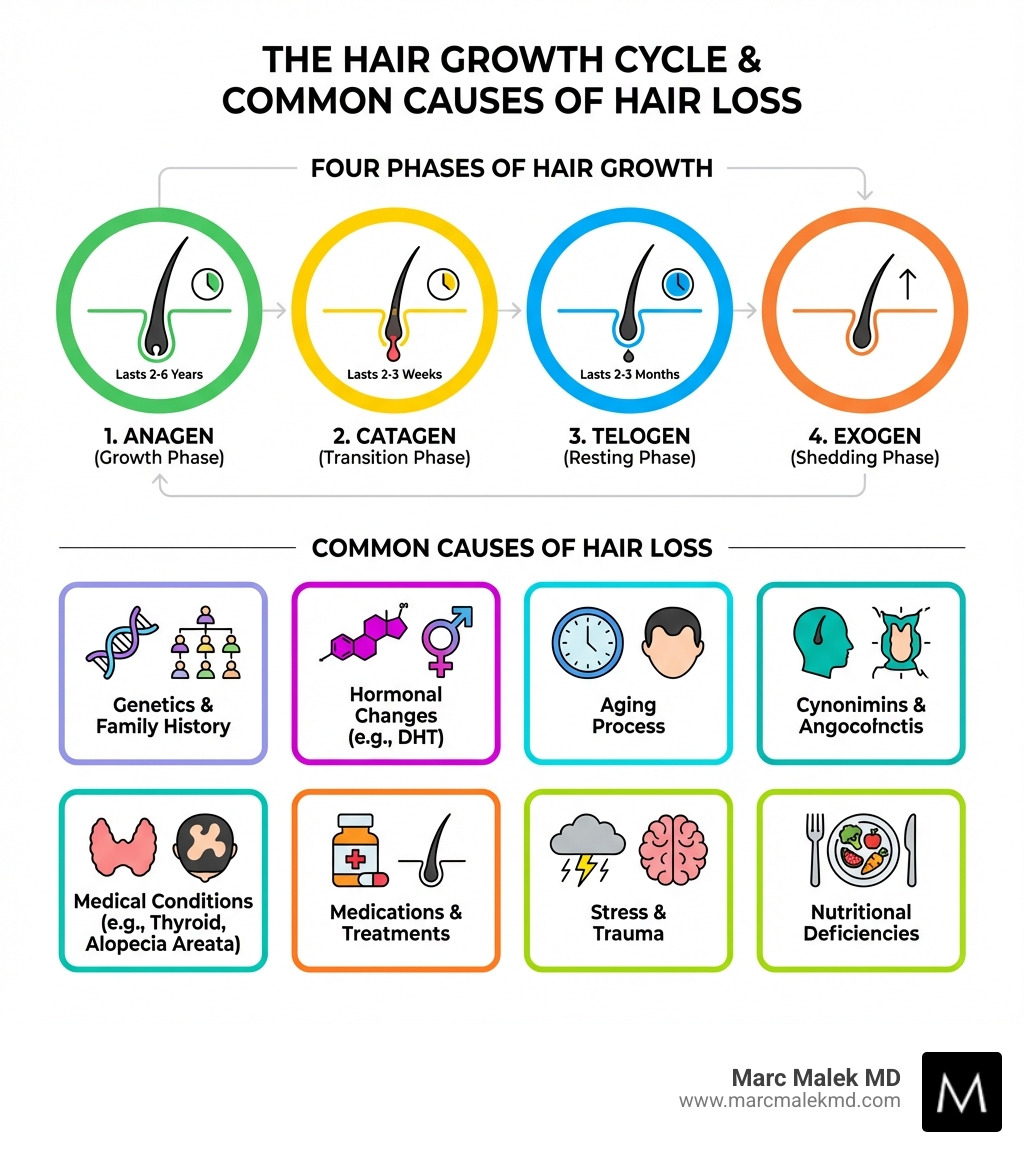
Understanding Hair Loss: Causes and Common Myths
Hair loss is a complex issue. To effectively address it, we first need to understand its root causes and separate fact from fiction.
The Science Behind Thinning Hair
The primary culprit behind most hair loss is androgenetic alopecia, or pattern baldness, which is largely a genetic predisposition.
- Androgenetic Alopecia: This condition is driven by dihydrotestosterone (DHT), a hormone that causes genetically susceptible hair follicles to shrink and stop producing hair—a process called miniaturization.
- Male and Female Pattern Baldness: In men, this often appears as a receding hairline and thinning crown. In women, it typically presents as diffuse thinning across the top of the scalp with a widening part.
- Genetics and Hormones: Our genes dictate how our hair follicles respond to hormones like DHT. Other hormonal shifts related to pregnancy, menopause, and thyroid imbalances can also lead to hair thinning.
- The Aging Process: As we age, the rate of hair growth naturally slows, and hair strands become finer, which can exacerbate other forms of hair loss.
For a deeper dive into the science of hair loss, you can Learn about Hair Loss from Johns Hopkins Medicine.
Other Contributing Factors
While genetics are a major player, other factors can contribute to hair loss:
- Medical Conditions: Autoimmune diseases like alopecia areata (patchy hair loss) and thyroid disorders can disrupt the hair growth cycle.
- Severe Emotional Stress: Extreme stress can trigger telogen effluvium, a condition causing sudden, significant hair shedding months later.
- Trauma and Burns: Physical trauma or burns can permanently damage hair follicles, causing scarring (cicatricial) alopecia.
- Certain Medications: Drugs for cancer, arthritis, depression, and heart problems can cause hair loss as a side effect.
- Nutritional Deficiencies: A lack of key nutrients like iron or zinc can impact hair health, but supplements are not a cure-all for pattern baldness.
Debunking Hair Loss Misconceptions
Let’s clear up some common myths:
- Wearing hats causes hair loss: False. Unless a hat is tight enough to cause friction damage, it won’t cause baldness.
- Poor scalp circulation causes hair loss: Unlikely. Genetics and hormones are the primary drivers of pattern baldness, not poor circulation.
- Dandruff is a primary cause of hair loss: No. While severe scratching from dandruff can damage follicles, dandruff itself doesn’t cause permanent hair loss.
- Vitamin deficiencies are always the cause: Rarely. Most people with pattern baldness have normal vitamin levels. Consult a doctor for testing.
- Hair loss is determined by the maternal grandfather: Myth. Hair loss genetics are inherited from both sides of the family.
- Men who haven’t lost hair by 40 will never lose it: Not true. Pattern baldness can begin or progress at any age.
Surgical Hair Restoration: A Deep Dive into Transplantation
For those seeking more definitive and permanent results, surgical hair restoration offers highly effective solutions by transplanting healthy hair follicles from one part of your scalp to another.

Follicular Unit Transplantation (FUT or Strip Method)
Follicular Unit Transplantation (FUT), or the “Strip Method,” involves surgically removing a strip of hair-bearing skin from a donor site (usually the back of the head). This method leaves a fine linear scar, which is closed with sutures. A team then uses microscopes to dissect the strip into individual follicular units (grafts of 1-4 hairs) for implantation.
Follicular Unit Extraction (FUE)
Follicular Unit Extraction (FUE) is a more modern technique where individual follicular units are extracted directly from the donor area using a micro-punch tool. This minimally invasive method avoids a linear scar, leaving only tiny, dot-like scars that are less noticeable with short hair. FUE generally offers a quicker recovery time. Advanced robotic systems can also be used to assist in the FUE process, enhancing precision.
For more detailed information on this procedure, you can find FUE Hair Transplant Procedure details from ISHRS.
| Feature | Follicular Unit Transplantation (FUT) | Follicular Unit Extraction (FUE) |
|---|---|---|
| Scarring | Linear scar at donor site, potentially visible with short hair | Tiny, punctate scars scattered across donor area, less noticeable with short hair |
| Recovery Time | Longer donor site healing (2-3 weeks), more discomfort initially | Faster donor site healing (days), less post-op discomfort |
| Cost | Generally less expensive per graft | Often more expensive per graft |
| Donor Hair Req. | Requires sufficient scalp laxity for strip removal | Can be performed on tighter scalps, more flexible donor area |
| Procedure Time | Typically 4-8 hours, depending on graft count | Typically 4-8 hours, can be longer for large sessions |
| Ideal Candidates | Those needing a large number of grafts, prefer to wear hair longer, or on a budget | Those preferring shorter hairstyles, seeking minimal scarring, or with tighter scalps |
Alternative Surgical Options
Other, more invasive surgical options exist but are less common than FUE and FUT. These include scalp reduction (removing bald scalp and stretching the remaining skin), flap surgery (rotating a flap of hair-bearing scalp to cover a bald area), and tissue expansion (stretching hair-bearing skin with a balloon-like expander to cover bald spots). These are typically reserved for specific cases of extensive baldness or scalp damage from trauma.
The Hair Transplant Journey: From Consultation to Full Results
Starting on a hair restoration journey is a significant decision. We guide our patients every step of the way, from initial inquiry to celebrating their full results.
Your Initial Hair Restoration Consultation
The first and most crucial step is a comprehensive consultation to understand your concerns and goals.
- Scalp and Donor Hair Analysis: We examine your scalp, hair loss extent, and donor area density to determine how many grafts can be safely harvested.
- Goal Setting and Hairline Design: We collaborate with you to design a natural-looking hairline that meets your aesthetic goals.
- Setting Realistic Expectations: We provide a transparent assessment of what is achievable based on your specific hair loss pattern and donor supply.
- Health Evaluation: We review your medical history and overall health to ensure you are a suitable candidate for the procedure.
What to Expect During the Procedure
Modern hair transplant surgery is a comfortable, outpatient experience.

- Procedure Duration: A session typically lasts 5-8 hours, depending on the number of grafts.
- Local Anesthesia: Your scalp is numbed for a comfortable, pain-free experience.
- Harvesting and Implantation: Donor hair is harvested via your chosen method (FUT or FUE). Each graft is then carefully implanted into the recipient area, matching the natural angle and direction of your hair.
- Artistic Hairline Creation: We artistically design the hairline to ensure a natural, seamless result.
Recovery and Timeline for Hair Growth
Post-operative care and understanding the growth timeline are key to achieving optimal results.
- Post-Op Care: You’ll receive detailed instructions on how to care for your scalp to ensure proper healing and graft survival.
- Initial Healing: Expect some temporary swelling, redness, and scabbing, which typically resolve within 7-10 days.
- “Shock Loss”: It’s normal for transplanted hairs to shed a few weeks after the procedure. This is temporary.
- Growth Timeline: New hair begins to grow around 3-6 months. You’ll see significant growth (around 60%) by 6-9 months, with final results appearing at 12-18 months as the hair matures.
Weighing Your Options: Benefits, Risks, and Costs
Like any medical procedure, hair restoration comes with its own set of considerations regarding outcomes, complications, and financial investment.
Potential Risks and Side Effects
While hair transplantation is generally safe, it’s important to be aware of possible risks:
- Infection and Bleeding: As with any surgery, there is a small risk of infection (minimized with antibiotics) and minor bleeding.
- Temporary Numbness: The treated areas may feel numb for a short time.
- Unnatural-Looking Growth: Poor technique can lead to unnatural results; choosing a skilled surgeon is crucial.
- Folliculitis: Inflammation of the hair follicles may occur but is typically treatable.
- Scarring: All methods leave some scarring, though modern techniques make it minimal and easy to conceal.
- Shock Loss: Temporary shedding of native hair around the transplant sites can occur.
The Cost of a Hair Transplant
The cost of a hair transplant in the U.S. typically ranges from $4,000 to $15,000. Pricing depends on the number of grafts, the chosen technique (FUE is often more expensive than FUT), and the surgeon’s expertise. Most insurance plans do not cover hair restoration as it is considered a cosmetic procedure, but exceptions may apply for hair loss due to trauma or medical conditions.
The Lasting Benefits of a Successful Transplant
Despite the considerations, the benefits of a successful hair restoration can be profound:
- Permanent Results: Hair transplanted from donor-dominant areas is genetically resistant to balding and will last a lifetime.
- Improved Confidence: A successful transplant can significantly boost self-esteem and quality of life.
- Natural Appearance: Modern, artistic techniques ensure the results blend seamlessly with your existing hair.
- Low Maintenance: Once healed, the transplanted hair is your own and can be cut, styled, and treated normally.
Beyond Surgery: Other Treatments and Choosing Your Surgeon
Surgical options are powerful, but they’re not the only path to hair restoration. Non-surgical methods, alone or in combination with surgery, can be very effective.
Non-Surgical Hair Restoration Methods
- Platelet-Rich Plasma (PRP) Therapy: This treatment uses growth factors from your own blood, injected into the scalp to stimulate dormant follicles and promote thicker hair. You can Discover more about Hair Restoration with PRP on our website.
- Low-Level Laser Therapy (LLLT): FDA-approved devices like caps or combs use light energy to stimulate hair follicles, offering a convenient at-home option.
- FDA-Approved Medications:
- Minoxidil (Rogaine): An over-the-counter topical treatment that stimulates follicles and prolongs the hair growth phase.
- Finasteride (Propecia): A prescription oral medication for men that blocks the formation of DHT, the hormone responsible for hair follicle miniaturization.
How to Choose a Qualified Plastic Surgeon
Choosing the right surgeon is paramount for a successful hair restoration outcome, impacting safety and aesthetic results.
- Board Certification: Ensure your surgeon is board-certified, which indicates a high level of training and expertise.
- Experience in Hair Restoration: Choose a surgeon with specific, experience in hair transplant surgery for the best artistic and technical results.
- Reviewing Before-and-After Photo Galleries: A strong portfolio demonstrates a surgeon’s skill and aesthetic style.
- Patient Testimonials: Read reviews to learn about other patients’ experiences.
- The Quality of the Consultation: A thorough consultation where the surgeon listens to your goals and sets realistic expectations is a sign of a qualified professional.
You can start your search for a qualified plastic surgeon near you by visiting Find a board-certified Plastic Surgeon near you. In Scottsdale, we pride ourselves on a personal and artistic approach, focusing on patient comfort and delivering fantastic, long-lasting results.
Frequently Asked Questions about Hair Transplants
Here are answers to some common inquiries we receive from patients considering hair restoration.
How painful is a hair transplant?
Modern hair transplants are designed for comfort. The scalp is numbed with a local anesthetic, so you won’t feel pain during the procedure—many patients relax, watch TV, or listen to music. Any post-operative soreness is mild and easily managed with prescribed pain medication.
Are hair transplant results permanent?
Yes, the results are permanent. Hair follicles are taken from a ‘donor dominant’ area (typically the back and sides of the head) where they are genetically resistant to balding. They retain this resistance when moved to a new location. However, your existing, non-transplanted hair may still be susceptible to future thinning, which is why ongoing non-surgical treatments are sometimes recommended.
What is the success rate of hair transplants?
The success rate for hair restoration is very high when performed by a skilled surgeon. Graft survival rates are excellent with modern techniques. Success also depends on the patient’s health, donor hair quality, and adherence to post-op care. While many patients achieve their goals in one session, some may opt for a second procedure to increase density or address future thinning.
Conclusion: Taking the Next Step Towards a Fuller Head of Hair
Navigating hair restoration can seem overwhelming, but a wide range of effective solutions is available. From understanding the causes of hair loss to exploring surgical options like FUE and FUT and non-surgical treatments like PRP, the path to a fuller head of hair is more advanced than ever.
The confidence gained from a successful restoration can be transformative. Our goal is to provide personalized, artistic, and patient-focused care to help you achieve your aesthetic goals.
A thorough consultation with a qualified plastic surgeon is the essential first step. In Scottsdale, Dr. Marc Malek uses a personal and artistic approach, focusing on patient comfort and delivering fantastic, long-lasting results.
Ready to take the next step towards renewed confidence?
Schedule your consultation for hair restoration with us today in Scottsdale or Phoenix, Arizona. We look forward to helping you on your journey!