

Everything You Need to Know Before Your Hairline Transplant
Is a Hairline Transplant Right for You?
A hairline transplant is a surgical procedure that moves healthy hair follicles from a donor area (usually the back of the scalp) to a receding or thinning hairline, creating permanent, natural-looking results.
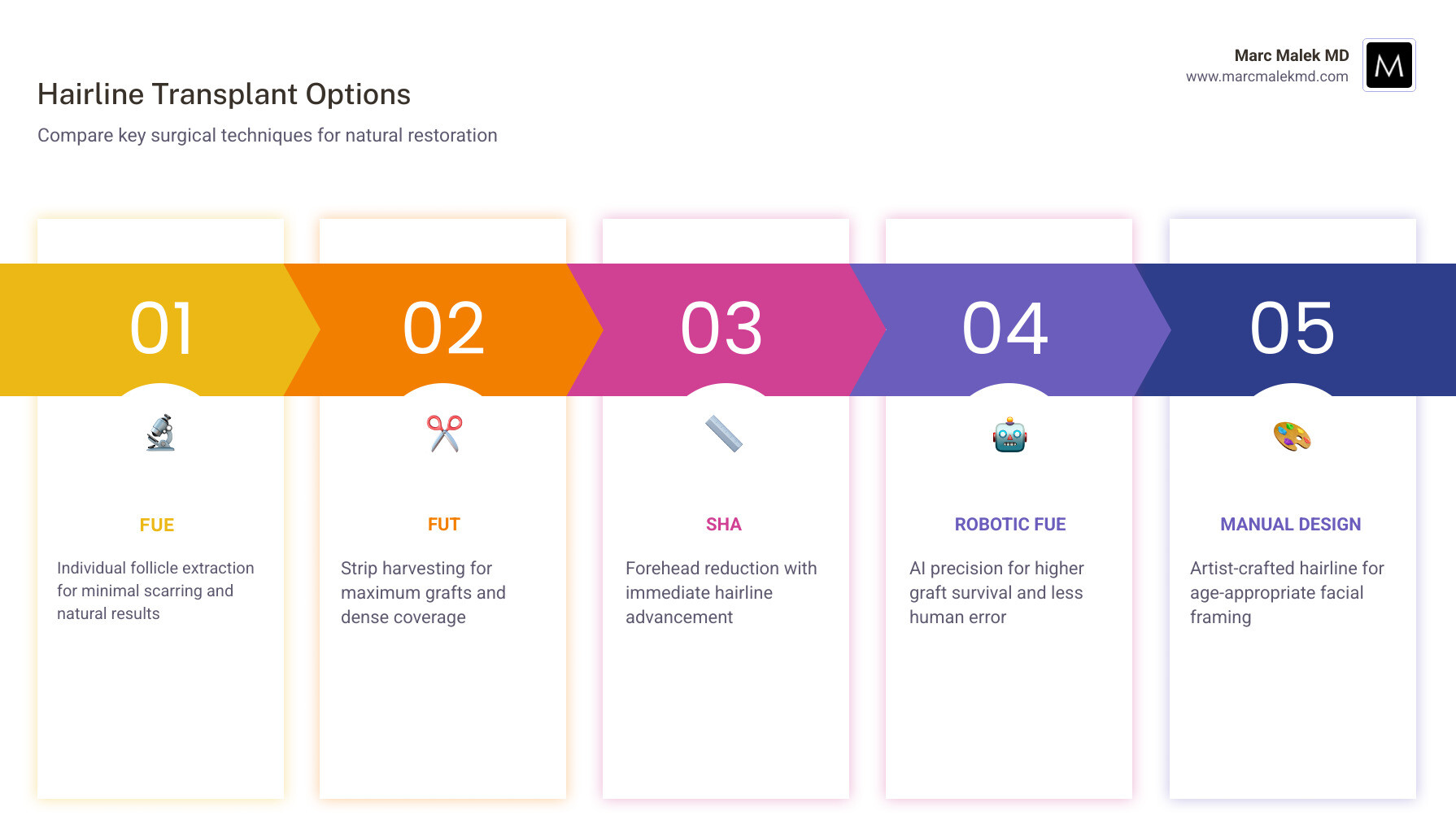
Here’s a quick overview of your main surgical options:
| Option | Best For | Results Timeline | Scarring |
|---|---|---|---|
| FUE (Follicular Unit Extraction) | Most patients; natural results | 8-12 months | Minimal, dot-like |
| FUT (Follicular Unit Transplantation) | Larger sessions; dense coverage | 8-12 months | Linear scar |
| SHA (Surgical Hairline Advancement) | High forehead; stable hairline | Immediate | Fine linear |
Hair loss hits differently when it’s your hairline. It’s the first thing people notice — and often the first thing you notice in the mirror each morning. Whether your hairline has been slowly retreating for years or you were simply born with a naturally high forehead, it can quietly chip away at your confidence.
The good news? Modern hairline restoration has come a long way. Today’s techniques are precise, artistic, and designed to produce results that look completely natural — not like a transplant at all.
But with several surgical approaches available, each with different trade-offs, knowing which option fits your situation is the most important step you can take before booking anything.
This guide walks you through everything — from causes and candidacy to techniques, design principles, recovery, and cost — so you can make a confident, informed decision.
Understanding the Hairline Transplant: Causes and Candidates
When we talk about a hairline transplant, we aren’t just talking about filling in a few bald spots. We are talking about framing your face. The hairline is the “anchor” of your facial symmetry. When it recedes, it can make the forehead appear disproportionately large or add years to your perceived age.
Most hairline issues stem from Androgenetic alopecia, more commonly known as male or female pattern baldness. This is a genetic condition where hair follicles are sensitive to hormones, causing them to shrink over time. However, we also see many patients in our Scottsdale and Phoenix offices dealing with Traction alopecia—hair loss caused by years of tight hairstyles that literally pull the hair out by the root. Interestingly, research shows that approximately one-third of Surgical Hairline Advancements (SHA) are performed on women of African ethnicity, often due to this specific type of loss.
Before jumping into surgery, it is vital to understand your specific hair loss pattern. For more academic depth, you can explore Scientific insights on hair transplantation or look into Hair Loss and Dermatology Research to see how various conditions affect the scalp.
Who is an ideal candidate for a hairline transplant?
Not everyone with a receding line is ready for the chair. We look for a few key markers of a “perfect” candidate:
- Age 25+: We generally recommend waiting until at least age 25. Why? Because hair loss patterns are progressive. If we transplant a new hairline on a 19-year-old, and their natural hair continues to recede behind it, they’ll end up with a “floating” island of hair that looks very unnatural.
- Stable Loss Patterns: We want to ensure your hair loss has leveled off, often with the help of medical therapies.
- Donor Hair Density: Since we are moving hair from the back to the front, you need a healthy “bank” of hair at the back of your head.
- Realistic Expectations: A transplant adds density and shape, but it doesn’t give you the exact hair you had at age 12.
- Scalp Laxity: For certain procedures like SHA, how much your scalp “stretches” determines how far we can move the hairline forward.
If you aren’t quite ready for surgery or want to boost your existing hair, you can find more info about hair restoration services like PRP that we offer to help revitalize dormant follicles.
Common causes of a receding or high hairline
While genetics is the big player, other factors can push that hairline back:
- Hormonal changes: Pregnancy, menopause, or thyroid issues.
- Aging: As we get older, the growth cycle of hair naturally slows down.
- Stress: Physical or emotional trauma can trigger “shock loss” or telogen effluvium.
- Frontal fibrosing alopecia: An inflammatory condition that causes a slow, linear recession.
- Ethnic hair characteristics: Different hair types (coarse vs. fine, curly vs. straight) respond differently to transplant techniques. For example, Asian hair, which is often dark and straight, requires incredibly fine single-hair grafts to avoid looking “pluggy.”
Surgical Techniques for Hairline Restoration
The “old school” hair plugs of the 1970s are a thing of the past. Today, we use micro-grafts to mimic the way hair naturally grows—in tiny groupings of one to four hairs.
The two heavy hitters in hairline transplant surgery are FUE and FUT.
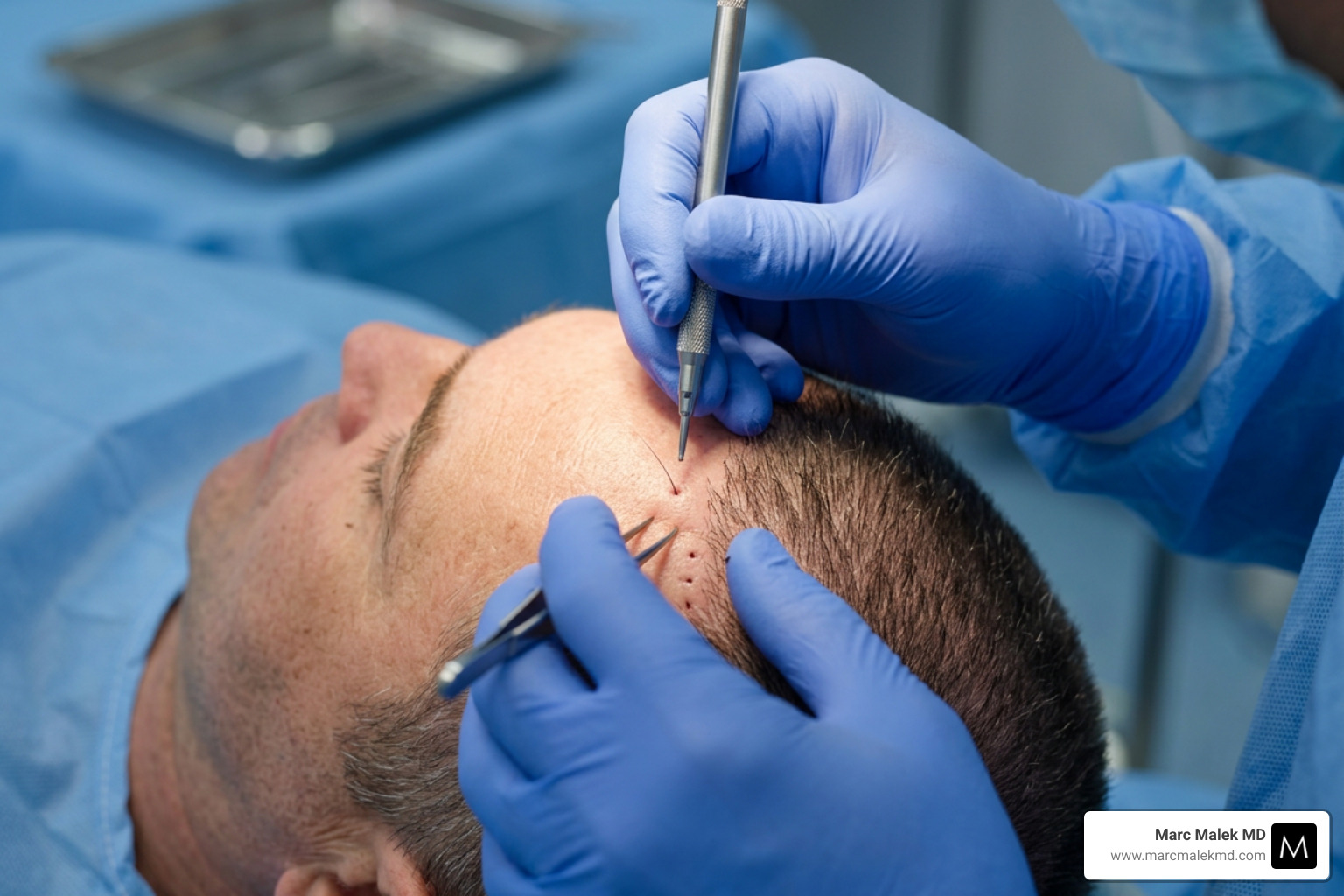
- Follicular Unit Extraction (FUE): This is the modern gold standard. We harvest individual follicles one by one using a tiny micro-punch (usually 0.6mm to 1.0mm). It leaves no linear scar, meaning you can wear your hair very short afterward.
- Follicular Unit Transplantation (FUT): Also known as the “strip method,” we remove a small strip of skin from the back of the head (typically 6 to 10 inches long) and divide it into 500 to 2,000 tiny grafts under a microscope. While it leaves a fine linear scar, it is often more efficient for very large sessions.
Both methods rely on the principle of donor dominance—the idea that hair taken from the “safe zone” at the back of the head will keep its genetic resistance to balding even when moved to the front.
Comparing hair grafting to Surgical Hairline Advancement (SHA)
Sometimes, the best way to fix a high hairline isn’t to add hair, but to move the entire scalp. This is called Surgical Hairline Advancement (SHA) or forehead reduction.
In an SHA, we make an incision right at the hairline (a trichophytic incision) and physically move the hair-bearing scalp forward.
- Advancement: We can usually move the hairline 1.5cm to as much as 5cm in a single session.
- Immediate Results: Unlike grafts, which take months to grow, SHA results are visible the moment you walk out of the OR.
- The Catch: It requires good scalp elasticity. If your scalp is tight, we might need “tissue expansion” (inflating the scalp over a few weeks) to get enough slack.
Many patients choose a “hybrid” approach: an SHA to lower the line, followed by a small hairline transplant of about 300 to 800 grafts to soften the scar and create a more natural transition. You can watch hairline surgery insights on YouTube to see how these procedures look in practice.
The role of automation in modern transplants
Technology has made these procedures faster and more precise. Systems like SmartGraft™ or NeoGraft® help us automate the extraction process. These tools use suction and specialized cooling to keep the grafts “alive” and hydrated while they are out of the body.
By using automation, we can ensure a higher “take” rate (graft viability) and minimize the time you spend in the chair. Most procedures take between 5 to 8 hours, and having smart technology on our side helps us maintain precision from the first graft to the 2,000th.
The Art of Designing a Natural Hairline Transplant
This is where the “science” of medicine meets the “art” of aesthetics. A poorly designed hairline is worse than no hairline at all. If it’s too straight, it looks like a hairpiece. If it’s too low, it won’t age well.
Our goal is to create an age-appropriate hairline. A 25-year-old might want a flat, low line, but we have to design something that will still look great when they are 65.
Principles of a feminine vs. masculine hairline transplant
Men and women have very different “ideal” hairlines:
- Masculine: Usually has a slight “M” shape. Even a restored male hairline should have a gentle recession at the temples to look natural.
- Feminine: Typically more rounded and lower. A classic feminine hairline is about 6-7cm above the glabella (the spot between your eyebrows) and lacks the deep temporal recession seen in men.
We use single-hair grafts for the very first row to create a “feathered” transition. Nobody is born with a wall of thick hair starting abruptly on their forehead. We need those fine, “vellus-like” hairs at the front to blur the line between skin and hair.
Strategic density and graft placement
We don’t just “fill in the blanks.” We have to manage your donor area carefully. Remember: you have a finite amount of hair at the back of your head. If we use 50% of your donor hair just to create a super-dense hairline today, you might not have enough left if you lose more hair on your crown ten years from now.
A typical session involves 800 to 2,800 grafts. We place them in staggered, irregular rows—never in a straight line. Nature is messy, and a “perfect” line is a dead giveaway of surgery. We also pay close attention to the angle of exit. Hair doesn’t grow straight up; it grows forward and out at specific angles that change as you move across the scalp.
The Procedure, Recovery, and Long-Term Results
The day of your hairline transplant is a long but generally relaxed one. We use local anesthesia, so you’ll be awake, comfortable, and likely watching a movie or chatting with us while we work.
- Preparation: We mark the design and numb the donor and recipient areas.
- Harvesting: Whether FUE or FUT, we carefully collect the follicles.
- Site Creation: We create thousands of tiny “slits” in the hairline area, following the artistic plan we drew earlier.
- Implantation: We place the grafts one by one into the sites.
Post-operative care and potential risks
Recovery is faster than most people expect. Most of our patients return to work within 24 to 48 hours, though you might have some redness or tiny scabs for about a week.
- Shock Loss: Don’t panic if your natural hair (or the new grafts) falls out a few weeks after surgery. This is a temporary reaction to the “trauma” of surgery. The roots are still there, and they will start growing back in a few months.
- Washing: You’ll need to be incredibly gentle for the first 5 days. No direct shower pressure!
- Risks: Like any surgery, there is a small risk of infection or scarring, but these are minimized when you follow our post-op instructions and take your prescribed antibiotics. For more on managing these, check out the latest research on hair restoration.
How long do results last and what is the success rate?
The results of a hairline transplant are designed to be permanent. Because the donor hair is harvested from the “permanent zone,” it should continue to grow for the rest of your life.
- The Timeline: Hair starts to grow at 4 months. You’ll see “impressive” results at 8 months, and full maturity at 12 months.
- Satisfaction: Over 98% of patients are satisfied with their results and would recommend the procedure to others.
- Maintenance: While the transplanted hair is permanent, your original hair around it might still be subject to balding. Many patients use PRP or medications to keep their native hair thick.
Frequently Asked Questions about Hairline Restoration
How much does a hairline transplant cost?
In the Scottsdale and Phoenix area, a hairline transplant typically ranges from $4,000 to $15,000.
The cost depends on:
- Graft Count: Most clinics charge between $3 and $10 per graft.
- Technique: FUE is often more expensive than FUT because it is more labor-intensive for the surgeon.
- Complexity: Reconstructing temples or fixing a previous “pluggy” transplant requires more time and artistry.
Are there non-surgical alternatives for the hairline?
Yes! If you aren’t ready for surgery, we often recommend Hair Restoration with PRP. Platelet-Rich Plasma uses your own blood’s growth factors to “wake up” thinning follicles. Other options include:
- Minoxidil (Rogaine): Increases blood flow to the scalp.
- Finasteride (Propecia): Blocks the DHT hormone that causes balding.
- Low-Level Laser Therapy: Uses light to stimulate cellular activity in the follicles.
What should I consider when choosing a surgeon?
The hairline is the most visible part of your hair. You shouldn’t shop for a surgeon based on the lowest price; you should shop based on their artistic portfolio.
- Board Certification: Ensure they are a qualified plastic surgeon or hair restoration specialist.
- Before & Afters: Look specifically at their hairline work. Do the hairlines look “soft” and irregular, or like a straight wall of hair?
- Consultation Quality: A good surgeon will tell you “no” if your expectations are unrealistic or if you are too young for the procedure.
Conclusion
At the office of Marc Malek MD, we believe that a successful hairline transplant should be felt, not seen. Our goal is to give you a result so natural that even your barber won’t know you’ve had work done.
By combining a personal, artistic approach with the latest medical technology, we help our patients in Scottsdale and Phoenix achieve proportionally balanced results that stand the test of time. Whether you are looking for a subtle refinement or a significant restoration, we focus on your comfort and long-term satisfaction.
Ready to stop worrying about your forehead and start loving your reflection? Schedule a consultation for hair restoration with us today, and let’s design a hairline that fits you perfectly.