

Everything You Need to Know About Lip Injections Lips
The Complete Guide to Lip Fillers: What You Need to Know Before You Go
Lip fillers are one of the most popular cosmetic treatments available today — and for good reason.
Quick answer: What are lip fillers?
| Question | Answer |
|---|---|
| What are they? | Injectable gel (usually hyaluronic acid) that adds volume and shape to lips |
| How long do results last? | 6 to 12 months, depending on filler type and your metabolism |
| Does it hurt? | Minimal discomfort — most fillers contain lidocaine, and numbing cream can be applied |
| How much filler is used? | About 1 mL (one-fifth of a teaspoon) on average |
| Are they reversible? | Yes — hyaluronic acid fillers can be dissolved with hyaluronidase |
| Who can get them? | Adults 22 and older (FDA-approved age requirement) |
Whether you want fuller lips, better symmetry, or a more defined Cupid’s bow, lip fillers offer a non-surgical way to get there — with minimal downtime and results you can see almost immediately.
But like any medical procedure, there’s a lot to understand before you book an appointment. The type of filler matters. So does the skill of your provider. And knowing what to expect — from the consultation room to your two-week follow-up — makes the whole experience smoother.
This guide covers everything: how fillers work, what the procedure involves, how long results last, and what the FDA says about safety.
What Are Lip Fillers and How Do They Work?
At their core, lip fillers are a type of dermal filler designed specifically for the delicate tissue of the mouth. While there are various substances used in aesthetics, the gold standard today is Hyaluronic Acid (HA).
HA is a naturally occurring sugar found in our skin that keeps things hydrated and plump. It is “hydrophilic,” which is a fancy way of saying it loves water. When we inject HA into the lips, it acts like a tiny sponge, pulling in moisture to create volume and structure. Because your body already produces HA, these fillers are generally well-tolerated and provide a soft, natural feel.
In the medical community, shaping lips with fillers is considered both a science and an art. We aren’t just making the lips “bigger.” We are looking at the overall facial aesthetics to ensure the results are proportionally balanced.

Understanding the Anatomy of a Perfect Pout
When we talk about lip enhancement, we focus on several key areas:
- The Vermillion Border: This is the edge of your lips where your lipstick goes. Defining this prevents “bleeding” of lip products and gives a crisp look.
- The Cupid’s Bow: That double-curve on the top lip. We can accentuate this to create a more youthful, “pouty” appearance.
- Philtrum Columns: The two vertical lines running from your nose to your upper lip. Adding a tiny bit of filler here can create a beautiful lift.
- Oral Commissures: The corners of the mouth. As we age, these can droop, making us look tired or sad. Filler can help turn those corners back up.
Juvederm vs. Restylane: What’s the Difference?
Most patients in Scottsdale and Phoenix will choose between two major brands: Juvederm and Restylane. While both are HA-based, they have slightly different “personalities.”
| Feature | Juvederm (e.g., Ultra XC, Volbella) | Restylane (e.g., Kysse, Silk) |
|---|---|---|
| Texture | Smoother, gel-like consistency | More granular, “particle” based |
| Best For | Immediate volumizing and smoothing fine lines | Adding structure and natural movement |
| Onset | Works almost right away | Results settle over a few days |
| Longevity | Up to 1 year | Up to 1 year (Kysse is specifically long-lasting) |
Who is a good candidate for lip fillers?
Most healthy adults are great candidates for lip fillers, but there are some specific guidelines we follow.
First, let’s talk about age. The U.S. Food and Drug Administration (FDA) has approved the use of dermal fillers in people aged 22 and older. While some specific lip products are approved for those 21 and up, we generally look for patients who have reached full facial maturity.
Beyond age, a good candidate is someone who:
- Is in good physical health.
- Does not smoke (smoking can slow healing and decrease the longevity of the filler).
- Has realistic expectations (we want to enhance your natural beauty, not turn you into a different person!).
- Wants to correct asymmetry, restore lost volume due to aging, or simply enhance their natural shape.
Preparing for your lip fillers treatment
Preparation is the key to minimizing “the blues”—specifically, bruising! Because the lips are incredibly vascular (lots of blood vessels), they are prone to a bit of swelling and bruising.
Here is our “pro-tip” checklist for the week before your appointment:
- Avoid Blood Thinners: If cleared by your doctor, avoid aspirin, ibuprofen (Advil/Motrin), and certain supplements like fish oil, Vitamin E, and ginkgo biloba for about a week. These can make your blood “slippery” and increase bruising.
- Alcohol Restriction: Skip the wine or cocktails for at least 24 to 48 hours before your treatment. Alcohol dilates blood vessels, which—you guessed it—leads to more bruising.
- Herpes Labialis (Cold Sores): If you have a history of cold sores, the needle sticks can actually trigger an outbreak. Please let us know! We can prescribe an antiviral medication to take before and after the procedure to keep your skin clear.
- Hydrate: Drink plenty of water. Since HA fillers love water, being well-hydrated helps the product settle beautifully.
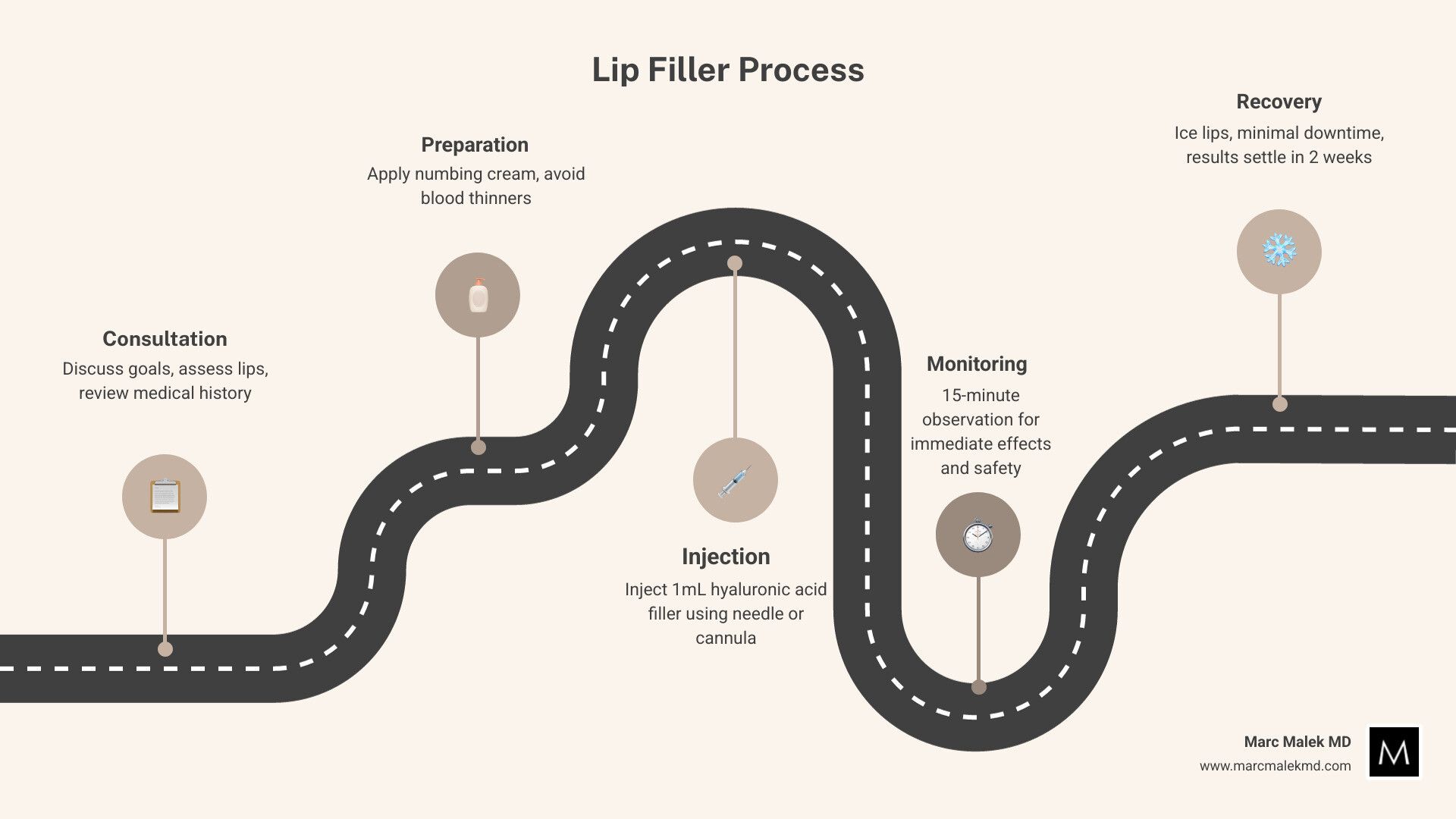
The Lip Filler Procedure: From Consultation to Recovery
We know that needles near the face can be intimidating, but we promise the process is much easier than most people expect. Most sessions take between 30 minutes and an hour.
Step 1: The Consultation and Assessment
Before we ever touch a syringe, we sit down for a thorough chat. We’ll discuss your goals—do you want a “lip flip” effect, or are you looking for significant volume? We also perform a mental health screening. It’s important to us that our patients have a healthy relationship with their body image and aren’t suffering from conditions like body dysmorphic disorder. We’ll take “before” photos for your medical record and map out the injection sites.
Step 2: Numbing for Comfort
Your comfort is our top priority. We typically apply a strong topical numbing cream, often called “BLT” (Benzocaine, Lidocaine, and Tetracaine). This needs about 15 to 30 minutes to fully kick in. In some cases, we might even use a nerve block (similar to what you get at the dentist) if you are particularly sensitive. Many modern fillers, like Juvederm Ultra XC, also have lidocaine mixed right into the gel, so the area becomes more numb as the procedure progresses.
Step 3: The Injection
Using either an ultra-fine needle or a blunt-tipped cannula, we strategically place the filler. Research on lip augmentation techniques suggests that small, controlled injections provide the most natural results. On average, we use about 1 mL of filler per session. To put that in perspective, 1 mL is only one-fifth of a teaspoon! It doesn’t take much to make a beautiful difference. We typically don’t inject deeper than 2.5 millimeters to ensure safety and precision.
Step 4: Monitoring and Immediate Aftercare
After the injections, we may gently massage the area to ensure the filler is distributed evenly. You’ll stay in the office for about 15 minutes so we can monitor you for any immediate reactions. We’ll give you an ice pack to help with the initial swelling.
Safety, Risks, and FDA Regulations
Are lip fillers safe? Generally, yes—when they are performed by a licensed, experienced professional using FDA-approved products. However, it is a medical procedure, and it comes with risks that you should be aware of.
The Warning on Needle-Free Devices
You may have seen “hyaluron pens” or needle-free injection devices sold online or used in non-medical spas. The FDA has issued a strong warning against needle-free injection pens. These devices use high pressure to force filler into the skin. Because they are unpredictable, they can cause serious permanent damage, including scarring, lumps, and even skin death. Never use these devices or buy filler to inject yourself.
Serious Risks: Vascular Occlusion
The most serious (though rare) risk of any dermal filler is vascular occlusion. This happens if the filler is accidentally injected into a blood vessel, blocking blood flow. If not treated immediately, this can lead to tissue necrosis (skin death), or in extremely rare cases, vision changes or stroke.
This is why choosing a provider who understands facial anatomy is non-negotiable. An expert knows the “danger zones” and has a plan in place—including an enzyme called hyaluronidase—to immediately dissolve the filler if a complication occurs.
Common Side Effects
Most people experience what we call “social downtime.” This includes:
- Swelling: This is most intense in the first 24–48 hours.
- Bruising: Small spots at the injection sites are common.
- Tenderness: Your lips might feel a bit sore or “tight” for a few days.
Longevity and Results: What to Expect
One of the most common questions we hear is: “How long will this last?” On average, you can expect your lip fillers to last anywhere from 6 to 12 months. However, there are a few factors that can speed up or slow down that timeline.
Why Do Fillers Fade?
- Metabolism: If you have a high metabolism (you’re a “fast burner”), your body may break down the hyaluronic acid more quickly.
- Movement: The lips are the most active part of the face. We talk, eat, kiss, and smile all day long. This constant movement physically breaks down the bonds of the filler gel over time.
- Product Choice: Thicker fillers generally last longer than thinner, more flexible ones. For instance, Restylane Kysse is specifically engineered to last up to a full year while maintaining natural movement.
The “Settle” Timeline
Don’t judge your results the second you leave the chair!
- Day 1: You will likely be swollen. Your lips might look bigger than you intended. Don’t panic!
- Day 3-5: Swelling usually subsides significantly.
- Day 14: This is the “sweet spot.” The filler has integrated with your tissue, the swelling is gone, and you are seeing the final result. We often schedule a follow-up at the two-week mark to see if any minor “tweakments” are needed.
Tips for Longevity
To get the most out of your investment, we recommend:
- Back Sleeping: Try to sleep on your back for the first few nights to avoid putting pressure on your new filler.
- Gentle Skincare: Don’t scrub your lips or use harsh exfoliants for the first week.
- Avoid Straws: The puckering motion can put unnecessary pressure on the filler while it is still settling.
Frequently Asked Questions about Lip Injections
How much do lip fillers cost?
The cost of lip fillers in the Scottsdale and Phoenix area typically depends on the type of filler used and the number of syringes required. Most patients achieve their desired look with a single 1 mL syringe. While it might be tempting to look for the lowest price, you are paying for the expertise and safety of the injector. High-quality, FDA-approved fillers and a board-certified approach are worth the investment for your face.
How do lip fillers differ from Botox?
This is a frequent point of confusion!
- Botox is a neuromodulator. It works by temporarily relaxing the muscles. A “Botox Lip Flip” involves injecting a tiny amount of Botox into the upper lip muscle to make it “roll” upward, showing more of the lip. It doesn’t add volume; it just changes the position.
- Lip Fillers add actual physical volume. If you want “plump” or “full” lips, you want filler.
Often, we use both together for a comprehensive rejuvenation of the mouth area.
Do lip fillers work right away?
Yes and no. Juvederm fillers, for example, provide an immediate volumizing effect because the gel takes up space as soon as it’s injected. However, because the injection process causes temporary swelling, the “immediate” look isn’t your “final” look. You’ll see the true, beautiful result once the inflammation calms down after a few days.
Conclusion: The Artistic Approach at Marc Malek MD
Choosing to get lip fillers is an exciting step toward feeling more confident in your appearance. At Marc Malek MD, we believe that the best results are the ones that leave people wondering if you’ve had anything done at all.
Our team, led by Dr. Malek in Scottsdale, Arizona, utilizes a personal and artistic approach to ensure your results are proportionally balanced with your unique facial structure. We focus on patient comfort and convenience, providing a safe, medical environment for all your aesthetic needs. Whether you are looking to restore volume lost over time or want to define your features for the first time, we are here to guide you through every step of the process.
Ready to see what lip fillers can do for you? We invite you to learn more info about dermal fillers and injections and schedule a consultation with us today. Let’s work together to create a look that is as unique and beautiful as you are.