

Why Choosing the Right Surgeon is Critical for Arm Lift Success
Finding a best brachioplasty surgeon requires more than a quick online search. The right surgeon combines board certification, specialized training, and an artistic eye to deliver safe, natural-looking results that last.
Quick answer for choosing a top brachioplasty surgeon:
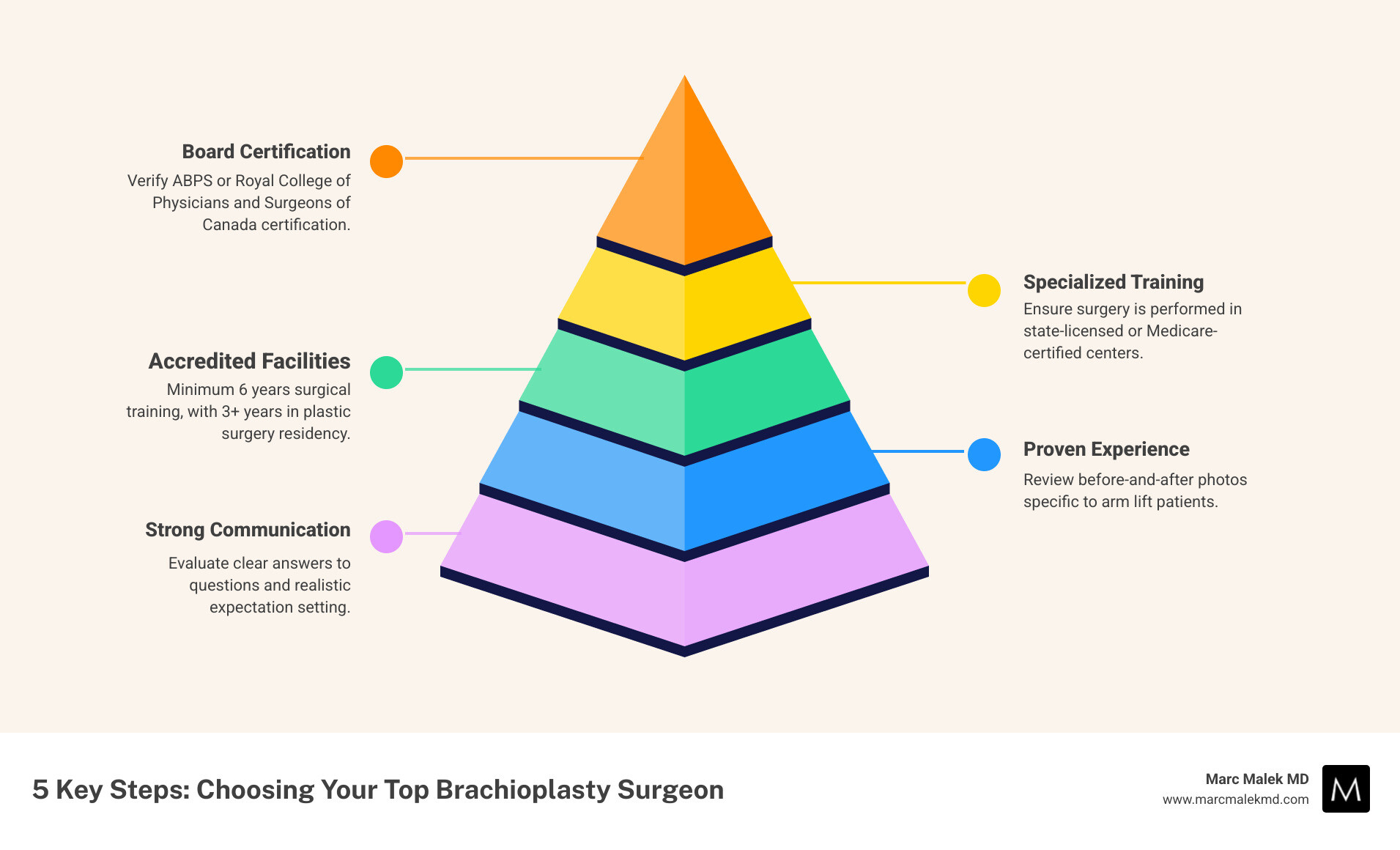
- Board certification – Verify certification by the American Board of Plastic Surgery (ABPS) or Royal College of Physicians and Surgeons of Canada
- Specialized training – At least 6 years of surgical training with minimum 3 years in plastic surgery residency
- Accredited facilities – Surgery performed in state-licensed or Medicare-certified surgical centers
- Proven experience – Review before-and-after photos of actual arm lift patients
- Strong communication – Clear answers to your questions and realistic expectations
If you’ve struggled with loose, hanging skin on your upper arms—what many call “bat wings”—you already know that no amount of exercise or dieting will fix it. As the American Society of Plastic Surgeons notes, excess skin that has lost elasticity cannot be improved through strength training or muscle conditioning.
An arm lift, or brachioplasty, surgically removes that excess skin and reshapes the upper arm from the underarm to the elbow. But here’s what matters most: the skill and qualifications of your surgeon directly impact your safety, your scars, and your final results.
The challenge? Not all “cosmetic surgeons” are equally qualified. The American Board of Medical Specialties, which has approved medical specialty boards since 1934, recognizes the ABPS—but there is no ABMS-recognized certifying board with “cosmetic surgery” in its name. That means patients can easily be misled by official-sounding certifications that don’t meet the same rigorous standards.
This guide walks you through the non-negotiable qualifications, the questions you must ask, and how to evaluate whether a surgeon is truly the right fit for your brachioplasty journey.
Best brachioplasty surgeon vocab to learn:
The Non-Negotiables: Core Qualifications of a Top Brachioplasty Surgeon
When starting on a surgical journey like brachioplasty, the first and most critical step is to ensure your chosen surgeon possesses impeccable credentials. These aren’t just fancy titles; they represent years of rigorous training, adherence to the highest safety standards, and a commitment to patient well-being. Think of it as building your dream home – you wouldn’t hire an uncertified contractor, right? The same principle applies to your body. We look for board certification, extensive surgical training, and operations performed in accredited facilities. Membership in professional societies like the American Society of Plastic Surgeons (ASPS) further indicates a surgeon’s dedication to ongoing education and ethical practice.
Decoding Board Certification: The Gold Standard
Understanding board certification is paramount. Many patients are confused by various “official-sounding” certifications. However, for plastic surgery, there’s a clear gold standard: certification by the American Board of Plastic Surgery (ABPS) in the United States, or the Royal College of Physicians and Surgeons of Canada for our neighbors to the north. These are the only boards recognized by the American Board of Medical Specialties (ABMS) for plastic surgery.
Why does this distinction matter so much? The ABMS has been approving medical specialty boards since 1934, setting the benchmark for physician qualification. As we’ve learned, there is no ABMS-recognized certifying board with “cosmetic surgery” in its name. This means that a surgeon advertising themselves as “board-certified in cosmetic surgery” may not have undergone the same extensive, specialized training and rigorous examinations as an ABPS-certified plastic surgeon. An ABPS-certified plastic surgeon has met stringent requirements, demonstrating expertise across the full spectrum of plastic and reconstructive surgery, including cosmetic procedures like brachioplasty. For more detailed information on selecting a qualified surgeon, we recommend reviewing this resource on Choosing a Plastic Surgeon for Arm Lift Surgery.
Essential Training and Surgical Experience
Beyond board certification, the depth and breadth of a surgeon’s training and experience are vital. An ASPS Member Surgeon, for example, meets rigorous standards that include:
- Complete at least six years of surgical training following medical school, with a minimum of three years dedicated specifically to plastic surgery residency training. This extensive period ensures a surgeon gains comprehensive knowledge and hands-on skills across diverse surgical scenarios.
- Passing comprehensive oral and written exams. These aren’t just pop quizzes; they are exhaustive evaluations designed to test a surgeon’s theoretical knowledge and practical judgment.
- Graduating from an accredited medical school. This foundational step ensures a solid medical education.
- Completing continuing medical education, including patient safety, each year. The field of plastic surgery is constantly evolving. A truly excellent surgeon remains at the forefront of new techniques, technologies, and safety protocols through continuous learning.
This combination of prolonged, specialized training and ongoing education means your surgeon is not only well-versed in the fundamentals but also committed to lifelong learning, which directly translates to better outcomes and improved safety for you.
Why Accredited Surgical Facilities Matter
The surgeon’s qualifications are crucial, but so is the environment in which your surgery takes place. We insist that any brachioplasty be performed in accredited, state-licensed, or Medicare-certified surgical facilities. This isn’t just about comfort; it’s about your safety.
These facilities adhere to strict standards for:
- Infection control: Ensuring a sterile environment to minimize the risk of post-operative infections.
- Anesthesia safety: Equipped with the necessary personnel and equipment to administer anesthesia safely and manage any potential complications.
- Emergency preparedness: Having protocols and resources in place to handle medical emergencies effectively.
Choosing a surgeon who operates in such a facility provides an additional layer of assurance regarding your well-being. It means the entire surgical team and setting have met independent, rigorous standards for patient care and safety. You can learn more about patient safety guidelines and resources here: More info about patient safety.
Finding the Best Brachioplasty Surgeon for You
Once you’ve confirmed a surgeon meets the foundational qualifications, the next step is to find the one who aligns best with your aesthetic goals and personal comfort. This is where the art meets the science of plastic surgery. We believe in a personal and artistic approach to deliver fantastic, long-lasting results, focusing on patient comfort, convenience, and promoting a healthy lifestyle for proportionally balanced bodies.

A top brachioplasty surgeon possesses not just technical skill, but also an “artistic eye.” This means they can visualize the ideal contour for your arms, taking into account your unique anatomy and overall body proportion. They’ll work to achieve personalized results that improve your natural shape, rather than applying a one-size-fits-all solution. Their body contouring philosophy should resonate with yours, and their communication style should make you feel heard and understood.
Evaluating a Surgeon’s Brachioplasty-Specific Expertise
While a board-certified plastic surgeon is qualified for many procedures, we also want to know about their specific experience with arm lifts. This includes:
- Experience with arm lifts: How many brachioplasties have they performed? How long have they been performing them? Experience often translates to refined technique and a deeper understanding of potential challenges.
- Body contouring specialization: Do they specialize in body contouring procedures, particularly for patients who have undergone significant weight loss? Many brachioplasty candidates have lost a substantial amount of weight, which requires a surgeon skilled in addressing widespread skin laxity.
- Different brachioplasty techniques: A skilled surgeon should be proficient in various brachioplasty techniques, including mini, traditional, and extended arm lifts, as well as liposuction-assisted procedures. They should be able to explain which technique is best for your specific needs, whether you have minimal sagging or significant excess skin extending to the chest. This ensures they can tailor the procedure to your unique anatomy and goals. You can find More info about Arm Lift Surgery here.
The Power of Visuals: Analyzing Before-and-After Photos
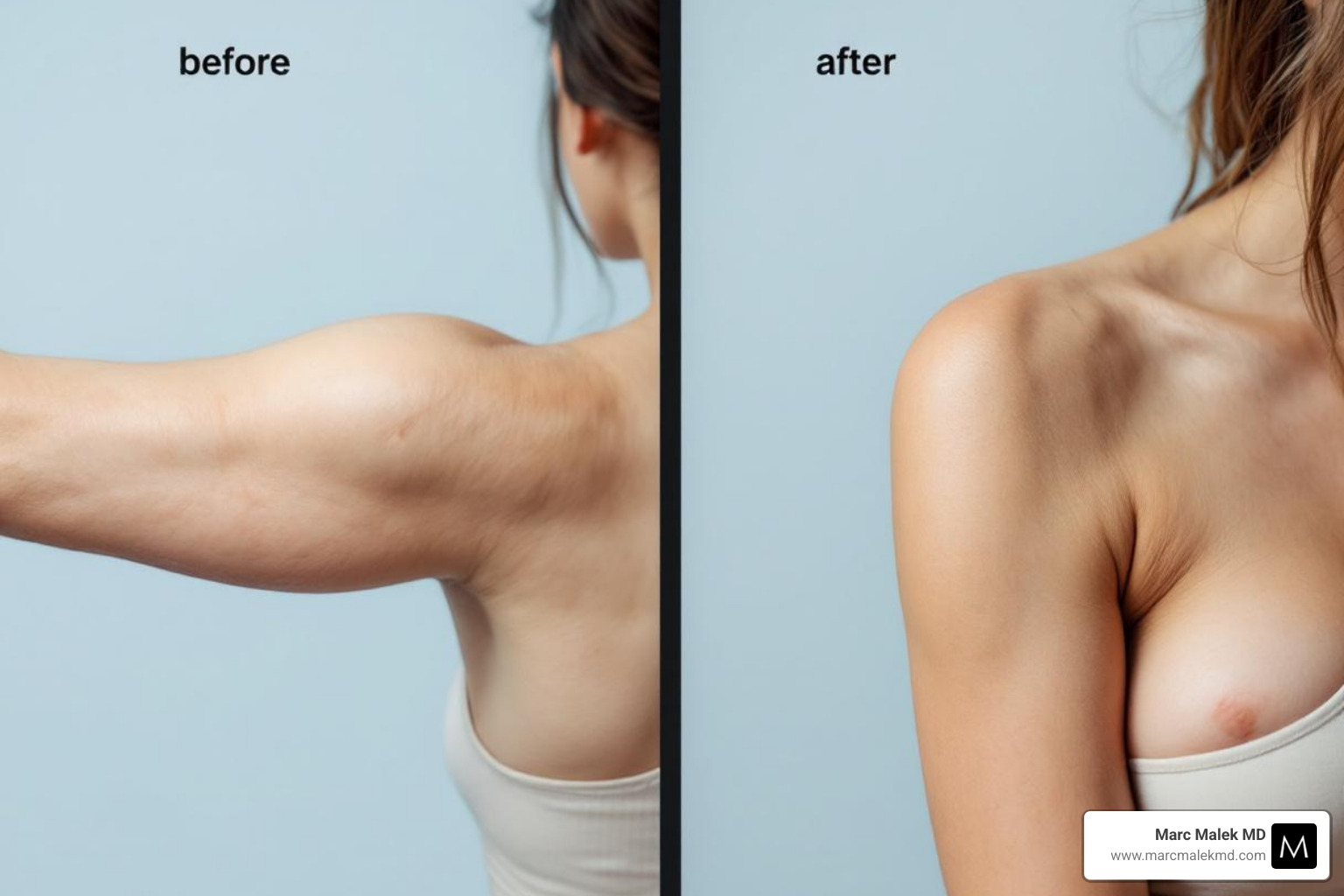
A picture is worth a thousand words, especially in plastic surgery. Before-and-after photos are an invaluable tool for evaluating a surgeon’s aesthetic and technical skill. When reviewing these photos, pay close attention to:
- Incision placement: Are the scars strategically placed to be as inconspicuous as possible, often along the inner arm?
- Scar quality: While all brachioplasties result in scars, a skilled surgeon’s technique can lead to finer, less noticeable scars that fade well over time. Look for consistent scar healing.
- Natural contours: Do the “after” arms look naturally sculpted and proportionate to the rest of the body? Avoid results that appear overly tight or unnatural.
- Consistency in results: Look for a pattern of successful outcomes across many patients, not just one or two standout cases.
- Body proportion: The arms should blend harmoniously with the shoulders and torso.
We invite you to View our Brachioplasty gallery to see examples of our work.
Reading Between the Lines: How to Use Patient Reviews
Patient reviews and testimonials offer a unique window into a surgeon’s practice. While not a substitute for your own consultation, they can provide valuable insights into:
- Surgeon’s bedside manner: Do patients describe the surgeon as compassionate, attentive, and good at explaining procedures? A warm and reassuring approach can make a significant difference in your overall experience.
- Office staff experience: A positive experience often extends beyond the surgeon to the entire team. Are the staff members helpful, friendly, and efficient?
- Post-operative care: Do reviews highlight thorough post-operative instructions and accessible support during recovery?
- Realistic expectations: Do patients feel the surgeon provided honest information about what to expect, including potential scars and recovery challenges?
Look for consistent themes in positive reviews, and don’t be afraid to ask about any concerns raised in negative ones during your consultation.
Your Consultation Checklist: Questions to Ask a Potential Surgeon
Your consultation is your opportunity to interview a potential best brachioplasty surgeon and determine if they are the right fit for you. Come prepared with a list of questions. A confident and transparent surgeon will welcome your inquiries and provide clear, detailed answers.
Here’s a list of essential questions for your brachioplasty consultation:
- Am I a good candidate for brachioplasty?
- How many arm lifts have you performed, and for how long?
- What specific brachioplasty technique do you recommend for me, and why?
- Where will the surgery be performed? What are the accreditation details of the facility?
- Are you board-certified by the American Board of Plastic Surgery (ABPS)?
- Where will my scars be located, and what can I expect regarding their appearance?
- Can brachioplasty be combined with other procedures, like liposuction, if I need it?
- What results can I realistically expect from this procedure?
- Can I see more before-and-after photos, especially of patients with similar body types to mine?
- What are the potential risks and complications associated with brachioplasty?
- What does the recovery process involve, and what is the typical timeline?
- Who will handle my post-operative care, and how often will I have follow-up appointments?
- What is the total cost of the brachioplasty, including surgeon’s fees, anesthesia, and facility charges? Are there financing options available?
- What are your recommendations for preparing for surgery (e.g., medications to avoid, smoking cessation)?
- What kind of support will I need at home during my recovery?
Questions to Ask the Best Brachioplasty Surgeon About Their Experience
During your consultation, we encourage you to be direct and thorough. These questions are designed to help you gauge the surgeon’s expertise and approach:
- Am I a good candidate for brachioplasty? A good surgeon will assess your overall health, weight stability, skin laxity, and realistic expectations. They’ll consider if you are a healthy individual without medical conditions that impair healing or increase surgical risk, and if you are a non-smoker.
- How many arm lifts have you performed? This gives you an idea of their specific experience. While a number isn’t everything, a surgeon who regularly performs brachioplasties is likely more adept at handling various scenarios.
- What technique do you recommend for me, and why? There are different approaches (mini, traditional, extended, liposuction-assisted). The best brachioplasty surgeon will explain the pros and cons of each for your unique situation.
- Where will the surgery be performed? As discussed, ensuring the facility is accredited, state-licensed, or Medicare-certified is crucial for your safety.
- Are you board-certified by the ABPS? This is a foundational question that should always be asked, even if you think you already know the answer.
Questions About Your Specific Procedure and Results
Every patient is unique, and your brachioplasty should be custom to you. These questions help ensure the surgeon understands your personal goals and can deliver results that meet your expectations:
- Where will my scars be, and what can I expect regarding their appearance? Scars are an inevitable part of brachioplasty. A skilled surgeon will strategically place incisions to minimize visibility, often along the inner arm. They should be able to show you how scars typically look and fade over time.
- Can this be combined with liposuction? For many patients, especially those with both excess skin and localized fat deposits, combining brachioplasty with liposuction can yield improved results.
- What results can I realistically expect? An honest surgeon will manage your expectations, explaining what is achievable and what limitations exist. They will emphasize that while results are long-lasting, natural aging continues.
- Can I see before-and-after photos of patients with similar body types to mine? This helps you visualize potential outcomes more accurately for your specific case.
Questions About Safety, Recovery, and Cost
Finally, understanding the practical aspects of safety, recovery, and financial investment is essential for making an informed decision:
- What are the potential risks and complications? Every surgery carries risks, including unfavorable scarring, bleeding, infection, fluid accumulation, poor wound healing, changes in skin sensation, and asymmetry. A comprehensive surgeon will discuss these thoroughly.
- What does recovery involve, and what is the typical timeline? You’ll want to know about compression garments, activity restrictions, pain management, and when you can return to work and exercise.
- Who handles post-operative care, and how often will I have follow-up appointments? Continuity of care is important for monitoring your healing process.
- What is the total cost of the brachioplasty? This includes surgeon’s fees, anesthesia, facility charges, and any additional related expenses. We can discuss payment options or financing plans.
Frequently Asked Questions about Arm Lift Surgery
We understand you likely have many questions about arm lift surgery. Here, we address some of the most common inquiries to help you feel more informed and confident about your decision.
Will I have a noticeable scar after an arm lift?
Yes, an arm lift will result in visible scarring, as incisions are required to remove excess skin and fatty tissue. However, a skilled best brachioplasty surgeon will focus on strategic incision placement to minimize their visibility. Typically, incisions are made along the inner arm, extending from the armpit to just above the elbow. For patients with less extensive skin laxity, a mini brachioplasty might involve a smaller, more concealable incision near the armpit.
While scars are permanent, they generally fade significantly over time. Scar maturation can take up to a year or more, during which they will become flatter and lighter. Your surgeon’s technique plays a crucial role in the quality of the scar. Following post-operative scar care instructions diligently, such as using recommended topical treatments and protecting scars from sun exposure, can further optimize their appearance.
How long do the results of a brachioplasty last?
The results of a brachioplasty are generally long-lasting, often for a decade or more, provided you maintain a stable weight and a healthy lifestyle. The procedure physically removes excess skin and tightens underlying supportive tissues, which provides a significant and lasting improvement to the arm contour.
However, it’s important to understand that the natural aging process will continue. Over time, skin may gradually lose some firmness due to decreasing collagen and elastin production, which is a normal part of aging. Significant fluctuations in weight after surgery can also compromise your results by stretching the remaining skin. By adopting a healthy diet and regular exercise routine (once cleared by your surgeon), you can help preserve muscle mass and maintain your refined arm contours for many years.
What is the typical recovery time for an arm lift?
Recovery time for an arm lift varies depending on the extent of the procedure and individual healing capabilities, but generally, patients can expect a few weeks of downtime.
- Immediately after surgery: Your arms will be bandaged, and you will likely wear compression garments to help reduce swelling and support the new contours. Drains may be temporarily placed to collect excess fluid. You will experience soreness, swelling, and bruising.
- First week: You’ll need assistance with daily activities, as arm mobility will be limited, and you should avoid lifting even light objects. Pain can be managed with prescribed medication. Most patients can return to desk jobs within one to two weeks.
- Weeks 2-4: Swelling will gradually subside, and you can slowly increase light activities. Compression garments are typically worn for several weeks.
- Weeks 4-6 and beyond: Strenuous activities, heavy lifting, and intense exercise should be avoided for at least four to six weeks. Your surgeon will advise when it’s safe to resume your full exercise routine. Full results become more apparent as swelling resolves over several months.
Throughout your recovery, following your surgeon’s post-operative instructions carefully is crucial for optimal healing and the best possible results.
Conclusion: Making Your Final Decision with Confidence
Choosing the best brachioplasty surgeon is a significant decision that directly impacts your safety, satisfaction, and the longevity of your results. We’ve explored the non-negotiable qualifications—board certification, extensive training, and accredited facilities—that form the bedrock of a safe and successful surgical experience. Beyond these, we’ve discussed the importance of a surgeon’s specific expertise in arm lifts, their artistic eye, and the invaluable insights gained from before-and-after photos and patient reviews.
The process culminates in a thorough consultation where you can ask essential questions about their experience, your specific procedure, and the practicalities of safety, recovery, and cost. It’s about finding a surgeon with whom you feel a strong sense of trust and rapport, someone whose artistic approach aligns with your vision for a more toned and proportionate physique.
At Marc Malek MD, we pride ourselves on a personal and artistic approach, striving to deliver fantastic, long-lasting results for our patients in Scottsdale, Phoenix, and throughout Arizona. We focus on patient comfort, convenience, and promoting a healthy lifestyle that contributes to proportionally balanced bodies. Our goal is to empower you to accept your full potential with confidence.
If you’re ready to take the next step toward sculpted, more youthful-looking arms, we invite you to Schedule your personal arm lift consultation today. Let us guide you through your brachioplasty journey with expertise, care, and a commitment to your beautiful outcome.