

Banishing the Breakout Baggage for Good
Acne Scars Are Common — But You Don’t Have to Live With Them
How to get rid of acne scars is one of the most searched skin concerns — and for good reason. Even after breakouts clear up, the marks they leave behind can stick around for years.
Here’s a quick overview of the most effective ways to reduce acne scars:
- Laser resurfacing (fractional CO2, Er:YAG) — best for moderate to severe atrophic scars
- Microneedling with PRP — stimulates collagen, effective for rolling and boxcar scars
- TCA CROSS — targets deep icepick scars with high-concentration acid
- Chemical peels — smooths surface texture and improves pigmentation
- Subcision + dermal fillers — lifts tethered scars and restores lost volume
- Punch excision — removes deep, isolated scars surgically
The right treatment depends on your scar type, skin tone, and how severe the scarring is. A personalized plan almost always works better than a single approach.
Acne is incredibly common. It affects more than 80% of adolescents, and it doesn’t stop there — up to 60% of women in their early 20s still deal with it, along with roughly 12% of women well into adulthood.
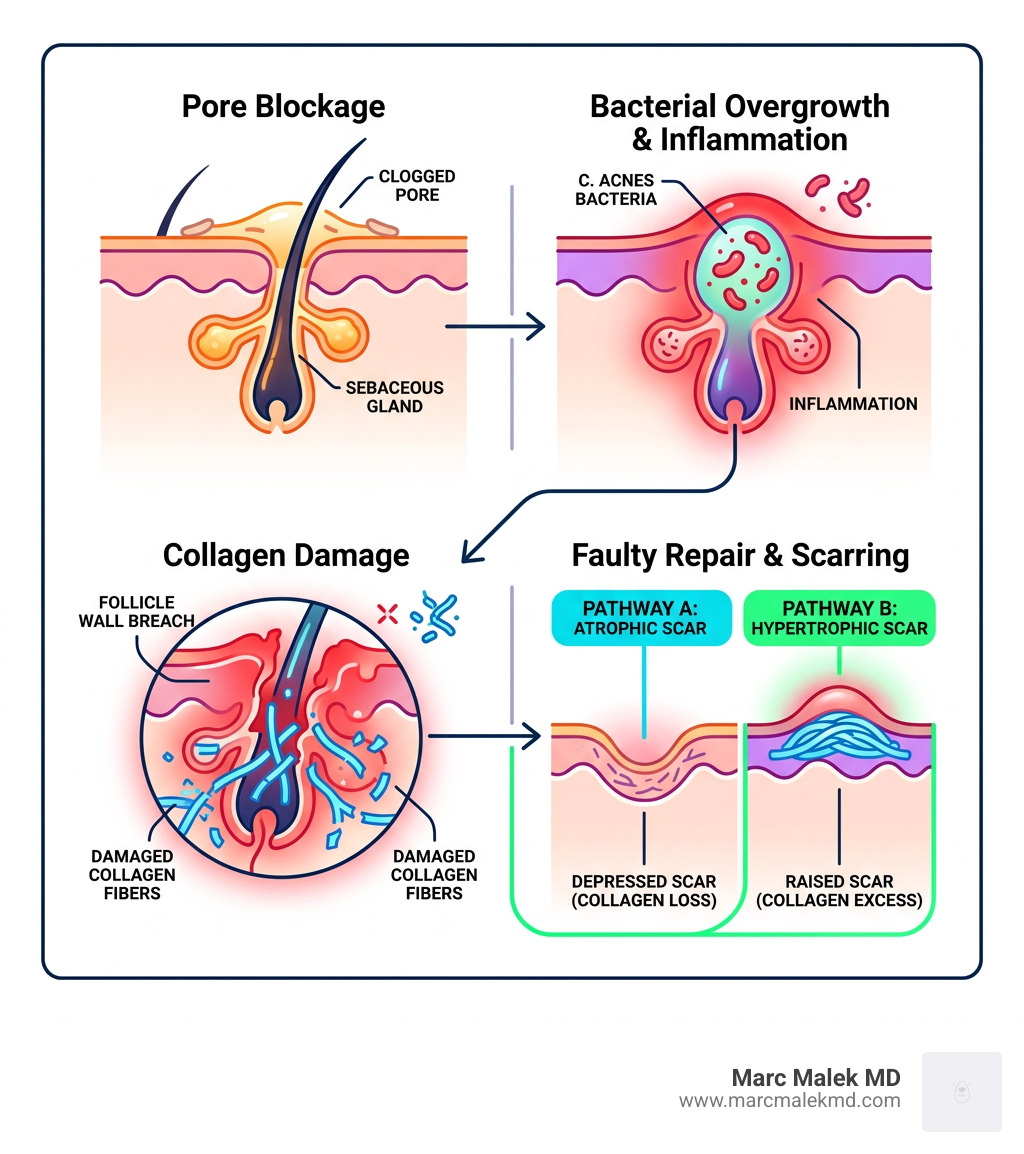
The scars it leaves come from inflammation. When a pore becomes inflamed, its wall can break down and spill infected material into surrounding tissue. The skin then rushes to repair the damage — but that repair process isn’t always clean. Sometimes too little collagen is produced, leaving a depression in the skin. Other times, too much collagen builds up, creating a raised scar.
About 1 in 5 people with acne develop scarring. That’s a significant number of people carrying a visible reminder of breakouts long after the acne itself is gone.
The good news? There are more effective treatment options today than ever before — and many scars can be dramatically reduced, if not nearly eliminated.
Understanding the Different Types of Acne Scars
Before we can dive into how to get rid of acne scars, we have to identify exactly what we are looking at. Not all “marks” left by acne are actually scars. For instance, post-inflammatory hyperpigmentation (PIH) consists of flat, dark, or red spots. While annoying, these usually fade on their own over three to six months because they only affect the skin’s color, not its texture.
True scarring involves structural changes to the skin’s architecture. These are generally divided into two main categories: atrophic (depressed) and hypertrophic (raised).
Atrophic Scars (Depressed)
Atrophic scars are the most common result of facial acne. They occur when the body doesn’t produce enough collagen during the healing process, leaving a “pit” or “dent” behind.
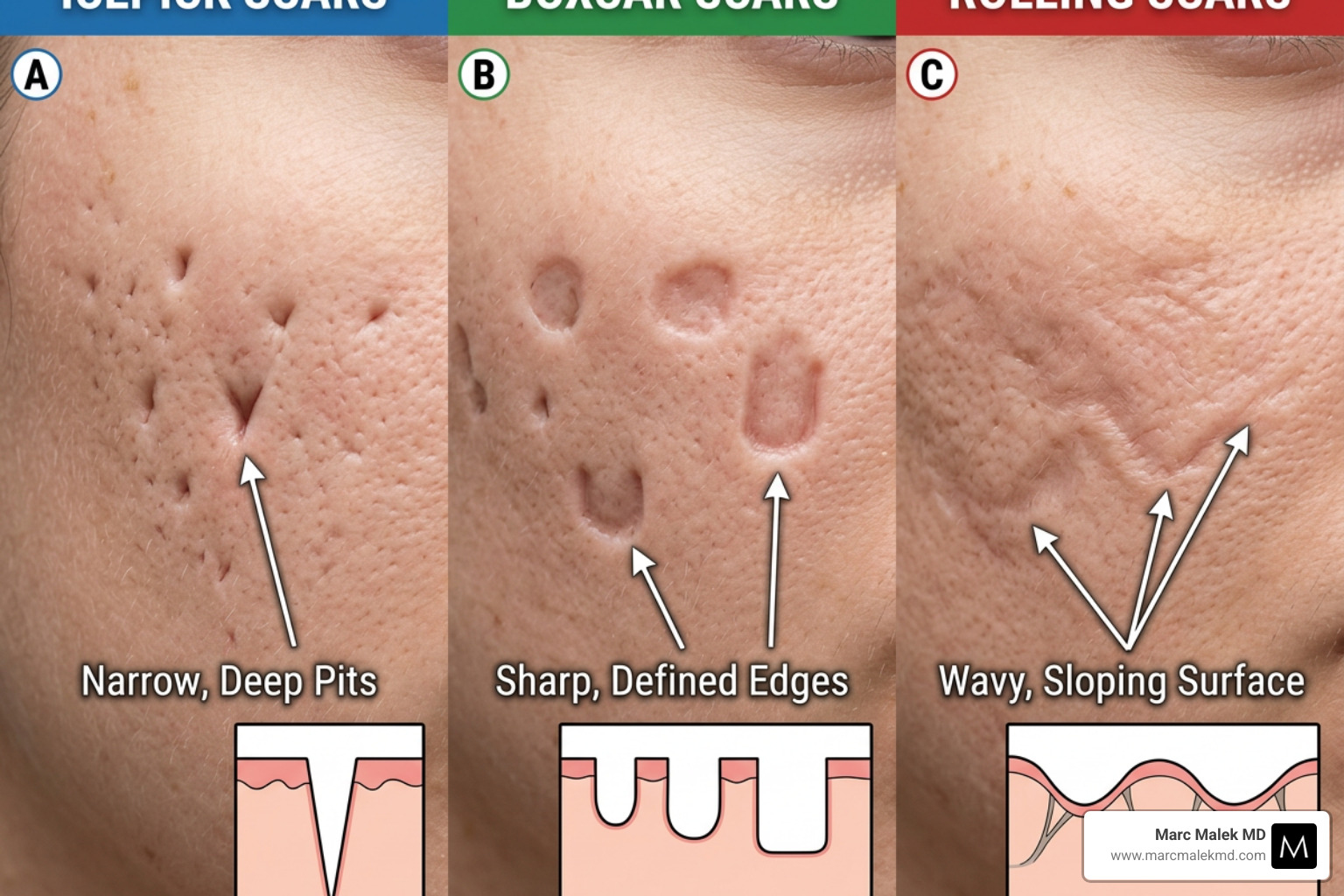
- Icepick Scars: These are the most common, accounting for 60% to 70% of atrophic scars. They are narrow (less than 2mm), V-shaped, and look like the skin has been punctured by a tiny sharp tool. Because they extend deep into the dermis, they can be the most challenging to treat with surface-level therapies.
- Boxcar Scars: Representing 15% to 20% of cases, these are round or oval depressions with sharp, vertical edges. They look similar to chickenpox scars. They can be shallow or deep, depending on the extent of the original inflammation.
- Rolling Scars: These make up 15% to 25% of atrophic scars. They have sloping edges and give the skin a wavy, undulating, or “rolling” appearance. They are often caused by fibrous bands of tissue that tether the skin to the deeper structures below.
Hypertrophic Scars and Keloids
Unlike atrophic scars, these are raised above the skin’s surface. They occur when the body produces too much collagen during healing. Hypertrophic scars stay within the boundary of the original wound, while keloids can grow much larger than the initial pimple. These are more common on the chest, back, and shoulders than on the face.
For a deeper dive into the clinical classification of these textures, you can explore this scientific research on scar classification.
Professional Treatments: How to Get Rid of Acne Scars
When it comes to significant improvement, over-the-counter creams often fall short. Professional intervention is usually required to remodel the collagen deep within the skin. At our Scottsdale practice, we often utilize advanced technologies to achieve these results.
One of the most powerful tools in our arsenal is Laser Skin Resurfacing. Lasers work by delivering targeted energy into the skin to break down old scar tissue and stimulate the birth of fresh, healthy collagen.
| Laser Type | Best For | Typical Recovery |
|---|---|---|
| Fractional CO2 | Deep atrophic scars | 7–10 days |
| Er:YAG | Moderate scarring/Texture | 5–7 days |
| 1450-nm Diode | Active acne + mild scars | Minimal |
| Pulsed Dye | Redness (Erythema) | 1–2 days |
Ablative vs. Non-Ablative Lasers
Ablative lasers, like the CO2 Laser Resurfacing or Er:YAG, remove the outer layers of the skin. This “resurfacing” allows the skin to grow back smoother. Non-ablative lasers work by heating the underlying tissue without damaging the surface, which means less downtime but often requires more sessions.
Research has shown that fractional CO2 laser efficacy is particularly high in treating atrophic scars, with many patients seeing significant improvement after just three sessions. However, melanin considerations are vital. Darker skin tones require specific laser settings (like those found in our Pixel technology) to avoid hyperpigmentation.
Laser Resurfacing and Light Therapies
Beyond traditional resurfacing, we use light therapies to target the “redness” often associated with newer scars. Intense Pulsed Light (IPL) and vascular lasers can reduce erythema (redness) by targeting blood vessels. This process, known as photobiomodulation, uses light to trigger cellular healing without the intense heat of a resurfacing laser. Erase Scars with the Help of Laser Technology explains how these light-based systems can even out the complexion while the deeper remodeling happens.
Chemical Peels and TCA CROSS
Chemical peels use specialized acids to exfoliate the skin and encourage cell turnover. While mild peels with glycolic or salicylic acid are great for surface texture and active acne, deeper scars often require the TCA CROSS technique.
CROSS stands for “Chemical Reconstruction of Skin Scars.” In this method, a high concentration of trichloroacetic acid (70%–100%) is applied directly into the base of deep scars—specifically icepick scars. This causes a controlled local injury that forces the skin to produce new collagen from the bottom up. A study on TCA CROSS for icepick scars found that 66% of patients saw good to very good improvement after treatment.
Advanced Procedures for Deep and Textured Scarring
Sometimes, surface treatments aren’t enough because the problem lies beneath the skin. If you have “tethered” scars that pull the skin down, we need to go deeper.
Microneedling and Fractional Radiofrequency for How to Get Rid of Acne Scars
Microneedling, or collagen induction therapy, uses tiny needles to create thousands of “micro-injuries” in the skin. This sounds scary, but it’s actually a brilliant way to trick the body into a healing frenzy.
We often elevate this treatment by adding Radiofrequency (RF) energy. Devices like Morpheus8 deliver RF heat through the needles into the deeper dermis. This provides a “double whammy”: the physical needling breaks up scar tissue, while the RF energy tightens and remodels the skin from within. For even better results, we frequently perform Microneedling with PRP (Platelet-Rich Plasma), which uses your own growth factors to speed up healing. A clinical study on microneedling results showed that over 70% of patients saw a visible upgrade in their skin grade after four sessions.
Dermal Fillers and Subcision for How to Get Rid of Acne Scars
For rolling scars that are tethered by fibrotic bands, we use a technique called Subcision. We use a small needle to gently break those bands, releasing the skin so it can “float” back to the surface.
Once the scar is released, we can use Dermal Fillers to restore lost volume. Fillers like Bellafill or hyaluronic acid-based products act as a “scaffold,” lifting the depression and creating an immediately smoother surface. In some cases, an autologous fat transfer—where we take a tiny bit of fat from another part of your body—can provide a permanent solution for volume loss.
Prevention and Results: What to Expect from Your Treatment Plan
We always tell our patients in Scottsdale and Phoenix that the best way to treat a scar is to prevent it from forming in the first place.
Key Prevention Strategies for How to Get Rid of Acne Scars
- Early Intervention: Treat active breakouts immediately to stop inflammation before it damages the pore wall.
- Hands Off!: We know it’s tempting, but picking or squeezing pimples is the fastest way to turn a temporary blemish into a permanent scar.
- Sun Protection: UV rays can darken scars and break down the collagen your skin is trying to rebuild.
- Retinoids: Using topical retinoids helps keep pores clear and encourages the healthy cell turnover necessary for smooth skin.
Treatment Timelines
Patience is a virtue when learning how to get rid of acne scars. While you might see a “glow” after a chemical peel in a few days, collagen remodeling takes time. Most patients see initial improvements in 4 to 6 weeks, but the full results of laser or microneedling treatments can take 6 months or longer to fully manifest.
It’s also important to acknowledge the mental toll of scarring. Acne can lead to significant psychological distress, anxiety, and social isolation. If you find yourself struggling, there are wonderful psychological support and resources available to help you navigate the emotional side of skin health.
Frequently Asked Questions about Acne Scar Removal
Are acne scar treatments permanent?
Most treatments that stimulate your own collagen (like lasers, microneedling, and subcision) provide long-lasting or permanent results. However, your skin will continue to age naturally. Dermal fillers are usually temporary, lasting 6 to 18 months, though some “biostimulatory” fillers can last much longer.
How many sessions of microneedling are needed for scars?
While a single session can improve skin texture, most people need a series of 3 to 6 treatments spaced about a month apart to see a dramatic reduction in acne scars.
Can natural remedies remove deep acne scars?
Unfortunately, no. While ingredients like lemon juice or honey might help with very minor surface discoloration, they cannot reach the depths of the dermis to remodel the scar tissue or “fill in” an atrophic pit. Professional procedures are the only proven way to change the actual texture of scarred skin.
Conclusion
At Marc Malek MD, we understand that your skin is a testament to your journey, but that doesn’t mean you have to carry the “baggage” of past breakouts forever. Our Scottsdale practice is dedicated to helping you achieve clear, confident skin through a personalized and artistic approach.
Dr. Malek focuses on more than just the surface; he utilizes a multi-modal strategy—combining the latest laser technologies, advanced needling, and surgical precision—to deliver results that are both natural and long-lasting. Whether you are interested in The Benefits of Laser Hair Removal on Scarred Areas or a comprehensive resurfacing plan, our goal is your comfort and confidence.
We invite you to reach out and discover how a proportionally balanced, healthy lifestyle can be complemented by modern skin science. Let us help you leave the breakout baggage behind for good.