

Best Non Ablative Laser for Wrinkles with Zero Downtime
The Best Non-Ablative Lasers for Wrinkles — A Quick Answer First
The best non ablative laser for wrinkles depends on your skin type and how deep your lines are, but the top-performing options backed by clinical evidence are:
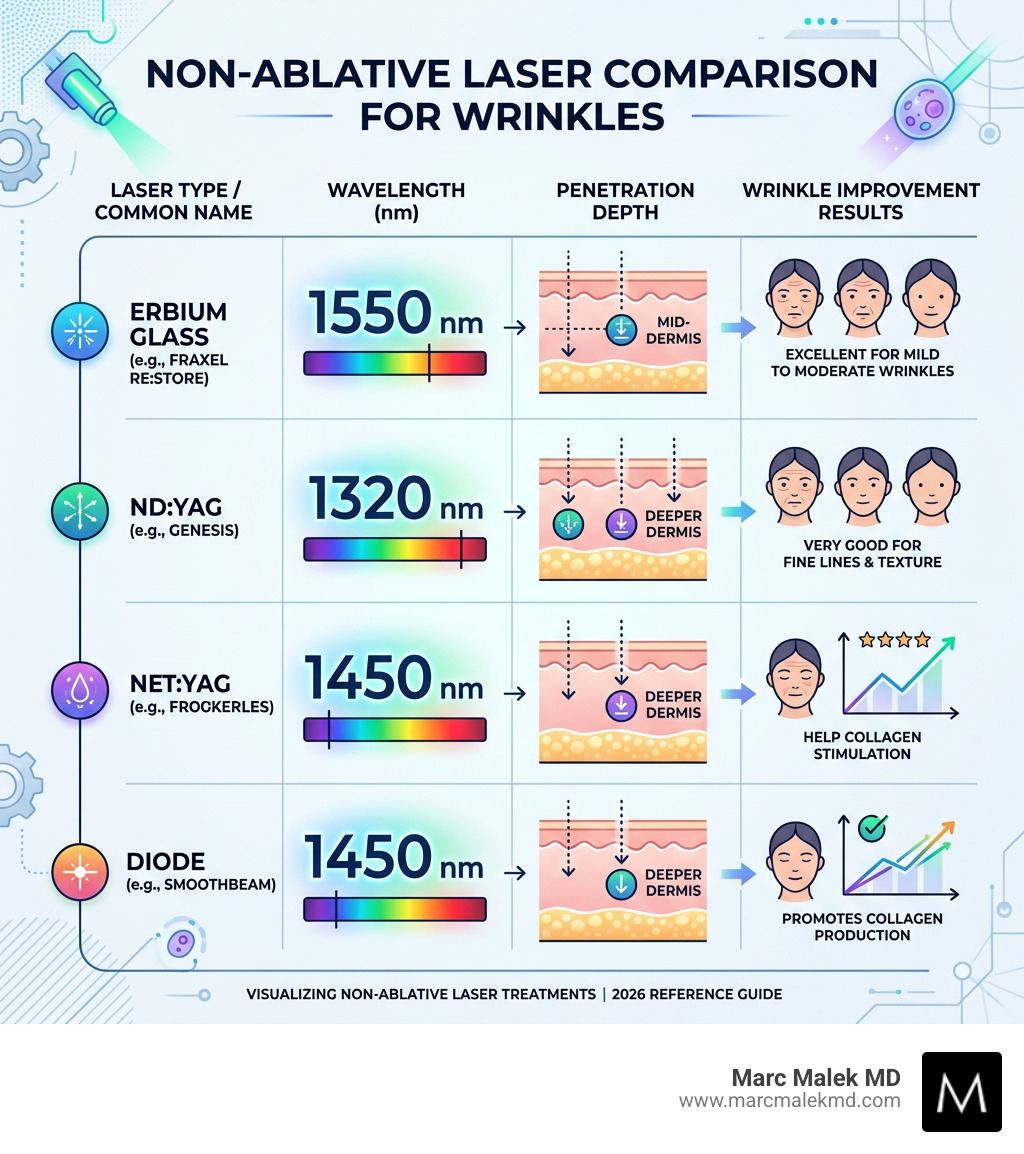
- 1550-nm Erbium Glass (Fraxel re:store) — Best overall for mild to moderate wrinkles; safe for most skin types; 3-5 sessions
- 1320-nm Nd:YAG (Laser Genesis / CoolTouch) — Excellent for fine lines; stimulates collagen types I, III, and VII; minimal downtime
- 1450-nm Diode (Smoothbeam) — Strong collagen remodeling; effective for fine lines and skin texture
- 1440-nm Nd:YAG (Affirm / StarLux) — Good for mild photoaging with low risk
- 1410-nm Fractional Laser (Fraxel re:fine) — Ideal for very subtle, early wrinkles
All of these preserve the outer layer of skin while heating the deeper dermis to stimulate new collagen — meaning little to no recovery time.
Wrinkles are a natural part of aging, but they don’t have to be permanent. The problem is that the most dramatic laser treatments — the ones that can erase deep lines in a single session — often come with 10 to 14 days of raw, peeling skin and weeks of redness. For most people, that kind of downtime simply isn’t realistic.
That’s exactly why non-ablative lasers have become so popular. They work beneath the skin’s surface, triggering collagen production in the dermis without damaging the outer layer. The result? Gradual, natural-looking improvement — with redness that typically fades within a few hours.
Research confirms that non-ablative lasers require 4 to 6 sessions for moderate wrinkle improvement, with most patients experiencing only a few hours of redness after each treatment. Studies on the 1320-nm Nd:YAG laser show it actively accelerates production of collagen types I, III, and VII — the structural proteins that make skin look firm and smooth.
The trade-off compared to ablative lasers is real: results are more gradual and modest. But for the right patient, that trade-off is absolutely worth it.
This guide breaks down every major non-ablative laser option, compares their wavelengths and effectiveness, and helps you understand which one is likely the best fit for your skin.
Explore more about best non ablative laser for wrinkles:
Understanding Non-Ablative vs. Ablative Technology
To choose the best non ablative laser for wrinkles, we first need to understand the “magic” happening under the surface. In dermatology, “ablative” means to remove or vaporize tissue. Traditional CO2 lasers are the heavy hitters of this category; they remove the entire outer layer of skin (the epidermis). While this leads to a 45% improvement in wrinkles, it also carries a 55% risk of side effects and significant downtime.
Non-ablative technology takes a much gentler approach. Instead of removing the skin surface, these lasers use specific wavelengths of light to pass through the epidermis and heat the underlying dermal tissue. This process, known as non-ablative skin resurfacing, creates controlled thermal injury (coagulation) in the deeper layers.
This heat “tricks” your body into thinking it’s been injured, which kicks the healing response into high gear. Fibroblasts begin churning out new collagen and elastin, leading to tissue remodeling from the inside out. Because the surface remains intact, you don’t have the open wounds associated with ablative skin resurfacing.
| Feature | Ablative Lasers (CO2, Er:YAG) | Non-Ablative Lasers (Nd:YAG, Diode) |
|---|---|---|
| Surface Impact | Vaporizes the epidermis | Leaves epidermis intact |
| Downtime | 7–14 days (peeling/raw) | 0–3 days (mild redness) |
| Results | Dramatic, single session | Subtle, progressive (4-6 sessions) |
| Pain Level | High (requires numbing/sedation) | Low to moderate (topical numbing) |
| Risk Profile | Higher risk of scarring/pigment | Very low risk; safe for dark skin |
The Best Non-Ablative Laser for Wrinkles: Top Wavelengths and Mechanisms
When we talk about the best non ablative laser for wrinkles, we are really talking about wavelengths. Different wavelengths of light penetrate to different depths and are absorbed by different targets (like water or melanin) in the skin.
- 1320-nm Nd:YAG: This was the first commercial non-ablative laser. It is a workhorse for laser skin resurfacing because it targets water in the dermis to stimulate collagen types I and III. It is particularly effective for fine lines and early signs of aging.
- 1450-nm Diode: Often used for both acne and wrinkles, this wavelength has a high affinity for water. It creates significant thermal damage in the mid-dermis, which is ideal for structural remodeling.
- 1550-nm Erbium Glass: This is the “gold standard” for fractional non-ablative treatment. It penetrates deeply (up to 2mm) to tackle moderate wrinkles and texture issues.

By stimulating collagen types I, III, and even VII, these lasers essentially “rebuild” the scaffolding of your skin. Over several months, this new collagen fills in the “valleys” of wrinkles, making the surface appear smoother and more youthful.
Fractional vs. Non-Fractional: Which is the best non ablative laser for wrinkles?
In the early days of laser technology, the entire area was treated with a solid beam of light. Today, we almost always prefer fractional technology.
Think of a fractional laser like the pixels on a television screen. Instead of treating 100% of the skin surface, the laser creates thousands of microscopic treatment zones (MTZs). These are tiny columns of thermal injury surrounded by healthy, untreated tissue. Because the “bridge” of healthy skin remains intact, the healing process is incredibly fast.
Technologies like Pixel allow us to provide deep dermal remodeling while maintaining epidermal integrity. This fractionation is the reason why you can have a treatment on a Friday and be back at work on Monday with nothing more than a slight “sunburned” look.
Comparing 1320-nm and 1550-nm: Finding the best non ablative laser for wrinkles
If you are looking for the absolute best non ablative laser for wrinkles, the choice often comes down to the 1320-nm Nd:YAG versus the 1550-nm Erbium Glass.
Clinical research on 1320-nm Nd:YAG shows that it is excellent for Asian skin types and those with very fine lines. It is often called a “lunchtime” laser because the redness lasts only a few hours. However, the 1550-nm Erbium Glass (like Fraxel re:store) typically offers more “punch.” Because 1550-nm light is absorbed so effectively by water, it can create deeper columns of collagen stimulation. While it might require 2-3 days of social downtime (slight swelling and pinkness), the histological correlations show a more significant increase in dermal thickness compared to the 1320-nm.
Ideal Candidates and Realistic Clinical Results
Who should be looking for the best non ablative laser for wrinkles? In our Scottsdale and Phoenix offices, we find that the ideal candidate is someone in their 30s to 50s with mild to moderate “rhytides” (the medical term for wrinkles).
Non-ablative lasers are particularly safe for Fitzpatrick skin types IV through VI (darker skin tones). Because the surface of the skin isn’t vaporized, there is a much lower risk of post-inflammatory hyperpigmentation (dark spots) compared to ablative lasers.
What can you realistically expect?
- Session Frequency: You will likely need a series of 3 to 6 treatments, spaced about 4 weeks apart.
- The “Glow”: Many patients see an immediate “insta-glow” due to temporary swelling, but real collagen building takes time.
- Longevity: Results are progressive. You’ll see the best version of your skin about 3 to 6 months after your final session. These results can last 1 to 2 years, though many of our patients opt for a single “maintenance” session every 6 to 12 months.
If you are dealing with significant sagging or very deep, etched-in furrows, we might discuss non-surgical facial rejuvenation combinations, such as pairing lasers with fillers or even considering surgical options if the skin laxity is severe.
Safety, Side Effects, and Essential Aftercare
Even the best non ablative laser for wrinkles comes with some minor side effects. The most common are:
- Erythema (Redness): Usually lasts 2 to 24 hours.
- Edema (Swelling): Mild swelling, especially around the eyes, for a day or two.
- Sandpaper Texture: As the MTZs heal, your skin might feel slightly rough for 3–5 days.
Research on side effects emphasizes that while risks are low, they aren’t zero. To minimize complications like hyperpigmentation, sun protection is non-negotiable. We recommend a broad-spectrum SPF 30 or higher every single day, even if it’s cloudy in Phoenix!
If you are using lasers to erase scars, your aftercare might involve specific serums (like Vitamin C or growth factors) to enhance the remodeling process. Always avoid harsh exfoliants (Retin-A, glycolic acids) for at least one week after your session.
Frequently Asked Questions about Non-Ablative Lasers
How many sessions are typically required for wrinkle reduction?
For most patients seeking the best non ablative laser for wrinkles, we recommend a “starter” series of 4 to 6 sessions. This allows the collagen to build cumulatively. If you only do one session, you might see a temporary glow, but you won’t get the structural change needed to smooth out wrinkles long-term.
How does IPL compare to non-ablative lasers for wrinkles?
Intense Pulsed Light (IPL) is fantastic for “photorejuvenation”—meaning it’s great at zapping brown spots and redness (rosacea). However, it is not a true laser. While it offers some very mild collagen stimulation, it is generally less effective for actual wrinkle reduction than a dedicated 1550-nm or 1320-nm laser. If your main concern is texture and lines, go with a laser. If it’s sunspots, go with IPL.
What is the typical downtime for these treatments?
Downtime is minimal. For a “light” treatment like Laser Genesis, you might be red for two hours. For a “stronger” fractional non-ablative treatment, you might look like you have a mild sunburn for 48 hours. Most patients can apply mineral makeup 24 hours after treatment and return to all normal activities immediately.
Conclusion
Finding the best non ablative laser for wrinkles is about balancing your goals with your lifestyle. If you want a “one and done” transformation and can afford two weeks of hiding away, an ablative laser might be for you. But if you are a busy professional or parent in Arizona who needs to look great on Monday morning, non-ablative technology is a game-changer.
At the practice of Marc Malek MD, we take an artistic and personal approach to skin rejuvenation. We don’t believe in “cookie-cutter” treatments. Whether we are utilizing the deep-reaching 1550-nm wavelengths or a gentler 1320-nm approach, our focus is always on patient comfort and natural, proportionally balanced results.
Ready to see which laser is right for you? Schedule a consultation for laser skin resurfacing at our Scottsdale office today, and let’s start rebuilding that collagen!