

The Best Way to Start Filling Nasolabial Folds
Why Smile Lines Get Deeper — and What Actually Works
Dermal fillers for nasolabial folds are the most effective non-surgical way to soften the deep creases that run from your nose to the corners of your mouth.
Here’s a quick summary of what you need to know:
| Question | Quick Answer |
|---|---|
| What are they? | Injectable hyaluronic acid that restores lost volume in smile lines |
| How long do results last? | Typically 6 to 18 months, depending on the filler and your metabolism |
| How much filler is needed? | Most people need 1–2ml for noticeable improvement |
| Is it painful? | Minimal — most fillers contain lidocaine, and topical numbing is applied first |
| Is it safe? | Yes, when performed by a qualified practitioner using medical-grade products |
| Main side effects? | Temporary swelling, bruising, and tenderness — usually gone within a week |
Those lines forming between your nose and mouth aren’t just a cosmetic annoyance. They’re a sign of something real happening beneath the skin — volume loss, collagen breakdown, and decades of repeated facial movement all working together.
The result? Folds that start as expression lines gradually become permanent creases.
For many people, no amount of skincare or lifestyle changes can fully reverse this. That’s exactly where dermal fillers come in — not to freeze your face, but to restore the volume that aging has taken away, so your face looks like you, just refreshed.
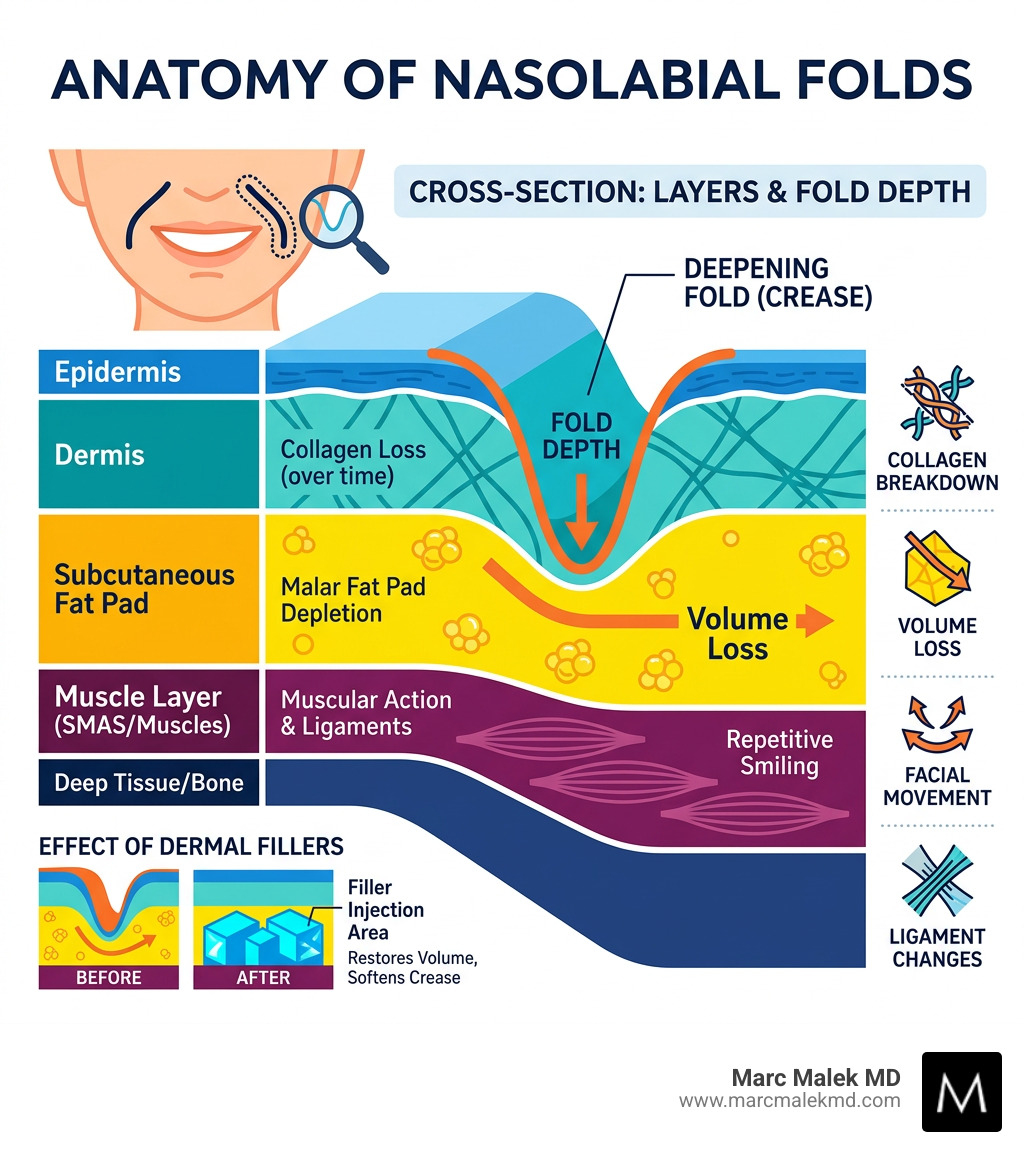
Understanding Nasolabial Folds and Their Causes
To treat a problem effectively, we first have to understand why it’s happening. Nasolabial folds are the indentations that stretch from the edge of the nose down to the corners of the mouth. While they are a natural part of human anatomy—even children have them when they smile—they tend to deepen and become “static” (visible even when the face is at rest) as we age.
Several biological factors contribute to this deepening. First and foremost is dermal aging. Over time, our bodies produce less collagen and elastin, the proteins responsible for keeping our skin firm and “bouncy.” According to scientific research on dermal aging, this depletion leads to a loss of structural integrity in the skin’s deeper layers.
Another major culprit is fat pad migration. In a youthful face, fat is distributed evenly, providing a smooth, lifted appearance to the cheeks. As the years pass, these fat pads can diminish or shift downward due to gravity. When the cheek fat slides down, it bunches up against the nasolabial line, making the fold look much deeper than it actually is.
Finally, we have to consider lifestyle and environmental factors. Photoaging—damage caused by UV rays—accelerates the breakdown of skin fibers. Repeated facial expressions, weight fluctuations, and even sleeping on your side can further etch these lines into the skin. When you combine midface volume loss with decreased skin elasticity, the nasolabial fold becomes a prominent “shadow” on the face.
How Dermal Fillers for Nasolabial Folds Restore Volume
The magic behind dermal fillers for nasolabial folds lies in a substance called hyaluronic acid (HA). HA is a sugar molecule that occurs naturally in our skin, and its primary job is to act like a sponge, attracting and binding water molecules to keep tissues hydrated and plump.
When we inject HA-based fillers into the nasolabial area, we aren’t just “filling a hole.” We are strategically restoring the hydration and structural support that has been lost. The science behind this involves the Basic Rheology of Dermal Filler, which is essentially the study of how the filler gel flows and maintains its shape under pressure. By choosing a filler with the right thickness and elasticity, we can smooth out the folds while ensuring your face still moves naturally when you laugh or talk.
Beyond the immediate “plumping” effect, these fillers also offer long-term benefits. The physical presence of the filler in the tissue can actually stimulate your body’s own collagen production. This means that even as the filler slowly breaks down over time, your skin may remain smoother than it was before the treatment. For those looking for a comprehensive approach, we often discuss these fillers as part of a broader plan for non-surgical facial rejuvenation.
Choosing the Right Dermal Fillers for Nasolabial Folds
Not all fillers are created equal. In our Scottsdale practice, we select products based on their “G-prime”—a technical term for the filler’s hardness or ability to lift tissue.
- Juvederm and Restylane: These are the industry titans. Variants like Juvederm Voluma or Restylane Lyft are often used because they provide robust support. For softer, more superficial lines, we might use Juvederm Volift or Restylane Refyne, which offer more flexibility for high-movement areas.
- Perfectha: This is another excellent option that uses E-brid technology to create a highly stable, cross-linked gel. Clinical studies show that Perfectha can maintain significant improvement for up to six months or longer, with high patient satisfaction.
- Cross-linking Technology: This refers to how the HA molecules are tied together. Higher cross-linking usually means a denser product that lasts longer, which is ideal for deep folds that need significant “lift.”
The Treatment Process: Step-by-Step Guide
If you’re new to injectables, the process is much simpler and faster than you might imagine. We prioritize your comfort and safety at every stage.

- Consultation and Marking: We start by assessing your facial anatomy in an upright position. This is crucial because gravity changes how the folds look when you’re lying down. We identify the “no-go zones,” such as areas with fat pad hypertrophy, to ensure we only add volume where it will truly soften the fold.
- Numbing: We apply a high-strength topical anesthesia to the area. Most modern fillers also have lidocaine integrated into the gel, so the area becomes further numbed as the treatment progresses.
- The Injection: Depending on your specific needs, we may use a traditional fine needle or a micro-cannula. A cannula is a blunt-tipped tool that often reduces the risk of bruising and increases safety by navigating around blood vessels.
- Placement and Depth: We typically inject into the mid-to-deep dermis. For very deep folds, we may place the filler deeper to provide a foundation, then add a softer layer more superficially to smooth out fine wrinkles.
- Massage and Review: Once the filler is placed, we gently massage the area to ensure the product is evenly distributed and looks natural. The entire procedure usually takes about 30 minutes.
Preparing for Your Dermal Fillers for Nasolabial Folds Procedure
To get the best results and minimize downtime, a little preparation goes a long way. We recommend avoiding blood-thinning medications and supplements—such as aspirin, ibuprofen, fish oil, and Vitamin E—for at least one week before your appointment. This significantly reduces the chance of bruising.
It’s also important to share your full medical history with us, including any history of cold sores, as injections can sometimes trigger a flare-up. Most importantly, come in with an open mind. Sometimes, the best way to fix a nasolabial fold isn’t by injecting the fold itself, but by adding volume to the cheeks to “lift” the skin upward.
Results, Longevity, and Safety Considerations
One of the most satisfying aspects of dermal fillers for nasolabial folds is that the results are visible almost instantly. However, it’s important to remember that what you see in the mirror immediately after treatment includes a bit of swelling.
Clinical data provides a clear picture of what to expect. According to a systematic review of filler efficacy, the average Wrinkle Severity Rating Scale (WSRS) score for nasolabial folds improves from a 3.23 (moderate-to-severe) at baseline to a 1.79 (mild) just one month after injection.
- Longevity: Most HA fillers in this area last between 6 and 18 months. Products like Juvederm Voluma can last up to 24 months in some patients, though the nasolabial area moves a lot, which can cause the filler to break down slightly faster than in static areas like the temples.
- The “Settling” Period: It takes about two weeks for the filler to fully integrate with your tissues and for all minor swelling to subside. This is when you see your true, final result.
Managing Potential Side Effects and Risks
While dermal fillers are generally very safe, they are still medical procedures. Common side effects include temporary swelling, redness, and bruising. Some patients may feel slight “lumpiness” or tenderness for a few days, but this typically resolves within a week.
Rare but serious complications, such as vascular events (where filler accidentally enters a blood vessel), require immediate medical attention. This is why choosing an experienced, board-certified professional is non-negotiable. We keep hyaluronidase—an enzyme that can instantly dissolve HA filler—on hand at all times as a safety protocol.
Comparing Fillers to Other Rejuvenation Methods
A common question we hear in Scottsdale is: “Should I get filler or Botox for these lines?” While both are amazing tools, they do very different things.
| Feature | Dermal Fillers | Botox / Neurotoxins |
|---|---|---|
| Primary Goal | Restore lost volume and “plump” | Relax muscles that cause wrinkles |
| Best For | Static lines (visible at rest) | Dynamic lines (visible during movement) |
| Mechanism | Physical gel support (HA) | Blocks nerve signals to muscles |
| Longevity | 6–18 months | 3–4 months |
| Area of Use | Nasolabial folds, cheeks, lips | Forehead, crow’s feet, frown lines |
In many cases, the best result comes from combination therapy. If your nasolabial folds are deepened by excessive muscle activity in the upper lip, a tiny bit of Botox can soften that movement, while filler addresses the volume loss. You can learn more about these differences in our guide on the difference between BOTOX and dermal fillers.
Frequently Asked Questions
How many syringes of filler are typically needed?
For most patients, 1 to 2 milliliters (usually 1 or 2 syringes) is the “sweet spot” for a noticeable but natural-looking improvement. If the folds are very deep or if we are also treating the cheeks to provide a lift, we might use up to 3 or 4 syringes. We always believe in a “less is more” approach to start—we can always add more at a follow-up appointment!
Is the procedure for nasolabial folds painful?
We do everything we can to make the experience comfortable. Between the high-strength numbing cream and the lidocaine already mixed into the filler, most patients describe the sensation as a light “pressure” or “pinching” rather than actual pain.
How soon will I see the final results?
You will see an immediate difference before you even leave our office! However, you’ll likely have some minor swelling for 24–48 hours. We tell our patients to wait a full two weeks to see the “final” integrated look, as that’s how long it takes for the HA to fully settle and hydrate the surrounding tissue.
Conclusion
At Marc Malek MD, we believe that aesthetic medicine is a blend of science and art. When treating nasolabial folds, our goal is never to “flatten” your face or make you look like a different person. Instead, we use an artistic approach to restore proportional balance, ensuring your results look natural and refreshed.
Whether you’re just starting to notice fine lines in your 30s or looking to address deeper creases in your 50s and beyond, we are here to guide you. Our Scottsdale practice is dedicated to patient comfort and delivering long-lasting results that help you look as young as you feel.
Ready to see what a difference a little volume can make? Start your journey with Dermal Fillers and Injections by scheduling a consultation with us today. We look forward to helping you achieve your aesthetic goals with safety and precision.