
Surgical Hair Replacement and What to Expect
What Is a Hair Transplant and How Does It Work?
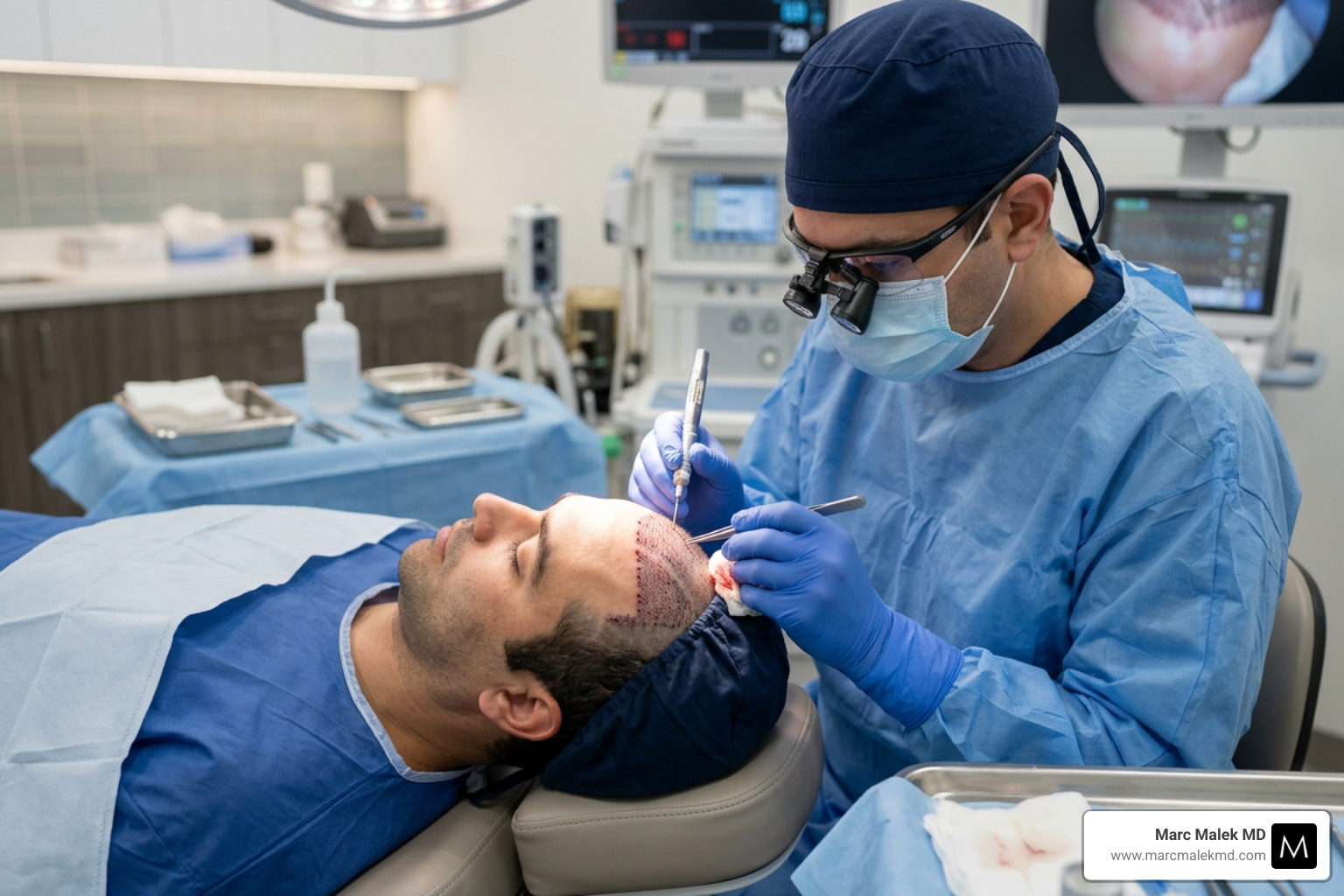
A hair transplant is a surgical procedure that moves healthy, permanent hair follicles from one part of your scalp (the donor zone) to areas where hair has thinned or stopped growing altogether.
Here’s a quick overview of what to know:
- What it treats: Male and female pattern baldness, thinning hair, scarring, and receding hairlines
- How it works: Follicles are harvested from a donor area (usually the back of the scalp) and implanted into balding areas
- Main techniques: FUE (Follicular Unit Extraction) and FUT (Follicular Unit Transplantation/Strip method)
- Results timeline: New growth begins around 4 months; full results visible in 10-18 months
- Permanence: Transplanted hair is designed to be permanent, as donor follicles are resistant to the hormones that cause baldness
- Ideal candidates: Adults with stable, well-defined hair loss patterns and adequate donor density
Losing your hair can feel deeply personal. It affects how you see yourself in the mirror and how confident you feel walking into a room. The good news is that modern hair restoration has come a long way from the obvious, unnatural-looking “hair plugs” of decades past.
Today’s techniques are precise, minimally invasive, and built to produce natural results — results that blend seamlessly with your existing hair.
But hair transplant surgery is still a significant decision. It requires careful planning, the right candidacy, and realistic expectations about what it can and cannot achieve.
This guide walks you through everything you need to know — from how the procedure works, to recovery, costs, risks, and whether you’re a good candidate.
Understanding the Hair Transplant Procedure and How It Works
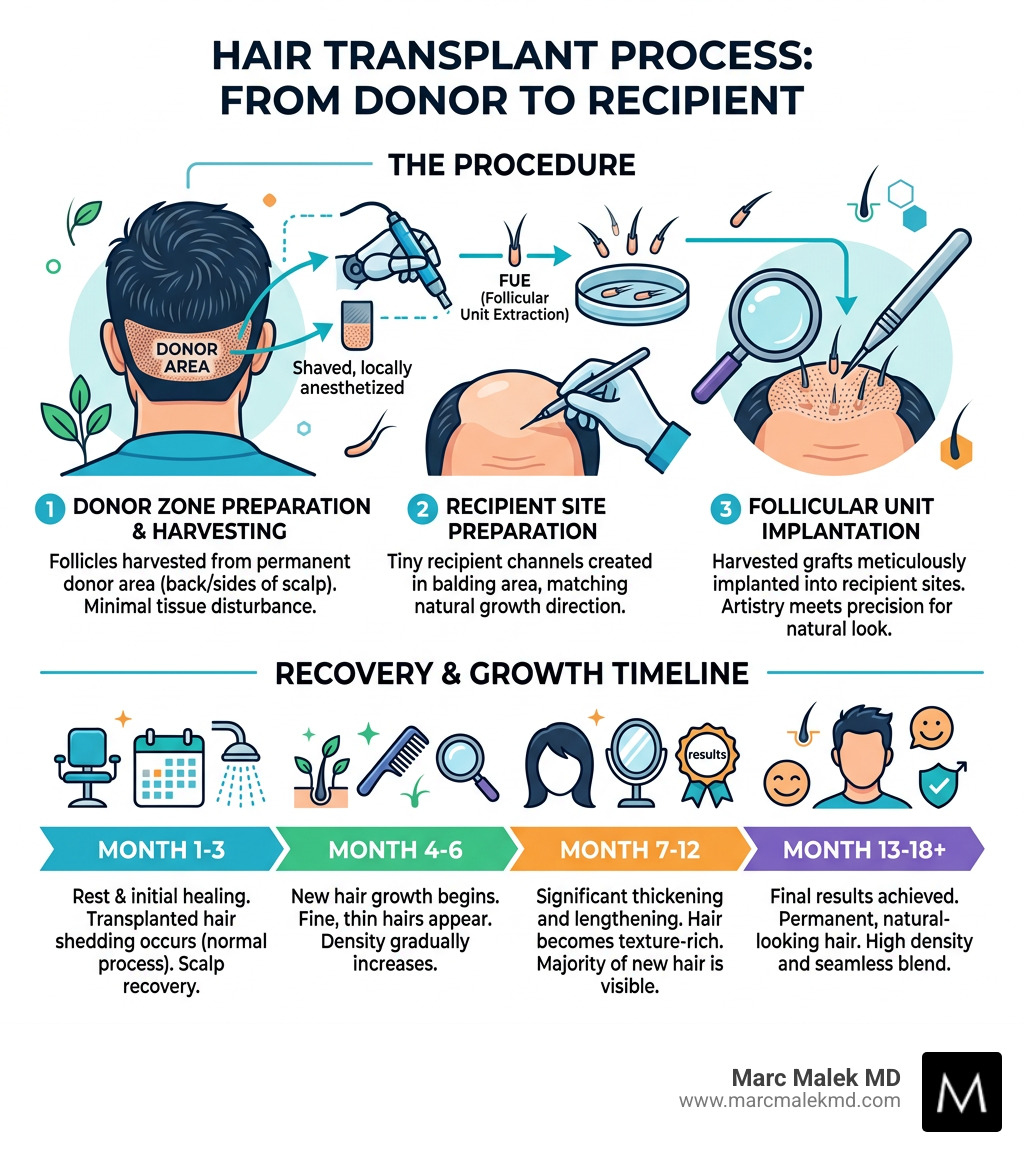
To understand how a hair transplant works, we first have to look at the biology of your scalp. The average human scalp contains between 100,000 and 150,000 hair follicles. In most cases of pattern baldness, the hair on the top and front of the head is sensitive to dihydrotestosterone (DHT), a hormone that causes follicles to shrink and eventually stop producing hair.
However, hair at the back and sides of the head—the “occipital scalp”—is genetically programmed to be resistant to DHT. This is known as “donor dominance.” When we move these hardy follicles to a bald area, they retain their resistance and continue to grow hair for a lifetime.
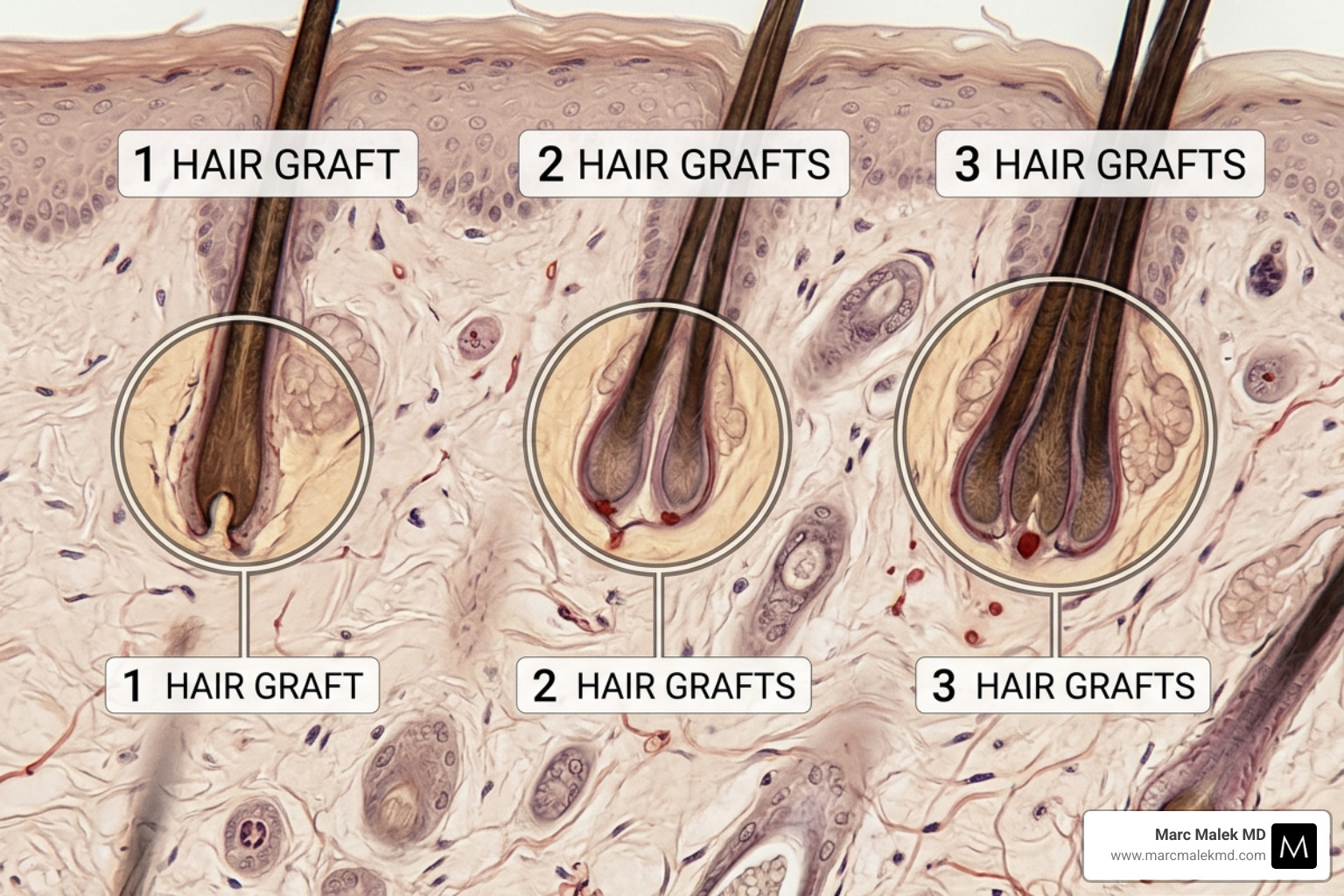
Each hair grows in a natural grouping called a “follicular unit,” which typically contains one to four terminal hairs, a sebaceous gland, and a tiny muscle. During a Scientific overview of hair transplantation, we focus on preserving these units to ensure the highest possible graft survival.
At any given time, about 90% to 95% of your scalp hairs are in the anagen (growing) phase. By carefully selecting follicles in this healthy phase, we can ensure that the transplanted hair thrives in its new home.
The Evolution of the hair transplant: From Plugs to FUE
If you’ve ever seen someone with “doll’s hair” or “hair plugs” from the 1970s or 80s, you’ve seen the results of old-school punch grafts. These were large circles of skin containing 10 to 15 hairs. They worked, but they looked obvious and often left circular scars.
Other older methods included:
- Scalp Reduction: We would literally remove a section of bald skin and stretch the hair-bearing skin to cover the gap.
- Flap Surgery: This involved moving a large “flap” of hair-bearing skin while keeping it attached to its original blood supply.
- Tissue Expansion: Primarily used for burns or reconstructive surgery, a balloon-like device was inflated under the scalp to stretch the skin over several weeks.
Thankfully, we have moved toward much more refined Evidence-based guidelines for alopecia treatment. Modern restoration uses micro-grafts (1-2 hairs) and follicular units to mimic the way hair grows naturally. We no longer just “fill a hole”; we artistically recreate a hairline.
Modern Harvesting: FUE vs. FUT
In our Scottsdale and Phoenix offices, we primarily discuss two modern harvesting methods:
- FUT (Follicular Unit Transplantation): Also called the “strip method,” this involves removing a thin strip of skin (usually 1 to 1.5 cm wide) from the donor area. Our team then uses high-powered microscopes to divide that strip into 500 to 2,000 tiny grafts. While it does leave a thin linear scar, it often allows for a higher number of grafts in a single session.
- FUE (Follicular Unit Extraction): This is the “gold standard” for those who want to avoid a linear scar. We use a micro-punch tool (0.6mm to 1.0mm in diameter) to extract individual follicular units one by one. This is ideal for patients who like to wear their hair short.
FUE vs. FUT Comparison Table
| Feature | FUE (Extraction) | FUT (Strip Method) |
|---|---|---|
| Scarring | Tiny dot scars (hardly visible) | Thin linear scar |
| Recovery Time | Fast (usually 3-5 days) | Moderate (2-3 weeks) |
| Graft Yield | Selective extraction | High volume in one strip |
| Ideal For | Short hairstyles | Advanced hair loss |
| Transection Rate | Slightly higher (target <5%) | Very low due to microscopy |
Modern advancements also include robotic assistance, like the ARTAS system, which uses algorithms to identify and harvest the best grafts, further reducing human error and transection (accidental damage to the follicle).
Determining If You Are an Ideal Candidate for Hair Restoration
Not everyone with hair loss is a good candidate for a hair transplant. To achieve those “wow” results we strive for at Marc Malek MD, we need two things: a stable pattern of loss and a healthy “bank” of donor hair.
We use the Hamilton-Norwood scale for men and the Ludwig classification for women to determine the extent of your loss. Generally, patients have lost about 50% of their native hair before the loss becomes noticeable to the naked eye. This is often the threshold where we begin considering surgery.
According to Research on patient selection and candidacy, the “safe donor zone” in the mid-occipital region typically contains 65 to 85 follicular units per square centimeter.
- Excellent Candidates: Donor density over 80 units/cm².
- Less Suitable: Densities below 40 units/cm².
We also look at scalp laxity (how stretchy your skin is) and your hair’s characteristics—thick, wavy hair provides much better coverage than thin, straight hair.
Contraindications and Suitability Factors
There are times when we might advise against a hair transplant. For example:
- Alopecia Areata: This is an autoimmune condition where the body attacks the hair. Since the problem is the immune system, not the follicle, a transplant won’t help.
- Diffuse Unpatterned Alopecia (DUPA): If you are thinning everywhere, including the back and sides, we don’t have a “safe” donor zone to pull from.
- Active Cicatricial (Scarring) Alopecia: Conditions like Lichen Planopilaris must be inactive for at least two years before we consider surgery.
- Age: We generally recommend waiting until at least age 25. Hair loss patterns are unpredictable in younger men, and we don’t want to place hair in a way that looks unnatural as the rest of your hair recedes.
Clinical significance of hair distribution shows that a conservative design is always better than an aggressive one that looks odd ten years down the road.
The Step-by-Step Guide to Surgical Hair Replacement
When you visit us in Scottsdale for your procedure, here is exactly what the day looks like:
- Preparation & Design: We start with preoperative trichoscopy (a high-tech scalp exam) and final hairline marking. We design the hairline to be irregular and “random” because nature never grows hair in a perfectly straight line.
- Anesthesia: We use local anesthesia (like Lignocaine or Bupivacaine) to numb the donor and recipient sites. Most patients find this is the only slightly uncomfortable part—after that, you can relax and watch a movie or listen to music.
- Harvesting: Whether we are doing FUE or FUT, the grafts are carefully removed. We use a chilled saline medium to keep the follicles “alive” and hydrated while they are outside your body.
- Recipient Site Creation: This is where the artistry happens. We create tiny “slits” or holes in the balding area at specific angles (usually 15° to 20° at the hairline) to match your natural growth pattern.
- Implantation: Our technicians meticulously place the grafts into the sites. We handle them only by the surrounding tissue to avoid damaging the delicate bulb.
What to Expect During Your hair transplant Recovery
The first few days after your hair transplant are about protection. You might experience some “postoperative edema”—fancy doctor talk for forehead swelling. This is normal and usually peaks on day three.
The Recovery Timeline:
- Days 1-3: Spray the grafts with saline every 2-3 hours to keep them moist. Sleep with your head elevated 15° to 30°.
- Days 5-7: You can start gentle washing (no rubbing!). This is also when we often recommend starting More info about PRP hair restoration to boost healing.
- Weeks 2-4: “Shock loss” occurs. Don’t panic! The transplanted hair shafts fall out, but the follicles stay behind and go into a resting phase.
- Months 4-6: New, fine hairs begin to sprout.
- Months 12-18: The hair thickens and matures into your final result.
Potential Risks and the Cost of a hair transplant
Every surgery has risks, though hair transplant complications are rare when performed by an experienced team. Potential issues include:
- Folliculitis: Small “pimples” or inflammation around the grafts.
- Shock Loss: Temporary thinning of your existing (native) hair due to the trauma of surgery.
- Scarring: While FUE minimizes this, keloid-prone individuals need to be cautious.
According to the Expert consensus on hair transplant care, following post-op instructions is the best way to prevent recipient site necrosis or infection.
The Cost Factor: In the United States, and specifically in the Scottsdale/Phoenix area, a hair transplant typically costs between $4,000 and $15,000. This varies based on:
- The number of grafts needed (often priced at $3 to $10 per graft).
- The technique used (FUE is generally more expensive than FUT).
- The expertise of the surgeon.
This is a permanent investment in your appearance. Choosing a clinic based solely on the lowest price can lead to unnatural results that are very expensive to “fix” later.
Non-Surgical Alternatives for Hair Loss
Not everyone is ready for the “big leap” into surgery. We often use non-surgical treatments either as a standalone solution or to support a transplant.
- PRP (Platelet-Rich Plasma): We draw your blood, spin it in a centrifuge to concentrate the growth factors, and inject it into the scalp. It’s like “fertilizer” for your hair. More info about non-surgical hair restoration can be found on our specialized PRP page.
- Minoxidil & Finasteride: These remain the FDA-approved “gold standards” for maintaining existing hair.
- Adenosine Complex: Newer Research on hair thickness growth suggests that adenosine can inhibit androgen receptor signaling, helping to thicken existing hair.
- Low-Level Light Therapy (LLLT): Laser caps or combs can stimulate blood flow to the follicles.
Frequently Asked Questions about Hair Restoration
Are hair transplant results permanent?
Yes! Because the donor hair is taken from the back of the head—an area resistant to the hormones that cause balding—the transplanted hair is designed to grow for the rest of your life. However, keep in mind that your original hair around the transplant may continue to thin, which is why we often recommend maintenance treatments like PRP.
How much does a hair transplant cost on average?
In our region, you can expect to pay anywhere from $4,000 to $15,000. We provide an exact quote during your personalized consultation after we determine how many grafts are needed to meet your goals.
When can I return to work after the procedure?
Most of our patients return to desk jobs within 24 to 48 hours. If your job involves heavy lifting or strenuous activity, we recommend taking one full week off to protect the new grafts.
Conclusion
At Marc Malek MD, we believe that a hair transplant is more than just a medical procedure—it’s an artistic restoration of your identity. Dr. Malek’s personal and artistic approach ensures that every hairline we design is proportionally balanced and looks completely natural for your face shape and age.
Whether you are just starting to notice thinning or are ready for a full transformation, we are here to guide you through every step with comfort and transparency. If you’re ready to see what’s possible, Schedule a consultation for hair restoration with PRP or a surgical evaluation at our Scottsdale office today. Let us help you look as young and vibrant on the outside as you feel on the inside.