

Why Men Are Turning to Abdominal Etching for Defined Abs
Male abdominal etching is a specialized liposuction technique that sculpts fat around your abdominal muscles to create a more defined, athletic six-pack appearance. Unlike traditional liposuction that simply removes fat, this procedure artfully carves out the natural lines and contours of your abs—even if diet and exercise haven’t gotten you there.
Key Facts About Male Abdominal Etching:
- What it is: A surgical procedure using targeted liposuction to highlight existing abdominal muscles
- Who it’s for: Men already in good shape (typically under 20% body fat) who can’t achieve visible ab definition
- Procedure time: 1-2 hours, usually outpatient
- Recovery: Return to work in 1 week, exercise in 2-4 weeks
- Cost: $7,000-$13,000 depending on location and surgeon experience
- Results: Permanent fat removal with 98% patient satisfaction rate
- Not for: Weight loss, poor muscle tone, or high body fat percentages
Sometimes, despite regular workouts and a balanced diet, the abdominal muscles remain stubbornly concealed underneath a layer of excess fat. It’s frustrating—you put in the work at the gym, but your abs refuse to show. This is where abdominal etching comes in as a solution for men who are already fit but genetically predisposed to storing fat in their midsection.
First introduced in the 1990s by Dr. Henry Mentz, the technique has evolved significantly. Modern methods like VASER and power-assisted liposuction now offer more precise sculpting with better skin tightening. The average patient is 36 years old with a BMI around 26.7—active individuals who simply need that final step to reveal the muscle definition they’ve worked hard to build.
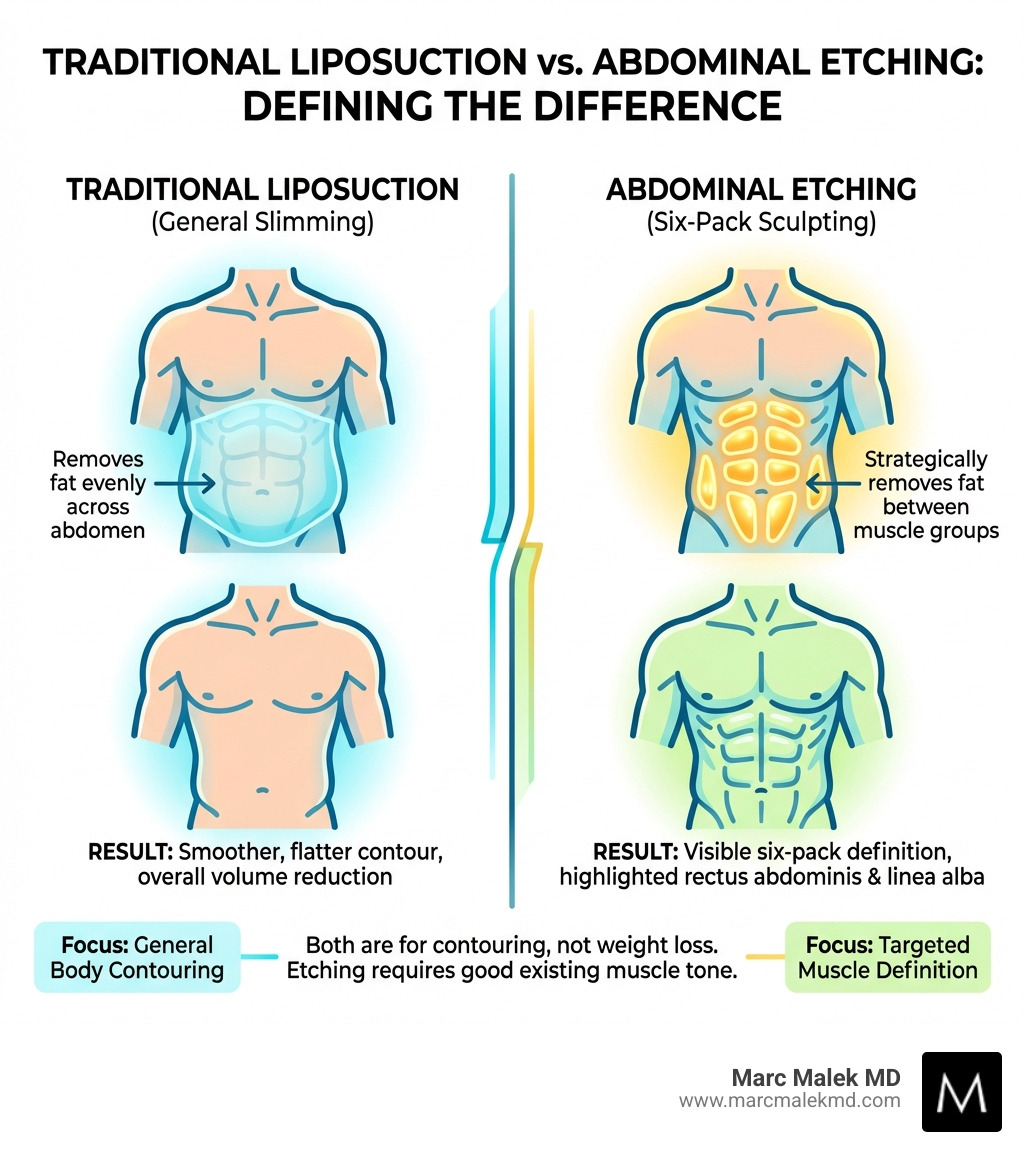
What is Abdominal Etching and How Does It Work?
In plain terms, abdominal etching is liposuction with a sculptor’s mindset. Instead of thinning fat evenly across the belly, we strategically remove (and sometimes leave a whisper of) fat along the natural lines of your abs to bring your six-pack into crisp focus.
- Liposuction vs. liposculpture: Traditional lipo reduces volume. Etching is liposuction used artistically to define anatomy.
- Sculpting existing muscle: We do not “create” muscles—your rectus abdominis, linea alba, semilunar lines, and tendinous inscriptions are revealed by shaping the fat that sits above them.
- Not a weight-loss tool: It’s a finishing touch for fit patients, not a substitute for cardio, clean eating, or core work.
History and evolution:
- The concept emerged in the early 1990s and has matured with high-definition techniques.
- Today we often use technologies like VASER (ultrasound-assisted liposuction) and PAL (power-assisted liposuction) to improve precision and reduce trauma to surrounding tissues.
- For men, the aesthetic aim is a sharper “six-pack” with pronounced vertical and horizontal lines (and often the lower “V” lines). For women, a softer, three-vertical-line look is typical. These goals are supported by professional guidance and outcomes discussed by the American Society of Plastic Surgeons.
Want to understand how standard body contouring compares? See our overview of Liposuction.
Are You a Candidate? The Benefits of a Sculpted Midsection
Who benefits most from male abdominal etching? The sweet spot is men who live a healthy lifestyle and have good core tone but still carry a slim, stubborn layer of fat that blurs definition.
From the largest published outcomes we have:
- Average patient age: about 36 years
- Average BMI: about 26.7
- In a study of 50 patients, 98% reported satisfaction, with follow-up averaging 27 months
- Procedure length: typically 1–2 hours
- Recovery: most return to work in around a week; full recovery is typically 4–6 weeks
- Minor complications reported included seromas (~10%) and contour irregularities (~12%) in that cohort
Source: Abdominal Etching: Surgical Technique and Outcomes (PubMed) and a professional society summary of that work.
Beyond numbers, there’s the “why”:
- Physical benefits: Sharper abdominal definition and a more athletic silhouette.
- Psychological benefits: Confidence tends to rise when your exterior reflects the work you put in. Many men tell us they simply feel “finished.”
- Social media influence: We’d be remiss not to note that social platforms have made visible abs a common goal, which can nudge already-fit men to explore a safe, surgical finishing touch—provided expectations are realistic and lifestyle is stable.
Key benefits of abdominal etching:
- Accentuates your natural abs rather than fabricating an artificial look
- Quick procedure with relatively straightforward recovery
- Permanent removal of etched fat cells
- Can be customized (subtle to pronounced) to match your style and anatomy
Ideal Candidates for Male Abdominal Etching
You’re likely a strong candidate if you:
- Are already in good shape with a stable weight and visible or palpable abdominal muscle tone
- Typically have body fat under about 20%
- Live a healthy lifestyle (nutrition, training, sleep) and can maintain it
- Do not smoke (or can stop well before and after surgery)
- Want a permanent improvement in definition, not a weight-loss shortcut
- Have realistic expectations for what surgical contouring can achieve
Considering options to address the midsection more broadly? Explore our Liposuction for Men gallery for real-world inspiration.
Who Should Avoid Abdominal Etching?
We’ll help you decide candidacy during consultation, but in general:
- If your body fat is above about 20%, you may need staged treatments or a different plan first.
- If your primary issue is excess skin or significant laxity (after weight loss, for example), abdominal etching alone won’t address that—skin-tightening or a tummy tuck may be more appropriate.
- Visceral fat (the kind beneath the abdominal muscles) cannot be removed with liposuction; this is managed with lifestyle and medical care.
- If you’re chasing a trend or expecting “gym-free” abs forever, the results may not be satisfying. Healthy habits still matter.
The Male Abdominal Etching Procedure: From Consultation to Sculpted Abs
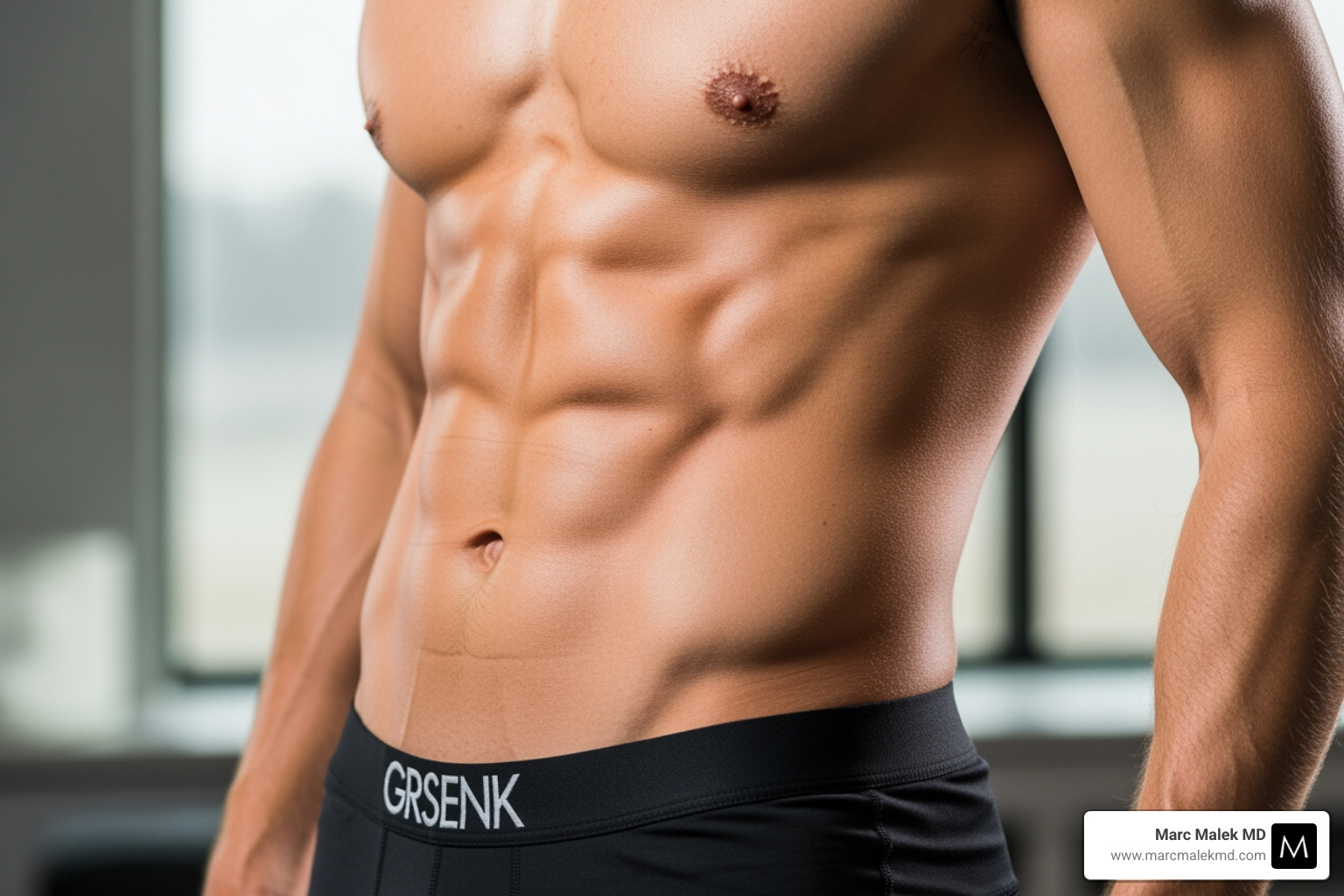
What to expect with us in Scottsdale and Phoenix:
Consultation and planning:
- We review health history, body composition, and goals.
- With you standing and flexing lightly, we mark the natural lines: the midline (linea alba), semilunar lines, and the tendinous inscriptions that form the “six.”
- We discuss whether you prefer a subtle athletic look or a show-ready six-pack and tailor accordingly.
Anesthesia and incisions:
- Abdominal etching is an outpatient procedure. Depending on your plan, we may use local anesthesia with sedation or general anesthesia to keep you comfortable.
- Tiny incisions are placed in natural creases or along lines we’ll etch, so scars are discreet.
Technique and sculpting:
- We infiltrate tumescent fluid to minimize bleeding and facilitate gentle fat removal.
- Using fine cannulas (often with power assistance or ultrasound energy), we precisely remove fat in the superficial plane where definition lives.
- We sculpt along the linea alba, semilunar lines, and tendinous inscriptions, and we preserve a thin layer of fat where highlights are desired—this contrast creates that crisp, natural definition.
- Typical surgical time is 1–2 hours.
What about volumes and blood loss?
- In published series of 50 patients, average tumescent infiltration was around 6 liters, average lipoaspirate about 5 liters, and average blood loss approximately 275 ml. These numbers vary by patient size and goals and are provided here to give you a sense of scale, not a target for every case. Reference: PubMed outcomes study.
Combination procedures:
- Many men pair etching with chest contouring, pectoral definition, or lower chest/axillary liposuction for a cohesive upper-body change.
- Some combine with selective trunk or flank liposuction to improve the abdominal “frame.”
- Considering broader male contouring? See our page for Gynecomastia surgery and related male procedures.
Recovery and Long-Term Results
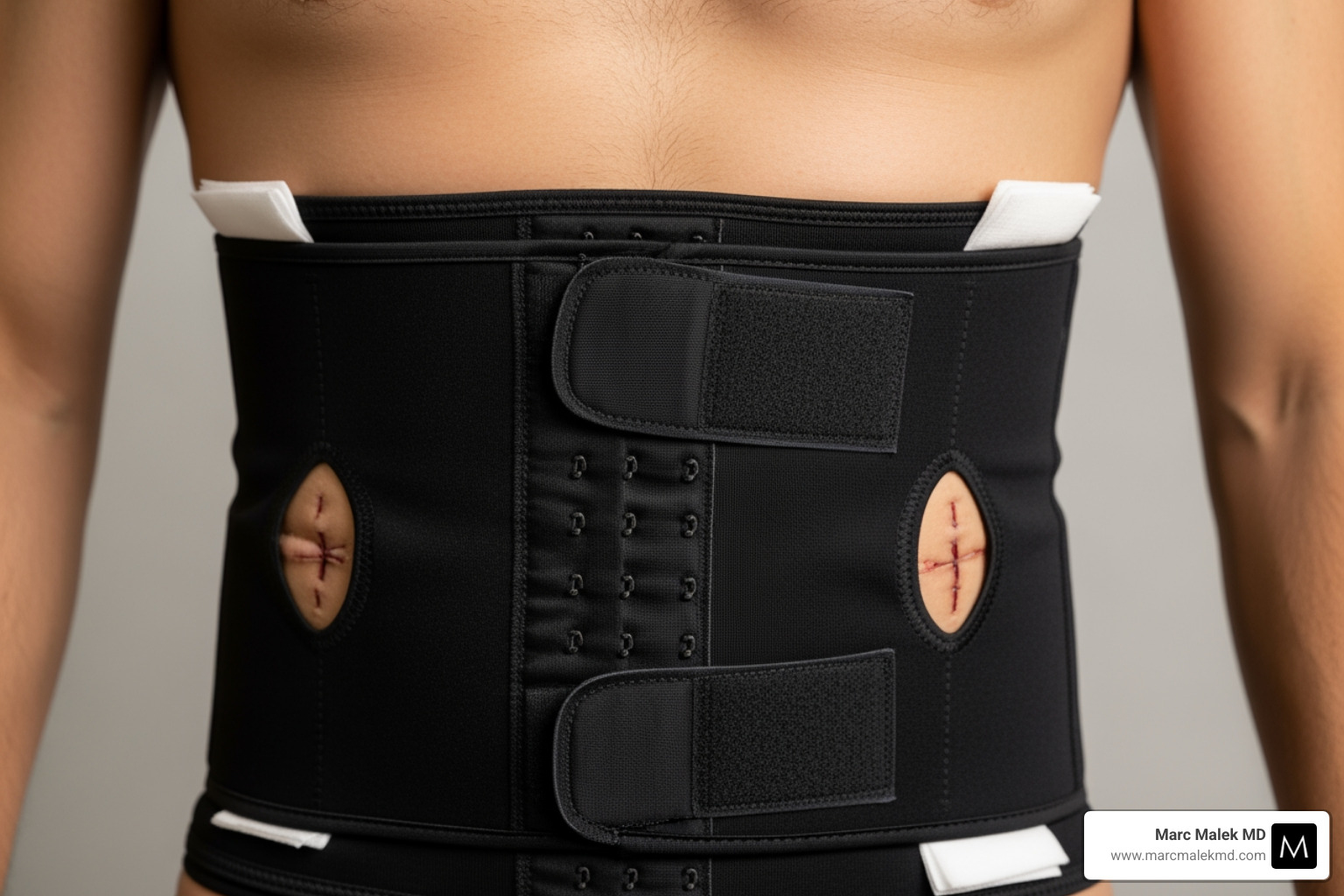
Immediate post-op:
- Expect swelling, tightness, and soreness for several days. We’ll review medications and guidelines in detail.
- We apply dressings and a compression garment to support your new contours and reduce swelling.
Compression and activity:
- A typical plan includes near-continuous compression for the first couple of weeks, then part-time for another few weeks, depending on our intraoperative findings and your healing.
- Many patients return to desk work in about a week.
- Light, non-core exercise often resumes around 2–4 weeks; more rigorous training typically at 4–6 weeks, depending on comfort and healing.
Results timeline:
- You’ll see early definition as swelling eases in the first few weeks.
- Expect your abs to sharpen progressively over 3–6 months as swelling resolves and tissues contract.
- Results are designed to last—once fat cells are removed, they don’t regenerate. Stable weight is key.
Risks and complications:
- In the 50-patient study referenced above, there were no major complications like DVT, fat embolus, or abdominal injuries. Minor complications included seromas (~10%), contour irregularities (~12%), and temporary hyperpigmentation (~2%). These are treatable and we follow you closely to address any issues early.
- Our team is proactive about seroma detection and management, and we’ll outline scar care and skin hygiene to minimize irritation and pigment changes.
- Source: Abdominal Etching: Surgical Technique and Outcomes (PubMed) and ASPS summary.
Maintaining Your Male Abdominal Etching Results
- Permanence: The etched fat cells are gone for good. However, remaining fat cells can enlarge with weight gain, softening definition.
- Lifestyle: Continue an active routine with strength training and conditioning, prioritize protein and balanced nutrition, and maintain sleep and stress management for sustainable results.
- Long-term satisfaction: With a stable lifestyle, men often report long-lasting satisfaction (98% in a key outcomes series). Reference: PubMed outcomes study.
If lax skin or separated abdominal muscles are your primary concerns (common after significant weight change), a tummy tuck may be more appropriate than etching. Explore our Tummy Tuck for Men gallery to see how skin removal and muscle repair differ from fat sculpting.
Key Considerations: Costs, Risks, and Choosing Your Surgeon
Costs in Scottsdale and Phoenix:
- Typical range for abdominal etching is about $7,000–$13,000. Your personalized quote depends on the complexity of sculpting, anesthesia choice, any combined procedures, and facility fees.
- We provide transparent estimates after examining your anatomy and goals during consultation.
Risks to consider:
- Expected, manageable effects: swelling, bruising, temporary numbness, soreness.
- Treatable minor risks: fluid collections (seromas), contour asymmetries, temporary skin discoloration.
- Rare but serious events: blood clots, infection, or anesthetic reactions. We reduce risks through careful screening, meticulous technique, and close follow-up.
Choosing the right surgeon:
- Board certification in plastic surgery and membership in reputable professional societies signals rigorous training and commitment to safety.
- Look for experience in male body contouring and an artistic, individualized approach to high-definition work.
- Review before-and-after photos of cases similar to yours and ask how often your surgeon performs male etching specifically.
- Our practice in Scottsdale and Phoenix focuses on thoughtful planning, precision sculpting, and a healthy-lifestyle mindset for long-lasting results that look like you—at your best.
Frequently Asked Questions about Male Abdominal Etching
Is abdominal etching painful?
You’ll feel soreness and tightness, particularly in the first week, but we manage discomfort with a multi-modal plan. Many patients describe it as “intense ab-day soreness plus bruising” rather than sharp pain. We’ll discuss anesthesia options (local with sedation or general anesthesia) to keep you comfortable during the procedure and tailor post-op pain control to your needs.
Will I have noticeable scars?
We place tiny incisions in natural creases or within the etched lines to keep them discreet. Early on, scars can look pink; they generally fade over months. We’ll guide you through incision care and best practices (silicone therapy, sun protection, massage as indicated) to help them mature well.
Is abdominal etching better than a tummy tuck?
They do different jobs:
- Abdominal etching is ideal for defining muscles by sculpting fat in patients with decent skin tone and minimal laxity.
- A tummy tuck removes excess skin and can repair separated abdominal muscles (diastasis), typically after major weight change or pregnancy.
To understand ab etching vs. skin removal, read our overview comparing techniques: Comparing the Full and Mini Tummy Tuck.
If you’re still deciding between options, you can also review our Tummy Tuck page for a deeper dive into indications and recovery.
Take the Next Step Towards a Defined Physique
Here’s the bottom line:
- Male abdominal etching is a precision technique for already-fit men who want their hard-earned abdominal muscles to show.
- It’s not a shortcut to fitness. Lifestyle matters before and after surgery.
- Outcomes are customizable—from refined athletic definition to a more dramatic six-pack—and long-lasting with stable weight.
- Safety and artistry go hand-in-hand: choose a surgeon who understands both anatomy and aesthetics and performs male etching regularly.
We bring a personal, artistic approach to each case and focus on your comfort, convenience, and long-term health. If you’re in Scottsdale or Phoenix and ready to see whether etching or another body-contouring option fits your goals, let’s talk.
Schedule a consultation to explore your options and create a plan that matches your physique and lifestyle: Schedule your consultation for body contouring
For more on surgical body contouring, visit our pages on Liposuction, Liposuction for Men, and Tummy Tuck for Men.
References for outcomes and technique: