

Understanding Scars and the Promise of Dermarolling
Dermaroller for scars is a minimally invasive treatment using tiny needles to create controlled micro-injuries in the skin. This process triggers your body’s natural healing to produce new collagen and gradually smooth out scar tissue.
Quick Answer: How Dermarollers Help Scars
- What it does: Creates microscopic punctures that stimulate collagen production
- Types of scars treated: Acne scars, surgical scars, stretch marks (not keloids)
- Needle length: 0.5mm-1.5mm depending on scar depth
- Results timeline: Visible improvement in 2-3 sessions; permanent results after 6 months
- Frequency: Every 10-14 days (1.0mm) or every 3-4 weeks (1.5mm)
- Success rate: Studies show over 94% of patients achieve scar reduction by one or two grades
Scars from acne, injuries, or surgery can affect both appearance and confidence. If you’ve struggled with textured skin that makeup and creams can’t fix, you’re not alone.
The good news is that a treatment exists that works with your skin’s natural healing abilities. Clinical studies show that over 80% of patients rate their dermaroller treatment results as “excellent” for reducing scar appearance.
Dermarolling, also known as microneedling, is a simple process. A handheld device with fine needles rolls across the skin, creating thousands of tiny channels. This awakens the body’s repair system, triggering fresh collagen and elastin production at the scar site.
This approach doesn’t just mask the problem; it remodels the skin from within, breaking down old scar tissue and building new, healthy tissue in its place.
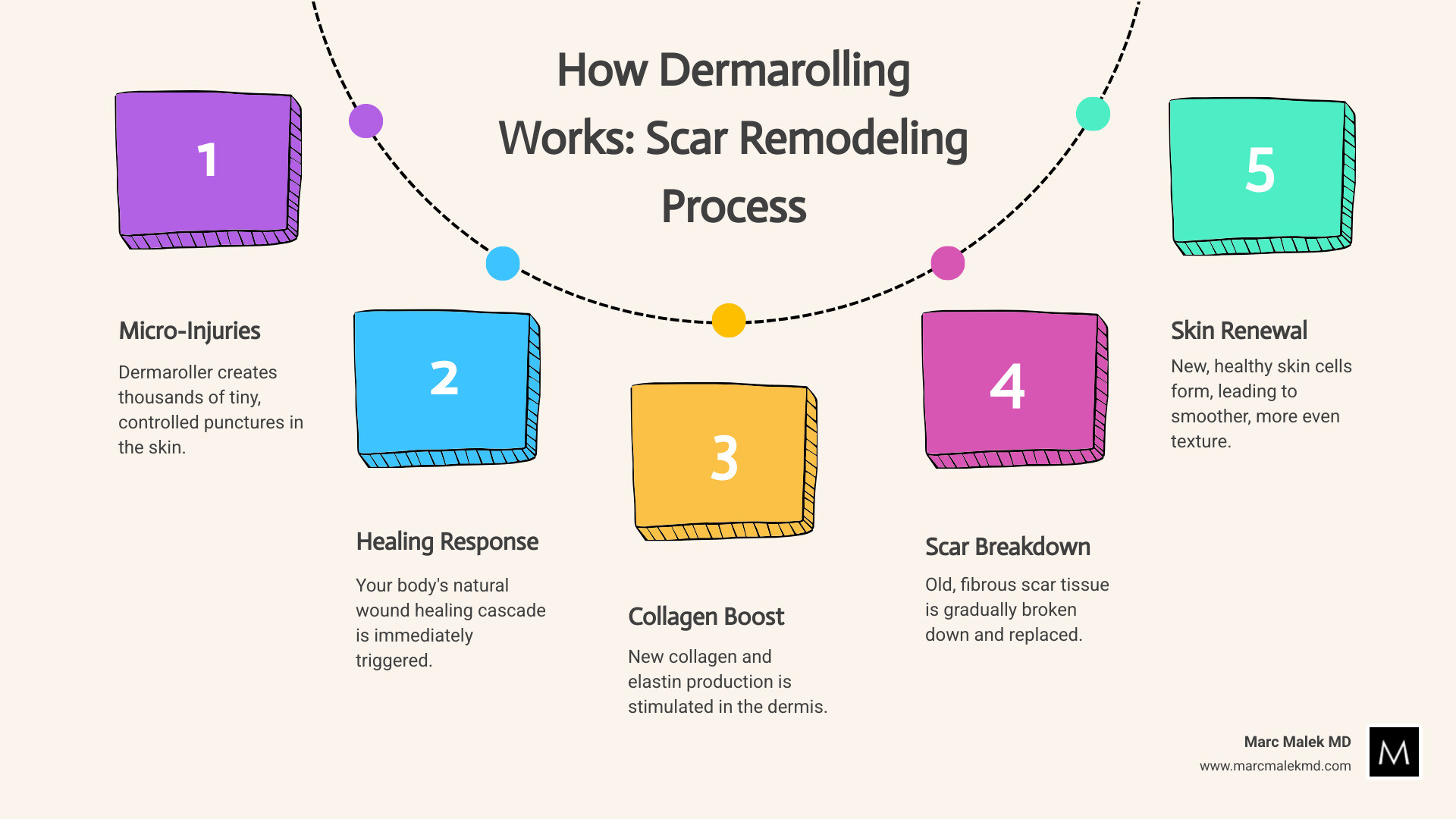
Dermaroller for scars terminology:
The Science of Skin Remodeling: How Dermarolling Works
At its core, dermarolling leverages the body’s natural wound healing response to improve skin texture. This principle is known as Collagen Induction Therapy (CIT).
When the tiny needles penetrate the skin, they create microscopic punctures that initiate a wound healing cascade:
- Inflammation: The skin releases growth factors, attracting cells that clean the area and prepare it for repair.
- Proliferation: Fibroblasts are stimulated to produce new collagen (neocollagenesis) and elastin, the proteins that give skin structure and firmness. New blood vessels also form, improving nutrient delivery.
- Remodeling: Over weeks and months, the new collagen matures and rearranges, strengthening the skin’s structure. This fresh collagen fills in depressed scars and smooths uneven skin.
Dermarolling also helps break down old, disorganized scar tissue, encouraging its replacement with healthier cells. Another key benefit is increased product absorption. The micro-channels allow topical serums to penetrate deeper, amplifying their effects. Research confirms this mechanism improves the transdermal delivery of various substances https://www.ncbi.nlm.nih.gov/pmc/articles/PMC4976400/.
What are the benefits of using a dermaroller for scars?
The appeal of using a dermaroller for scars lies in its impressive benefits:
- Reduced Scar Appearance: By stimulating new collagen, dermarollers fill in depressed scars. Studies show over 94% of patients achieve a reduction in scar severity, with over 80% rating their results as ‘excellent’.
- Improved Skin Texture: Increased collagen leads to an overall improvement in skin texture, making it feel softer and look smoother.
- Cost-Effective Solution: Compared to treatments like laser resurfacing, dermarolling can be a more affordable option, especially for at-home use.
- Minimal Downtime: While some redness is common, most people can return to normal activities within a day or two.
- Safe for Many Skin Types: Dermarolling is considered safe for various skin tones, including darker skin, which can have a higher risk of hyperpigmentation with some laser treatments.
- Improved Product Absorption: The micro-channels significantly improve the absorption of topical serums and creams.
The History and Principles of Collagen Induction Therapy
The concept of using needles for skin healing is not new. In 1995, Dr. Orentreich’s “subcision” used a needle to break up scar tissue. This was followed by “needle dermabrasion” in 1997. However, it was Dr. Desmond Fernandes who popularized percutaneous collagen induction therapy (PCI) in 2006. He showed that controlled micro-injuries could stimulate collagen production without significant epidermal damage, establishing microneedling as a recognized dermatological procedure https://pubmed.ncbi.nlm.nih.gov/18088764/. The underlying principle remains the same: controlled injury triggers a healing cascade, leading to the synthesis of new collagen and elastin, which remodels scar tissue from within.
Your Practical Guide to Using a Dermaroller for Scars
Using a dermaroller for scars correctly is key to success. The goal is to support your skin’s natural healing, which requires targeted treatment, patience, and realistic expectations.
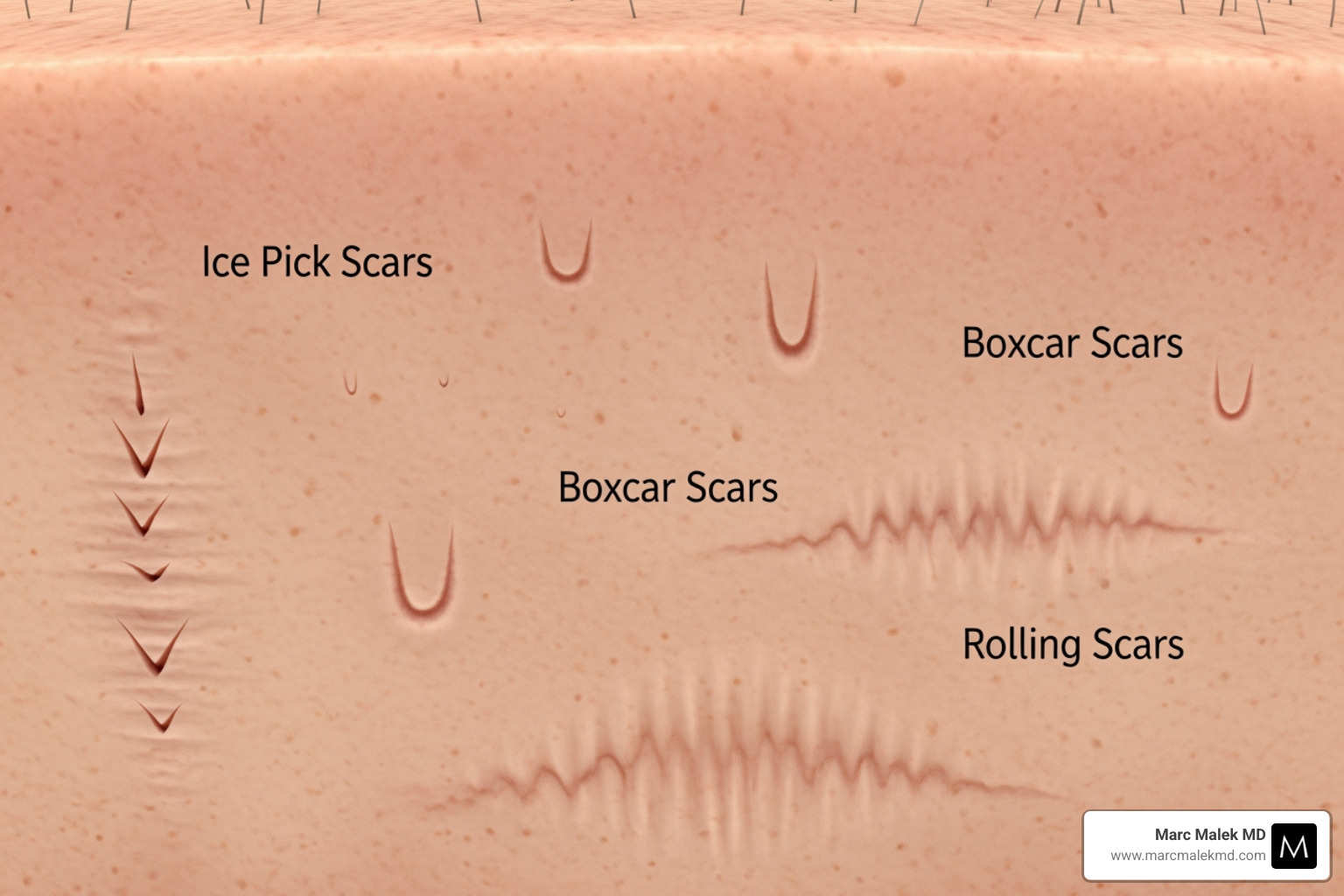
What Types of Scars Can Dermarollers Treat?
Dermarollers are most effective for atrophic (depressed) scars where tissue has been lost.
- Acne Scars: Works well on rolling scars (wave-like depressions), boxcar scars (round depressions with sharp edges), and shallow ice pick scars.
- Surgical Scars: Can improve the texture of mature, non-raised surgical scars.
- Stretch Marks (Striae): Stimulates collagen to improve their color and texture.
- Varicella Scars: The depressed scars left by chickenpox.
Dermarollers are not recommended for raised scars like keloids or hypertrophic scars, as microneedling could worsen them.
What is the Recommended Needle Length for Treating Different Scars?
Choosing the correct needle length is crucial for safe and effective treatment.
- 0.5mm: Best for enhancing product absorption and treating very minor textural issues.
- 1.0mm: Ideal for shallow acne scars and noticeable texture issues.
- 1.5mm: Suited for deeper acne scars, surgical scars, and significant stretch marks.
- Body vs. Face: For at-home facial use, stick to 1.5mm or less. Longer needles are for professional use only.
If you’re new to dermarolling, start with a shorter needle length (e.g., 0.5mm) and gradually increase as your skin builds tolerance. For a deeper dive, you can consult a scientific review on needle depths https://academic.oup.com/asj/article/37/1/71/2705996.
Proper Technique for Using a Dermaroller for Scars at Home
Mastering the proper technique is vital for safety and efficacy.
-
Preparation:
- Cleanse Skin: Start with a thoroughly cleansed and dry face.
- Disinfect Skin (Optional): For needles over 0.5mm, wipe the area with 70% isopropyl alcohol.
- Numbing Cream (Optional): For needles 1.0mm or longer, apply a topical numbing cream 30-45 minutes prior, wiping it off completely before rolling.
-
The Rolling Technique:
- Section Your Face: Work in small sections (forehead, cheeks, chin).
- Gentle Pressure: Use light, even pressure.
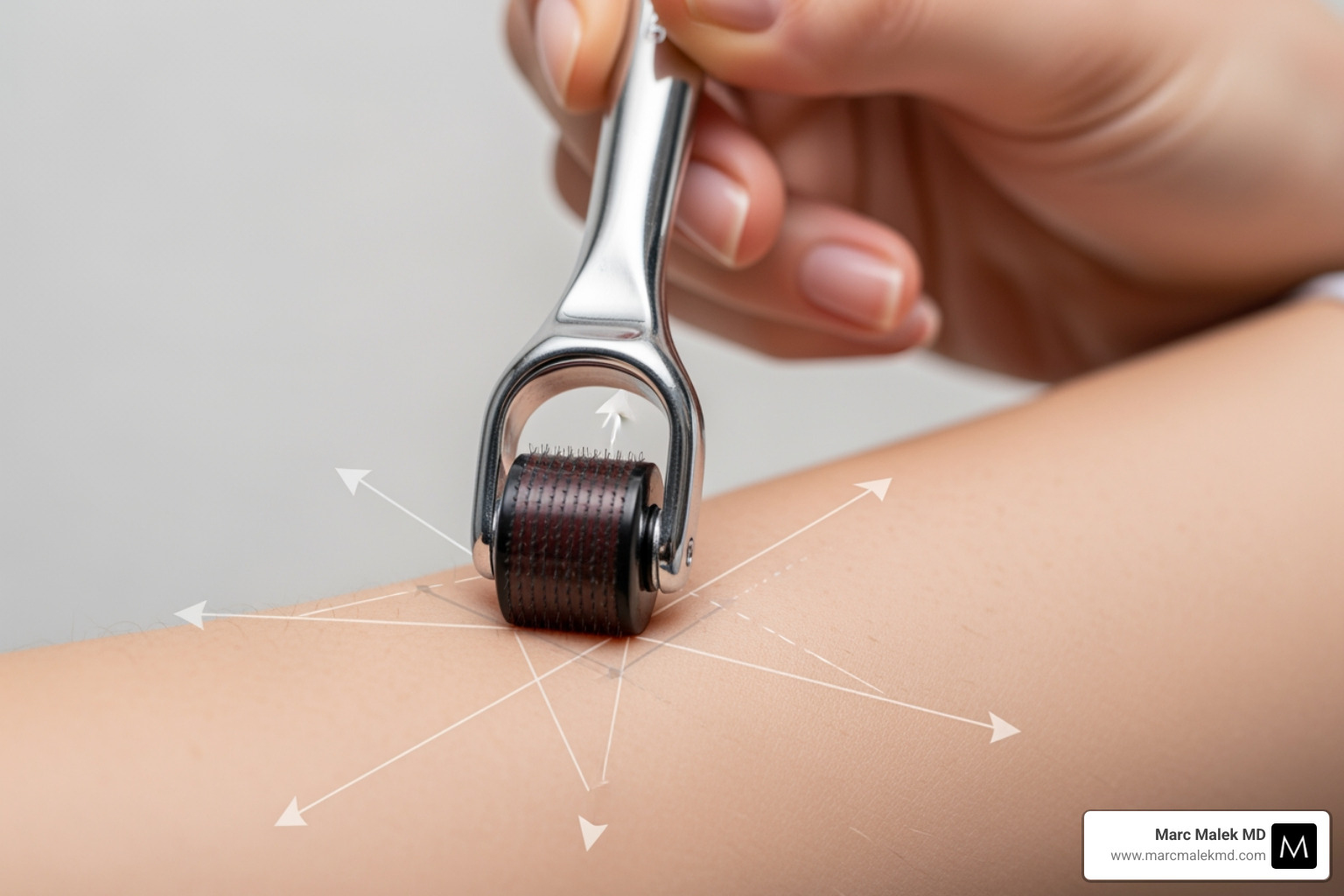
- Star-Pattern Rolling: Roll 4-5 times vertically, lift the roller, then roll 4-5 times horizontally. Lift again and repeat in both diagonal directions. This ensures comprehensive coverage.
- Avoid Sensitive Areas: Be cautious around the eyes and avoid rolling on lips.
- Post-Rolling Care:
- Rinse Gently: Rinse your face with cool water only.
- Apply Soothing Products: Immediately apply a gentle, hydrating serum (like hyaluronic acid) and moisturizer. Avoid harsh actives (retinoids, AHAs/BHAs) for 24-48 hours.
- Sun Protection: Your skin will be sun-sensitive. Apply a broad-spectrum SPF 30+ daily.
How Often Should You Dermaroll and When Will You See Results?
The frequency of your sessions depends on the needle length. Overdoing it can hinder healing.
- 0.5mm needles: 1-3 times per week.
- 1.0mm needles: Once every 10 to 14 days.
- 1.5mm needles: Once every three to four weeks.
When to expect results:
Patience is key, as results are gradual.
- Initial Results: You may see improvements in texture after 2 to 3 sessions.
- Significant Improvement: More noticeable scar reduction typically takes 3 to 4 treatments. Research shows results can be permanent.
- Cumulative Effect: Benefits build with consistent, properly spaced treatments.
Safety First: Dermaroller Protocols, Risks, and Aftercare
While using a dermaroller for scars at home is convenient, safety is your top priority. Improper use can lead to complications. Hygiene is critical, and it’s important to note that the Food and Drug Administration (FDA) has not approved any microneedling instruments for over-the-counter sale, emphasizing the need for caution. For more details, refer to the FDA’s consumer updates on microneedling devices.
Essential Steps for Disinfecting Your Dermaroller
This step is non-negotiable to prevent infection.
-
Before Use:
- Wash the roller with soap and warm water.
- Submerge the roller head in 70% isopropyl alcohol for 5-10 minutes.
- Let it air dry completely on a clean surface.
-
After Use:
- Rinse the roller under warm water to remove debris.
- Wash again with soap and water.
- Disinfect again in 70% isopropyl alcohol for 5-10 minutes.
- Air dry completely before storing it in its protective case.
We recommend replacing your dermaroller every 6 to 8 months, or sooner if you notice any bent or dull needles.
Potential Risks and Contraindications
While generally safe when done correctly, be aware of potential risks.
Potential Risks:
- Skin Irritation and Redness: Common and usually subsides in 24-48 hours.
- Infection: A serious risk from improper sterilization.
- Post-Inflammatory Hyperpigmentation (PIH): Dark spots can occur, especially in darker skin tones, from sun exposure or over-treatment.
- Bleeding: Pinpoint bleeding is normal; excessive bleeding is not.
- “Tram Track” Scars: Caused by dragging the roller sideways instead of lifting it.
Contraindications (When NOT to use a dermaroller):
- On active acne, open wounds, cuts, or sores.
- If you have eczema, psoriasis, or rosacea.
- On keloid or hypertrophic scars.
- Over warts or suspicious skin lesions.
- On sunburned skin.
- If you have blood clotting disorders or are on anticoagulant therapy.
- While undergoing chemotherapy or radiation.
When in doubt, consult a qualified dermatologist or plastic surgeon. Our team in Scottsdale and Phoenix, AZ, can provide personalized guidance.
Recommended Post-Procedure Care
Proper aftercare is just as important as the rolling itself.
- Gentle Cleansing: For 24 hours, rinse with cool water only. Then, use a very mild cleanser.
- Hydration: Immediately apply a hydrating serum (like hyaluronic acid) and a soothing moisturizer.
- Avoid Harsh Actives: For at least 24-48 hours, avoid retinoids, AHAs, BHAs, and Vitamin C serums.
- Sun Protection: Your skin is highly susceptible to sun damage. Apply a broad-spectrum SPF 30+ daily and avoid direct sun.
- No Makeup: Avoid makeup for at least 24 hours.
- Avoid Sweating and Heat: For 24 hours, avoid strenuous exercise, saunas, and hot tubs.
Dermarolling in Perspective: A Comparison of Scar Treatments
It’s helpful to see how dermaroller for scars compares to other popular treatments. They differ in mechanism, invasiveness, downtime, and cost.
| Feature | Dermarolling (Microneedling) | Microdermabrasion | Laser Resurfacing |
|---|---|---|---|
| Mechanism | Creates micro-injuries with needles to stimulate collagen. | Exfoliates top layer of skin with abrasive crystals/diamond. | Uses focused light energy to remove skin layers or heat tissue. |
| Invasiveness | Minimally invasive. | Non-invasive, superficial. | Invasive (ablative) or minimally invasive (non-ablative). |
| Downtime | Minimal (1-2 days redness/swelling). | None to very minimal (slight redness for hours). | Moderate to significant (days to weeks, depending on laser). |
| Effectiveness for Scars | Good for atrophic acne, surgical, stretch marks. Stimulates deep collagen. | Best for very superficial scars, texture, and pigmentation. | Excellent for various scars, deep wrinkles. Highly customizable. |
| Cost | Relatively low for at-home. Moderate for professional. | Low to moderate. | High. |
| Risks | Infection (if unsterile), PIH, irritation. | Mild irritation, sensitivity. | PIH, infection, prolonged redness, scarring (rare). |
| Skin Types | Safe for all skin types, including darker tones (low PIH risk). | Safe for most, but caution with very sensitive skin. | Some lasers not recommended for darker skin tones (higher PIH risk). |
| Anesthesia | Topical numbing cream for professional/longer needles. | None needed. | Topical or local anesthetic, sometimes sedation. |
| Results | Gradual, cumulative (weeks to months). | Immediate but subtle; requires ongoing treatment. | Can be dramatic; full results seen after healing. |
At-Home Dermarolling vs. Professional Microneedling
The choice between at-home and professional treatment depends on needle length, safety, and desired results.
- Needle Length: At-home devices use shorter needles (0.25mm-1.5mm). Professionals can use longer needles (up to 3.0mm) for deeper, more severe scarring.
- Safety and Sterilization: Professional clinics follow strict medical sterilization protocols, reducing infection risk. At-home sterilization is prone to error.
- Expertise: A trained professional can assess your skin, choose the correct technique, and use advanced devices (like those combining microneedling with radiofrequency) for greater precision and better results.
- Intensity and Results: Professional treatments are more intense and typically deliver faster, more dramatic improvements.
- Cost: At-home use has a low initial cost, while professional sessions cost more but are often safer and more effective.
For significant scar revision, professional microneedling is the recommended option. Our clinics in Scottsdale and Phoenix, AZ, offer advanced treatments that can be custom to your specific needs for superior and safer results.
Can Dermarolling Be Combined with Other Treatments?
Yes, combining dermarolling with other therapies can improve results.
- Topical Treatments: Dermarolling boosts the absorption of serums with hyaluronic acid, peptides, or growth factors.
- Platelet-Rich Plasma (PRP): Applying PRP (derived from your own blood) after microneedling uses your body’s growth factors to accelerate healing and improve collagen production.
- Chemical Peels: Alternating microneedling with chemical peels can further refine skin texture and address discoloration. (For more, see our Chemical Peels page).
- Subcision: For deep, tethered acne scars, subcision can be performed to break up fibrous bands, followed by microneedling to promote healing.
- Laser Treatments: Microneedling can be strategically combined with certain laser treatments for a multi-faceted approach to scar revision. (Explore our Laser Skin Resurfacing options).
A professional consultation is required to determine the most effective combination therapy for your specific needs. Our team specializes in creating personalized treatment plans for optimal outcomes.
Conclusion
The journey to smoother skin can feel daunting, but dermaroller for scars offers a powerful, scientifically-backed solution. By using your body’s innate ability to heal, microneedling stimulates new collagen, effectively reducing the appearance of scars and improving skin texture.
We’ve explored how microneedling works, the scars it treats, and provided a guide for safe at-home use, including disinfection and aftercare. We also highlighted the differences between at-home and professional treatments, noting that professional settings often yield superior and safer results for significant scar revision.
Safety is paramount. Always ensure proper hygiene, choose the correct needle length, and understand when to avoid dermarolling. Patience and consistency are your allies, as collagen remodeling takes time.
While at-home dermarolling can offer improvements, consulting a board-certified plastic surgeon like Dr. Marc Malek ensures a safe, personalized treatment plan for advanced scar revision. Our team in Scottsdale and Phoenix, AZ, is dedicated to helping you achieve your aesthetic goals. If you’re ready to transform your skin, contact us today to schedule a consultation.