
Understanding Your Options for Natural Breast Improvement
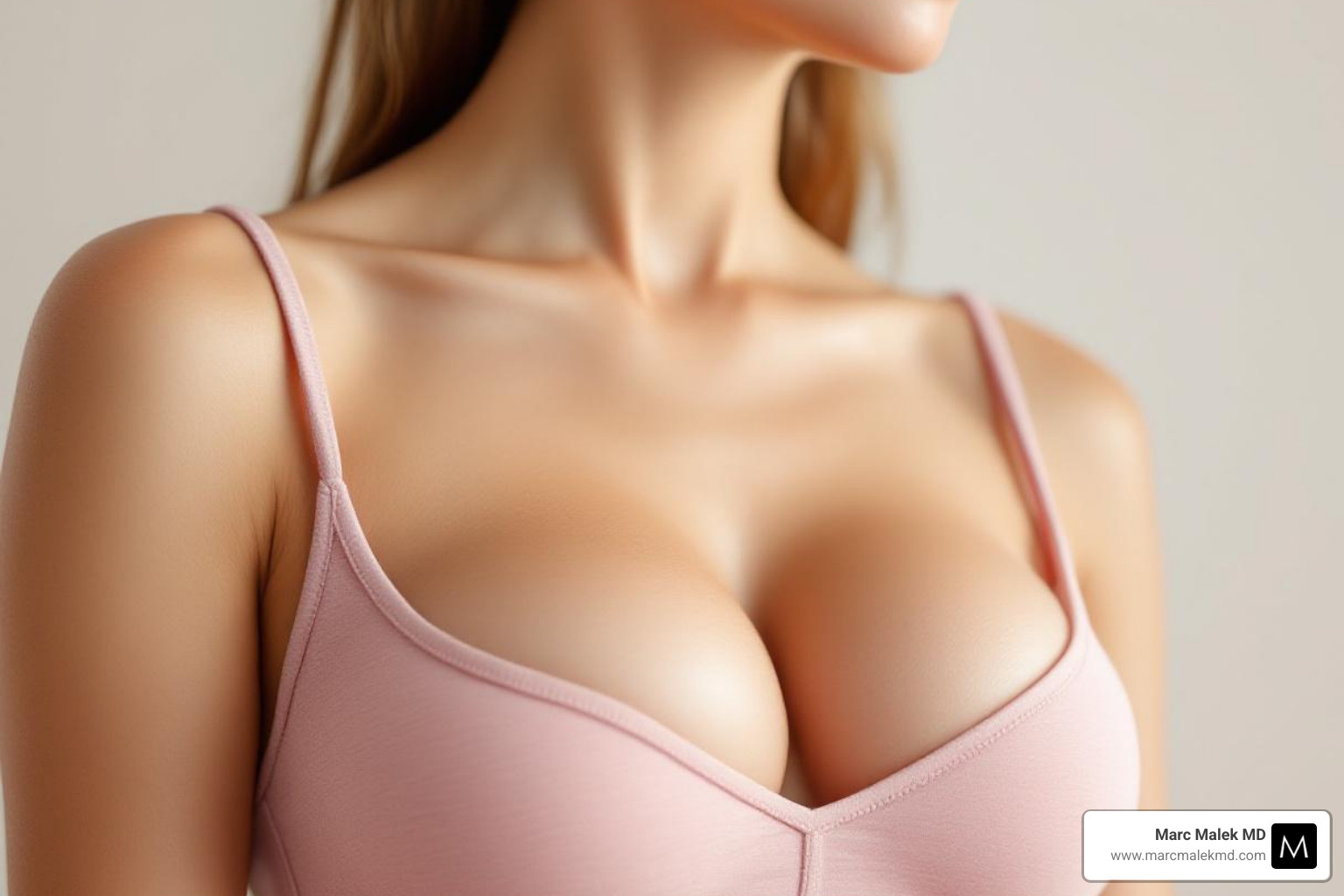
Breast fat transfer is a surgical procedure that uses your own body fat to improve breast size and shape. Instead of using artificial implants, a plastic surgeon removes excess fat from areas like your abdomen, thighs, or flanks through liposuction, then purifies and injects that fat into your breasts.
Quick Facts:
- Also called: Fat grafting, lipofilling, or autologous fat transfer
- Size increase: Typically one to two cup sizes
- Procedure time: 2-3 hours on average
- Recovery: 2-4 days initial downtime; 4-6 weeks until full activity
- Results: Permanent, though 30-50% of transferred fat may be reabsorbed
- Cost: Starts around $10,000 (varies by location and case complexity)
If you’ve been frustrated by breasts that feel too small or asymmetric, and you want a natural alternative to implants, breast fat transfer might be worth exploring. This procedure has gained significant popularity over the past decade, particularly in North America, after being widely used in Europe and South America for over 25 years.
The appeal is clear: you’re using your own tissue rather than foreign materials, which means the results look and feel completely natural. Plus, you get the added benefit of reducing unwanted fat from problem areas—essentially combining breast improvement with body contouring in a single surgery.
That said, fat transfer isn’t for everyone. It works best for women seeking modest improvement rather than dramatic size changes. It also requires that you have enough excess fat available for harvesting, which makes it less suitable for very thin individuals.
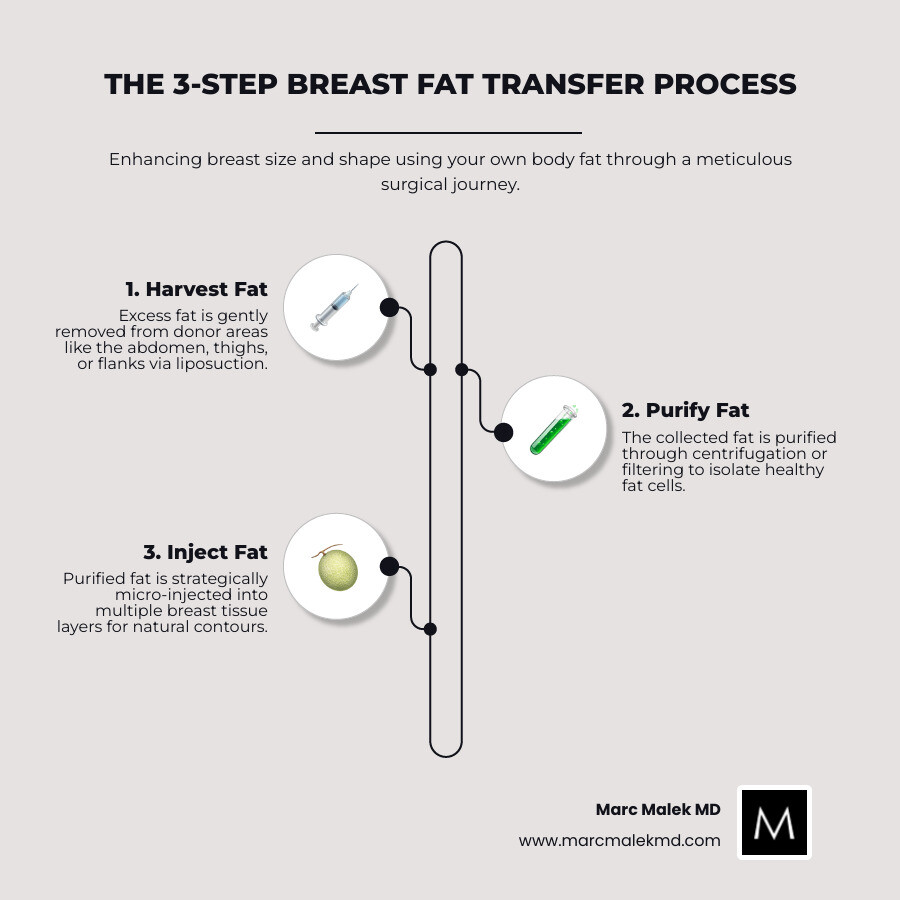
The procedure involves three main steps: harvesting fat through gentle liposuction, purifying the collected fat to remove fluids and damaged cells, and carefully injecting the prepared fat into multiple layers of breast tissue to create smooth, natural contours.
Breast fat transfer further reading:
The Breast Fat Transfer Procedure: From Harvest to Improvement
The breast fat transfer procedure is a meticulous, three-step process that combines body contouring with breast augmentation. Typically lasting 2 to 3 hours, it is performed as an outpatient procedure under general anesthesia for your comfort.
How Fat is Harvested and Prepared
The first step is harvesting fat cells from donor areas like the abdomen, flanks (“love handles”), or outer thighs (“saddlebags”). This not only gathers healthy fat for transfer but also sculpts a more contoured silhouette in the donor region.
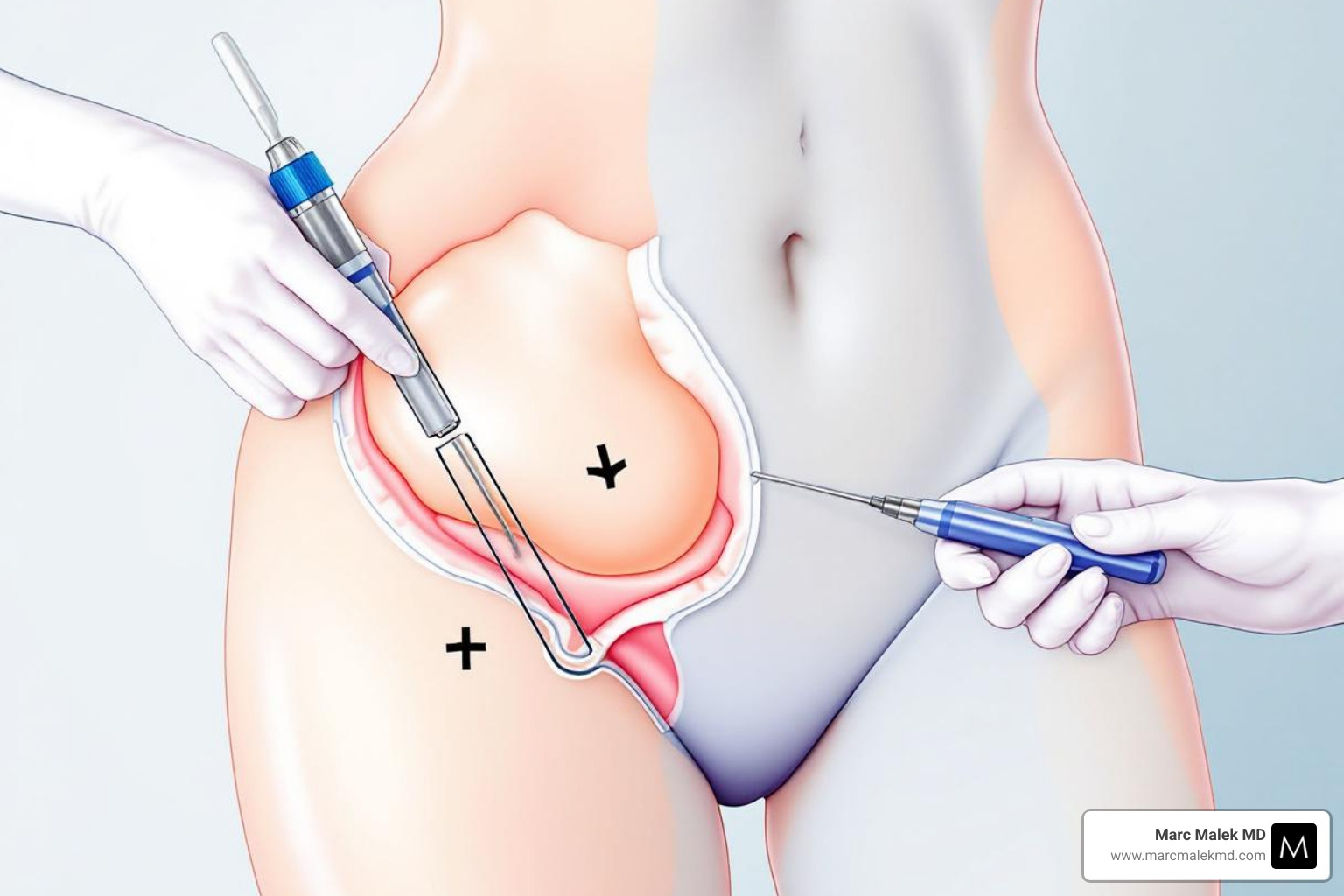
The surgeon first infiltrates the donor area with a tumescent solution to numb the site, reduce bleeding, and loosen fat cells. Then, using a gentle liposuction technique with small cannulas (thin tubes), the fat is carefully removed. This gentle approach is vital to maintain the viability of the fat cells, which is key to the success of the transfer.
Once harvested, the fat is purified to remove blood, excess fluid, and damaged cells. This is often done through centrifugation, where the fat is spun at high speeds to separate healthy, viable cells from impurities. This preparation ensures only the highest quality fat is used for injection, maximizing its survival rate.
The Art of Fat Injection
With the fat purified, the surgeon precisely injects the living fat cells into your breasts. This step requires significant skill and artistry to sculpt a natural-looking and feeling breast contour. Using tiny cannulas, the surgeon strategically injects small droplets of fat into multiple layers of breast tissue. This micro-grafting technique helps each fat cell establish a new blood supply and thrive, creating smooth contours and preventing lumps.
The careful layering of fat is essential for a soft, natural feel. The procedure’s duration can vary based on the number of donor sites and the amount of fat transferred. Our approach in Scottsdale focuses on delivering fantastic, long-lasting results, utilizing a personal and artistic approach to create proportionally balanced bodies.
Is Fat Transfer Right for You? Benefits, Candidacy, and Expectations
Breast fat transfer is a unique alternative to traditional implants, offering distinct benefits and considerations for those considering breast augmentation.
Key Benefits Compared to Breast Implants
One of the most compelling benefits is the natural result. Because the procedure uses your own tissue, the augmented breasts look and feel incredibly soft and authentic. This also eliminates concerns associated with foreign materials.
Here’s a comparison:
| Feature | Breast Fat Transfer | Breast Implants |
|---|---|---|
| Material | Autologous fat (your own body tissue) | Saline or Silicone gel |
| Feel & Look | Exceptionally natural, soft, and indistinguishable from natural breast tissue | Can feel natural, but sometimes a firmer or less natural feel is possible; visible rippling can occur |
| Scarring | Minimal, tiny incisions (often hidden) from liposuction and injection sites | Incisions are necessary for implant placement, though often well-hidden |
| Longevity | Permanent, as surviving fat cells are living tissue; can last lifelong if weight is stable | Not permanent; typically requires replacement surgery every 10-15 years |
| Body Contouring | Dual benefit: improves breasts while reducing fat from donor areas (e.g., abdomen, thighs) | No body contouring benefit |
| Risks | Fewer risks than implants; no risk of rupture, leak, capsular contracture, or BIA-ALCL | Risks include rupture, leak, capsular contracture, rippling, and BIA-ALCL |
| Volume Increase | Modest (typically 1-2 cup sizes) | Can achieve significant volume changes |
Beyond the natural feel, there are no implant-related risks like rupture, leakage, capsular contracture, or the rare cancer BIA-ALCL. The procedure also provides a “body sculpting bonus” by removing unwanted fat from areas like the abdomen or thighs. Finally, scars are minimal and often imperceptible.
Who is an Ideal Candidate for breast fat transfer?
Ideal candidates for breast fat transfer typically meet the following criteria:
- Sufficient Donor Fat: You must have enough excess fat on your abdomen, flanks, or thighs for harvesting. Very thin patients may not be suitable.
- Good Overall Health: Candidates should be in good health and able to undergo general anesthesia safely.
- Non-Smoker: Smoking impairs healing and fat cell survival, so being a non-smoker is recommended for optimal results.
- Realistic Expectations: The procedure provides a modest increase of one to two cup sizes. It is not for those seeking dramatic volume changes.
- Desire to Improve Symmetry or Shape: Fat transfer is excellent for correcting minor asymmetries or restoring volume lost due to pregnancy or weight changes.
For those in Scottsdale and Phoenix seeking a subtle boost in volume without implants, breast fat transfer can be a transformative option.
How Much Volume Can Be Achieved?
A common question is, “How much bigger can my breasts get?” Fat transfer offers a modest, natural improvement, typically increasing breast size by one to two cup sizes. This makes it an excellent choice for women seeking subtle improvement.
The final volume depends on the amount of fat harvested, your breast tissue’s capacity, and the fat survival rate. It’s understood that 30 to 50% of the transferred fat will be naturally reabsorbed by the body. Surgeons account for this by injecting slightly more fat than the desired final volume.
Due to this resorption, multiple sessions may be needed to achieve your desired result, especially if aiming for a two-cup-size increase. For more details, you can review resources like the Cleveland Clinic’s guide on Fat Transfer Breast Augmentation: Procedure, Results & Risks. Our goal is to provide a safe and effective path to your aesthetic goals.
Navigating Recovery, Risks, and Long-Term Results
Understanding the post-operative journey is crucial. With breast fat transfer, we aim for a smooth recovery and long-term satisfaction.
The Recovery Process: What to Expect
Recovery from breast fat transfer is generally straightforward, often quicker than with traditional implants. Most patients experience an initial downtime of 2 to 4 days before resuming their normal routine.

Immediately after surgery, you’ll wear a soft, supportive bra and a compression garment on the donor areas. Expect some bruising and swelling in both sites, which is manageable with prescribed pain relievers. Many patients return to work and light activities within a week. However, avoid strenuous exercise and heavy lifting for 4-6 weeks. Sleeping on your back is also recommended to protect the new fat cells.
While initial swelling subsides in a few weeks, it can take up to six months to see the final results as the transferred fat fully integrates. We provide detailed aftercare instructions to optimize your outcome.
Potential Risks and Complications
While breast fat transfer is generally safe with a low rate of more serious complications, it’s important to know the risks. A key factor is the fat resorption rate; 30 to 50% of transferred fat may not survive, which can influence the final volume and may require additional sessions.
Other rare complications include:
- Asymmetry
- Infection
- Scarring
- Fat Necrosis (firm lumps from fat cells that don’t survive)
- Oil Cysts or Calcifications (benign but may be visible on mammograms)
- Bleeding
We prioritize your well-being and will discuss these risks during your consultation.
Long-Term Results and Mammogram Impact
The results of breast fat transfer are permanent. Once the fat stabilizes after about 6 months, it is living tissue and will last a lifetime, provided your weight remains stable. Unlike implants, no replacement is needed.
Regarding mammograms, it’s important to know that transferred fat can form microcalcifications or cysts. While almost always benign, they can mimic signs of breast cancer on imaging, potentially requiring further tests to rule out issues. It is crucial to inform your mammographer about your surgical history. Current understanding suggests breast fat transfer does not increase breast cancer risk. For more details, you can review scientific research on mammographic changes after fat transfer. Your safety is our top priority.
Advanced Applications and Financial Considerations
Breast fat transfer is a versatile procedure, not only serving as a standalone cosmetic improvement but also proving invaluable when combined with other surgeries or used in reconstructive contexts. Understanding its broader applications and the financial aspects is key to informed decision-making.
Combining Breast Fat Transfer with Other Procedures
The beauty of breast fat transfer lies in its synergistic potential. It can be seamlessly integrated with several other procedures to achieve a more comprehensive aesthetic change:
- Breast Lift (Mastopexy): For women experiencing sagging or ptosis due to aging, pregnancy, or weight loss, fat transfer alone cannot lift the breast. However, combining it with a breast lift can provide both improved position and added volume, especially in the upper pole, for a more youthful and full appearance.
- Breast Implant Removal or Exchange: If you’re considering removing existing breast implants due to complications, dissatisfaction, or a desire for a more natural look, breast fat transfer can be an excellent option for volume replacement. This can be done as a “Simultaneous Implant Exchange with Fat” (S.I.E.F.) or as an immediate large-volume grafting procedure following implant removal, helping to maintain breast shape and volume. We can also use fat to improve the appearance of breast implant rippling, particularly in thin patients.
- Mommy Makeover: This popular combination procedure often includes a tummy tuck and liposuction, making it an ideal opportunity to incorporate breast fat transfer. The fat harvested during the liposuction (part of the tummy tuck or from other areas) can then be used to restore breast volume lost after pregnancy and breastfeeding, creating a more cohesive and refreshd post-pregnancy physique.
- Tummy Tuck (Abdominoplasty): When undergoing a tummy tuck to remove excess skin and tighten abdominal muscles, liposuction is often performed simultaneously. This harvested fat can then be used for breast augmentation, offering a dual benefit of a flatter abdomen and fuller breasts.
These combinations allow us to address multiple aesthetic concerns in a single surgical plan, promoting a healthy lifestyle and proportionally balanced bodies for our patients in Arizona.
Augmentation vs. Reconstruction with Fat Transfer
It’s important to distinguish between the cosmetic and reconstructive applications of breast fat transfer, as while the technique is similar, the goals and considerations can differ significantly.
- Cosmetic Augmentation Goals: When used for cosmetic purposes, the primary objective is to increase breast size, improve shape, and improve overall breast aesthetics for healthy individuals. This is an elective procedure driven by a desire to improve appearance and self-confidence. Patients typically seek a modest increase in cup size and a more natural contour without the use of implants.
- Reconstructive Goals after Mastectomy or Lumpectomy: Breast fat transfer plays a crucial role in breast reconstruction, particularly for patients who have undergone surgery for breast cancer. It can be used as an adjunctive procedure for those who have had a lumpectomy, helping to fill in contour irregularities and restore symmetry. Following a mastectomy, it can be used to recreate breasts, often in conjunction with other reconstructive methods, or to improve the appearance and feel of implant-based reconstructions by softening outlines and hiding implant rippling. A randomized clinical trial has even explored the Effect of Breast Reconstruction With Autologous Fat Transfer vs Implants on Quality of Life, showing promising results for fat transfer in terms of patient-reported quality of life. In these cases, the procedure is often considered medically necessary to help patients regain their sense of wholeness and well-being after cancer treatment.
Understanding the Cost of Breast Fat Transfer
The cost of breast fat transfer is a common and important consideration for our patients in Scottsdale and Phoenix. It’s not a fixed price but rather varies significantly based on several factors unique to each individual and their treatment plan.
Key factors influencing the price include:
- Surgeon’s Fee: This is determined by the surgeon’s experience, reputation, and the complexity of your specific case. Our Dr. Malek offers plastic surgery in Scottsdale, utilizing a personal and artistic approach, which is reflected in the expertise provided.
- Anesthesia Costs: The type of anesthesia used (typically general anesthesia) and the duration of the procedure will impact this cost.
- Facility Fees: These cover the use of the surgical facility, its equipment, and support staff.
- Number of Donor Areas: If fat is harvested from multiple areas of your body, the liposuction component of the procedure will be more extensive, influencing the overall cost.
- Amount of Fat Transferred and Surgery Time: Larger volumes of fat to be harvested and injected, or more intricate sculpting, will naturally require more surgical time.
- Additional Procedures: If breast fat transfer is combined with other procedures like a breast lift or tummy tuck, the total cost will increase accordingly.
While it’s challenging to provide a precise figure without a personal consultation, costs for breast fat transfer vary significantly. In major metropolitan areas, the cost can start around $10,000 and go upward, depending on the factors mentioned above. Health insurance typically does not cover fat grafting breast surgery for purely cosmetic purposes. During your consultation with us, we will provide a detailed breakdown of all anticipated costs, and discuss any available financing options, ensuring transparency and clarity.
Frequently Asked Questions about Breast Fat Transfer
We understand you likely have many questions about breast fat transfer. Here are answers to some of the most common inquiries we receive:
How long do the results of breast fat transfer last?
The results of breast fat transfer are considered permanent. Once the transferred fat cells successfully establish a new blood supply and integrate into their new location within the breast, they become a living part of your body. These cells will then behave like any other fat cells, meaning they will grow if you gain weight and shrink if you lose weight. It typically takes about six months for the final volume to stabilize as any initial swelling subsides and the fat cells fully settle. While the results are long-lasting, it’s important to understand that significant weight fluctuations, pregnancy, breastfeeding, and the natural aging process can all subtly alter the appearance of your breasts over time.
Is breast fat transfer painful?
The breast fat transfer procedure itself is performed under general anesthesia, so you will not experience any pain during the surgery. Post-operatively, you can expect some soreness, discomfort, bruising, and swelling in both the donor areas (where the fat was harvested) and the breasts. This discomfort is typically mild to moderate and is well-managed with prescribed pain medication. Many patients report that the recovery is often less painful compared to traditional breast implant surgery. The areas that underwent liposuction might feel more tender initially than the breasts themselves. We provide comprehensive pain management strategies to ensure your recovery is as comfortable as possible.
How much fat is needed for the transfer?
The amount of fat needed for breast fat transfer depends directly on your aesthetic goals and the desired increase in breast volume. Since fat transfer aims for a modest increase (typically one to two cup sizes), you’ll need to have enough excess fat available in donor sites such as your abdomen, flanks, or thighs. During the harvesting process, your surgeon will typically collect more fat than the final desired volume. This is because some fat cells may be lost during purification, and a percentage (around 30-50%) of the transferred fat may not survive once injected. Therefore, having adequate donor fat reserves is a key factor in determining if you are a suitable candidate for this procedure.
Conclusion
Breast fat transfer stands as a remarkable option for individuals seeking a natural approach to breast improvement. By utilizing your body’s own resources, this procedure offers the dual benefits of subtle, natural-looking breast augmentation and targeted body contouring from the areas where fat is harvested. The result is often a beautifully sculpted, proportionally balanced physique, enhancing both your silhouette and your self-confidence.
While the appeal of using your own tissue is undeniable, it’s crucial to approach breast fat transfer with realistic expectations regarding the achievable volume increase and the recovery process. This procedure is best suited for those desiring a modest improvement and who understand the nuances of fat survival and long-term results.
The success and safety of your breast fat transfer depend significantly on the expertise of your surgeon. We pride ourselves on offering plastic surgery in Scottsdale, utilizing a personal and artistic approach to deliver fantastic, long-lasting results. Our focus is always on your comfort, convenience, and promoting a healthy lifestyle.
If you’re considering breast fat transfer and wish to explore how this natural technique can align with your aesthetic goals, we invite you to take the next step.
Schedule your personal consultation to discuss your aesthetic goals today.