

Understanding Forehead Reduction: A Path to Facial Balance
Hairline lowering surgery Arizona is a surgical solution for individuals with a high hairline seeking more balanced facial proportions. Also known as forehead reduction, this procedure can lower your hairline by up to 1.5-2 inches in a single session, creating immediate, lasting results.
Quick Overview: What You Need to Know
- What it is: A surgical procedure that advances the hairline by removing excess forehead skin
- Procedure time: Typically 2-3 hours under local anesthesia with sedation
- Recovery: Most patients return to work within 1-2 weeks
- Results: Immediate improvement with final results visible in 3-6 months
- Cost in Arizona: Generally ranges from $8,000-$13,000
- Best candidates: Those with good scalp flexibility, a stable hairline, and realistic expectations
A high hairline can create the appearance of an unusually large forehead, disrupting facial harmony and causing self-consciousness. The procedure involves an incision along the natural hairline, through which a surgeon removes a strip of forehead skin and advances the hair-bearing scalp forward. The incision is carefully placed so hair can grow through and in front of the scar, making it virtually undetectable over time.
Unlike hair transplants, which take months to show results, hairline lowering provides immediate improvement. A lower hairline is noticeable as soon as the bandages are removed, with final results appearing as swelling subsides and hair regrows.
A typical hairline is about 5-6.5 cm above the eyebrows. A higher hairline can create facial imbalance, which forehead reduction corrects to restore proportion and confidence.
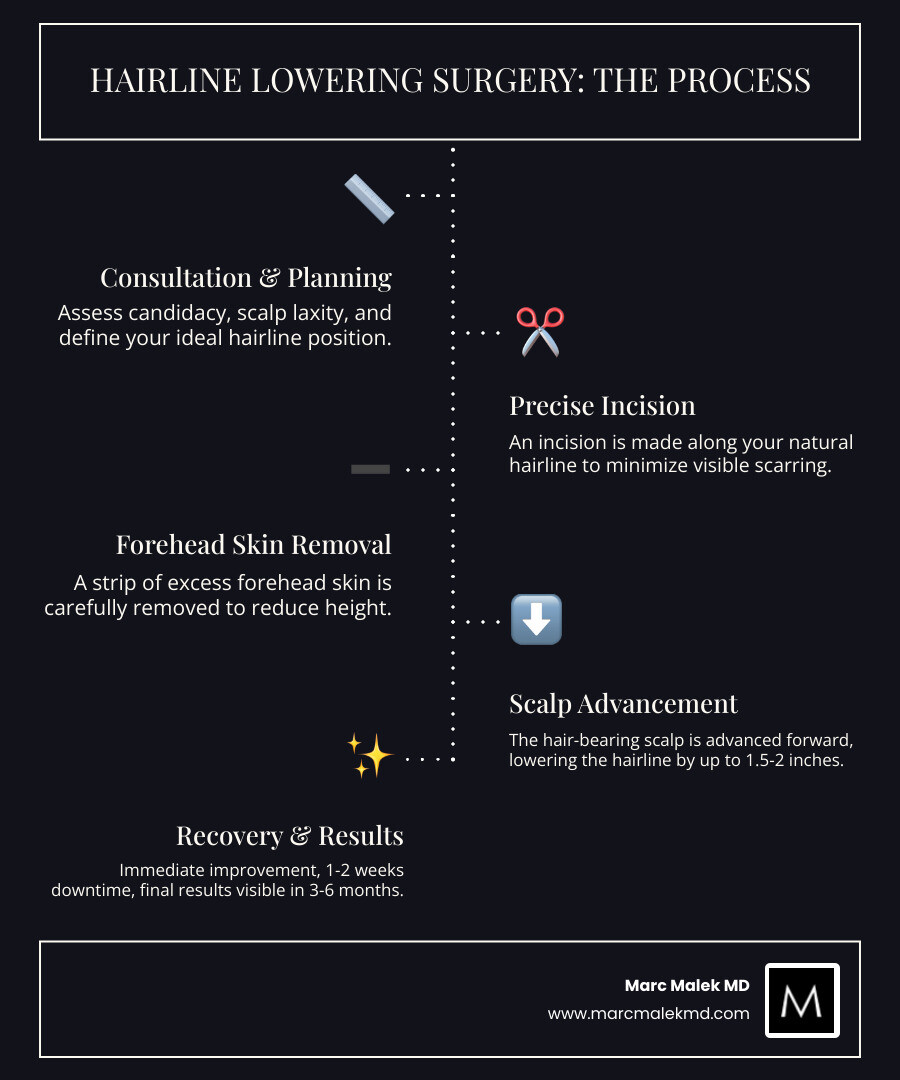
Hairline lowering surgery Arizona terms explained:
The Hairline Lowering Procedure: From Candidacy to Recovery
Understanding the journey for hairline lowering surgery Arizona, from consultation to full recovery, is essential. The process involves careful assessment, a precise surgical technique, and a dedicated recovery period to achieve a naturally balanced facial appearance.
Who is a Good Candidate for Hairline Lowering Surgery in Arizona?
Determining if you’re a good candidate for forehead reduction is a crucial first step. We assess several key factors to ensure safety and desired results.
Ideal candidates for hairline lowering surgery Arizona typically:
- Have a naturally high hairline or large forehead: The procedure is ideal for those who feel their forehead is disproportionately large.
- Possess good scalp laxity: This is the most critical factor. Good scalp flexibility, assessed during your consultation, determines how much the hairline can be lowered (often 1.5 to 2 inches).
- Maintain a stable hairline: The procedure is best for those with a stable hairline and no significant, ongoing hair loss. A hair transplant may be better for progressive hair loss.
- Have no family history of significant hair loss: A strong family history of pattern baldness is a consideration, as future hair loss could expose the incision.
- Hold realistic expectations: Your goals should align with what surgery can realistically achieve. We focus on natural, balanced results.
- Are in good overall health: Good health is essential to minimize surgical risks and promote healing.
There’s no strict age limit; patients are often in their 20s to 50s. The most important factors are a stable hairline and good scalp laxity.
How is the Surgery Performed?
The hairline lowering surgery Arizona procedure takes about 2 to 3 hours and is performed on an outpatient basis.
Here’s a general overview:
- Anesthesia: The procedure is typically performed under local anesthesia with intravenous sedation for your comfort.
- Marking the New Hairline: Your surgeon marks the new hairline, considering your facial proportions and goals to create a natural, slightly irregular line.
- Incision Along the Hairline: A careful incision is made along the hairline, placed to allow hair to grow through and camouflage the scar.
- Forehead Skin Removal: A strip of excess forehead skin (typically 1.5 to 2 inches) is removed to reduce forehead height.
- Scalp Repositioning: The hair-bearing scalp is advanced to its new, lower position.
- Suture Closure: The scalp is secured with dissolvable anchors, and the incision is closed in layers with sutures to minimize tension and scarring.
Our artistic approach ensures every detail contributes to a harmonious and natural-looking result.
What is the Recovery Process Like?
After hairline lowering surgery Arizona, a smooth recovery is vital. Here’s what to expect:
- Initial Discomfort: Some discomfort, tightness, and mild pain are normal and managed with prescribed medication.
- Swelling and Bruising: Swelling and bruising are common, peaking at 48 hours and mostly resolving in one to two weeks. Cold compresses help.
- Downtime: Most patients need about one week off from work.
- Suture Removal: Sutures are removed 6 to 10 days after surgery.
- Temporary Scalp Numbness: Temporary numbness of the forehead and scalp is common, with sensation returning over several weeks to months.
- Avoiding Strenuous Activity: Avoid strenuous activity for at least two weeks. Heavy lifting should be avoided for approximately 12 weeks.
- Hair Regrowth: Temporary hair thinning near the incision (“shock alopecia”) can occur, with regrowth typically starting in 3 to 6 months.
Following post-operative instructions carefully is key to a successful recovery. For more comprehensive information, you can refer to resources like A Guide to Hairline Lowering.
What Are the Potential Risks?
While hairline lowering surgery Arizona is generally safe when performed by a skilled facial plastic surgeon, it’s important to be aware of potential risks.
Potential risks include:
- Scarring: Some scarring is inevitable but is placed to be camouflaged by hair. Scars fade over time, and revision is possible in rare cases.
- Infection: Infection is rare and minimized with sterile techniques and antibiotics.
- Hair Loss at Incision (Shock Alopecia): Temporary hair thinning around the incision can occur but usually regrows.
- Asymmetry: Minor asymmetries can occur.
- Changes in Sensation: Temporary numbness is expected; permanent changes are very rare.
- Bleeding/Hematoma: A hematoma (collection of blood) is the most common complication (about 5% incidence) and may require drainage.
- Unnatural Results: An inexperienced surgeon can create an unnatural hairline, highlighting the need for a board-certified specialist.
We encourage you to learn more about various facial procedures by exploring resources like our page on More info about facial procedures. Our commitment is to ensure you’re fully informed.
Hairline Lowering vs. Other Hairline Correction Approaches
When seeking to reduce a high forehead, it’s helpful to compare hairline lowering surgery Arizona with other options, like hair transplants. Each has unique benefits and is suited for different candidates.
Let’s compare these two primary surgical approaches:
| Feature | Surgical Hairline Lowering (Forehead Reduction) | Hair Transplant Surgery (FUE/FUT) |
|---|---|---|
| Method | Directly removes a strip of non-hair-bearing forehead skin and advances the scalp forward. | Transfers hair follicles from a donor area (usually the back of the head) to the hairline. |
| Results Timeline | Immediate reduction in forehead height. Hairline position is established during surgery. | Gradual. New hair growth begins around 4 months, with full results visible between 10-12 months. |
| Best For | Individuals with a naturally high hairline, large forehead, and good scalp laxity. No significant ongoing hair loss. | Individuals with a receding hairline, thinning hair, or those needing to fill in temple areas. Can address hair loss. |
| Scar Location | A fine incision line along the new hairline, designed to be camouflaged by hair growth through and in front of it. | Tiny donor site scars (FUE) or a linear scar (FUT) at the back/sides of the head, plus very small recipient site scars at the hairline. |
| Procedure Time | Typically 2-3 hours. | Can vary widely, often 4-8 hours or more, depending on the number of grafts. |
| Hair Density | Maintains natural hair density at the new hairline. | Creates new hair density where grafts are placed. Density depends on graft count and placement. |
| Scalp Laxity Required | Yes, crucial for significant lowering. | Not directly required, but healthy donor hair is essential. |
Surgical hairline lowering is ideal for patients wanting an immediate, significant reduction in forehead size who have good scalp elasticity. Hair transplants are better for those with less scalp laxity, ongoing hair loss, or who need to refine the hairline shape over time.
Sometimes, a combination approach is best. Hairline lowering can provide the initial reduction, and hair grafts can be used to soften the new hairline. We personalize our recommendation to your unique needs.
The Process for Hairline Lowering Surgery in Arizona
Starting on your hairline lowering surgery Arizona journey involves a clear, step-by-step process designed for your safety, comfort, and satisfaction.
What to Expect During Your Consultation
Your consultation is the cornerstone of a successful procedure, where we align your goals with the surgical possibilities.
Here’s what to expect:
- Comprehensive Facial Analysis: We examine your facial structure and proportions to determine the optimal new hairline position for facial harmony.
- Scalp Laxity Test: We perform a “pitch test” to assess your scalp’s flexibility, which determines how much your hairline can be lowered.
- Discussing Aesthetic Goals: We discuss your vision for your hairline’s shape to create a natural, pleasing outcome that reflects our artistic approach.
- Medical History Review: We review your full medical history to ensure you are a good candidate and to plan a safe procedure.
- Creating a Surgical Plan: We create a personalized surgical plan detailing the extent of lowering, incision placement, and what to expect.
- Answering Your Questions: We encourage all questions so you can feel fully informed and confident.

This consultation is a collaborative process. To learn more about our philosophy, we invite you to Meet Dr. Malek.
How to Choose a Surgeon and Their Credentials
Choosing the right surgeon for your hairline lowering surgery Arizona is the most critical decision you’ll make. The outcome depends on the surgeon’s skill, experience, and artistic eye.
Here’s what to look for:
- Board-Certified Plastic Surgeon: Ensure your surgeon is board-certified by the American Board of Plastic Surgery, which signifies rigorous training and ethical standards.
- Specialization in Facial Surgery: Look for a surgeon who specializes in facial plastic surgery, as this indicates a deeper understanding of facial anatomy and aesthetics.
- Reviewing Before-and-After Photos: Review the surgeon’s photo gallery to assess their aesthetic style and see how well scars are camouflaged.
- Experience with Hairline Procedures: Ask about their specific experience with hairline lowering, as extensive experience leads to refined techniques for optimal results and scar management.
- An Artistic Approach: The best results come from an artistic approach that sculpts a harmonious facial appearance. Dr. Malek is known for his personal, artistic method that delivers fantastic, natural, and long-lasting results.
- Patient Comfort Focus: A good surgeon prioritizes your comfort and well-being throughout the entire process.
How Much Does Hairline Lowering Surgery Cost in Arizona?
Understanding the cost of hairline lowering surgery Arizona is an important step. The cost in Arizona can range from approximately $8,000 to $13,000. This range typically includes the surgeon’s fee, facility costs, anesthesia fees, and follow-up care.
Factors that can influence the total cost include:
- Surgical Complexity: More complex cases may have higher costs.
- Surgeon’s Expertise: A surgeon’s experience and reputation influence their fees.
- Geographic Location: Costs can vary between cities like Scottsdale and Phoenix.
- Combination Procedures: Combining procedures, like a brow lift, will increase the total cost.
Cosmetic procedures like hairline lowering are not covered by health insurance. However, many practices offer financing options. Our patient coordinator will provide a clear cost estimate during your consultation.
Advanced Considerations: Combining Procedures and Long-Term Outcomes
For comprehensive facial rejuvenation, hairline lowering surgery Arizona can be part of a broader strategy. Understanding how it combines with other procedures and its long-term outcomes is key to lasting satisfaction.
Can Hairline Lowering Be Combined with a Brow Lift?
Yes, combining hairline lowering with a brow lift is a popular and effective approach for total upper facial rejuvenation, especially for patients in Scottsdale and Phoenix with both a high hairline and a sagging brow.
These procedures complement each other by:
- Addressing Both Concerns: Hairline lowering reduces forehead height, while a brow lift lifts sagging eyebrows and smooths wrinkles. Combining them addresses both issues for a harmonious result.
- Improved Facial Harmony: Lowering the hairline while lifting the brows creates a more balanced and youthful upper face, improving the ratio between the brows and hairline.
- Optimized Incisions: The incisions for both procedures can often be integrated, improving scar camouflage.
- Comprehensive Rejuvenation: Combining procedures is common for patients seeking a refreshed, alert appearance that addresses multiple aging concerns at once.
We encourage you to explore our dedicated page for More info about a Brow Lift to understand how this procedure can further improve your results.
What Are the Long-Term Results?
A key benefit of hairline lowering surgery Arizona is its permanence. The new hairline position is lasting.
Here’s what you can expect long-term:
- Permanent Hairline Position: The reduction in forehead height is permanent, providing a lasting improvement in facial balance.
- Scar Maturation and Concealment: The incision scar matures and fades over a year. Hair growth through and in front of the scar helps conceal it, making it virtually undetectable.
- Hair Regrowth Through the Scar: A unique advantage is that fine hairs grow through the incision, further softening and hiding the scar.
- Natural Aging Process Continues: The hairline position is permanent, but the natural aging process will continue.
- Lasting Youthful Effect: The overall rejuvenating effect typically lasts 10-20 years, depending on lifestyle and aging. A healthy lifestyle, good skincare, and sun protection can help preserve your results.
The long-term satisfaction rate for hairline lowering is very high, with many patients reporting increased self-confidence.
Frequently Asked Questions about Forehead Reduction
Here, we address some of the most common inquiries about hairline lowering surgery Arizona.
How painful is hairline lowering surgery?
Pain is a significant concern, but it is well-managed.
- Performed Under Anesthesia: You will not feel pain during the surgery, which is performed under local anesthesia with sedation for your comfort.
- Post-Operative Discomfort: It is normal to experience some mild pain, tightness, and a pressure-like sensation after surgery.
- Manageable with Medication: Discomfort is easily managed with prescribed pain medication, and most patients switch to over-the-counter relievers after a few days.
- Tightness Sensation: A feeling of tightness is common and subsides as you heal.
Our team is dedicated to ensuring your comfort throughout your recovery.
Will I have a noticeable scar?
We address the concern about scarring with meticulous surgical care.
- Incision Designed for Camouflage: The incision is carefully placed along the new hairline, often in an irregular pattern to mimic a natural hairline and optimize camouflage.
- Hair Grows Through the Scar: A key advantage is that hair grows through and in front of the incision, effectively camouflaging the scar.
- Scar Fading Over Time: The scar will be red initially but will fade to a fine, pale line over several months to a year.
- Potential for Scar Revision: In the rare case of a noticeable scar, treatments like scar revision or Laser Skin Resurfacing can improve its appearance. Our goal is a virtually imperceptible scar.
What is the best age for forehead reduction surgery?
There is no single “best age” for this surgery; candidacy depends on individual factors rather than age.
- No Specific Age Limit: Patients of many ages can benefit from this procedure.
- Typical Age Range: Most patients are in their 20s to 50s, seeking to correct a lifelong concern or as part of an anti-aging plan.
- Stable Hairline is Key: The most important factor is a stable hairline with no significant, ongoing hair loss. It’s best to wait if your hairline is still receding.
- Facial Maturity: It’s often recommended to wait until the mid-20s when facial structures have fully matured. An in-person assessment is the best way to determine candidacy.
Conclusion: Take the Next Step Towards a More Confident You
Hairline lowering surgery Arizona offers a profound opportunity to transform your appearance and boost your self-confidence by creating a more balanced, harmonious facial aesthetic.
We’ve covered candidacy in Scottsdale and Phoenix, the procedure, recovery, and the importance of choosing a board-certified surgeon with an artistic eye for natural, lasting results. Our commitment is to your well-being, comfort, and promoting a healthy lifestyle.
If you’re ready to explore how forehead reduction can restore your facial harmony, we invite you to connect with us. Your journey to a more confident you starts with an informed conversation.
Schedule your consultation for Hair Restoration with PRP today, and let us help you take the next step.